

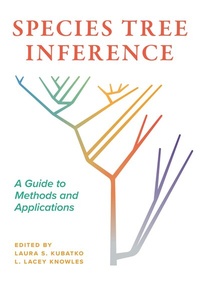
Species Tree Inference
A Guide to Methods and Applications
1st Edition
Published on 14. March 2023
352 pages
978-0-691-24515-7 (ISBN)
Description

No detailed description available for "Species Tree Inference".
More details
Language
English
Place of publication
Princeton, NJ
United States
Publishing group
De Gruyter
Target group
Professional and scholarly
Edition type
Digital original
Product notice
Reflowable
Illustrations
101 b/w figures. 6 tables.
101 b/w figures. 6 tables.
ISBN-13
978-0-691-24515-7 (9780691245157)
Schweitzer Classification
Other editions
Additional editions
Book
03/2023
Princeton University Press
€51.00
Shipment within 10-20 days
Book
03/2023
Princeton University Press
€111.50
Shipment within 10-20 days
Persons
Laura S. Kubatko is Professor of Statistics and of Evolution, Ecology, and Organismal Biology at The Ohio State University. L. Lacey Knowles is the Robert B. Payne Collegiate Professor of Ecology and Evolutionary Biology and Curator of Insects at the University of Michigan. They are the coeditors of Estimating Species Trees: Practical and Theoretical Aspects.
Content
- Cover
- Contents
- Preface
- Acknowledgments
- List of Contributors
- Chapter 1. Introduction to Species Tree Inference
- 1.1 Introduction
- 1.2 Background and Terminology
- 1.2.1 Definitions and Terminology
- 1.2.2 An Introduction to the Multispecies Coalescent
- 1.2.3 Data Types and Technologies for Generating Phylogenomic Data
- 1.3 Overview of Current Methods for Species Tree Inference
- 1.3.1 Controversies in the Estimation of Species Trees
- 1.4 A Look to the Future
- 1.4.1 Current Limitations and Future Prospects
- 1.4.2 Beyond the Species Tree
- 1.5 Organization of This Book
- Part I. Analytical and Methodological Developments
- Chapter 2. Large-Scale Species Tree Estimation
- 2.1 Introduction
- 2.2 Species Tree Estimation Methods Addressing ILS
- 2.2.1 Overview
- 2.2.2 Summary Methods
- 2.2.3 Coestimation Methods
- 2.2.4 Site Based Methods
- 2.2.5 Evaluation of Branch Support in Species Trees
- 2.3 Species Tree Estimation under GDL
- 2.4 Parallel Implementations for Species Tree Estimation
- 2.4.1 ASTRAL-MP
- 2.4.2 Multilocus Species Tree Estimation Using Maximum Likelihood
- 2.5 Divide-and-Conquer Species Tree Estimation
- 2.5.1 Divide-and-Conquer Using Supertree Methods
- 2.5.2 Divide-and-Conquer Using Disjoint Tree Merger Methods
- 2.6 Choice of Method
- 2.6.1 Statistical Consistency
- 2.6.2 Empirical Performance
- 2.7 Summary, Challenges, and Future Directions
- 2.8 Appendix: Big-O Analysis
- Chapter 3. Species Tree Estimation Using ASTRAL: Practical Considerations
- 3.1 Introduction
- 3.2 ASTRAL Algorithm
- 3.2.1 Motivation and History
- 3.2.2 ASTRAL Algorithm
- 3.2.3 Summary of Known Theoretical Results Related to ASTRAL
- 3.3 Accuracy
- 3.4 Running Time
- 3.5 Input to ASTRAL: Practical Considerations
- 3.5.1 Gene Tree Estimation
- 3.5.2 Filtering of Data
- 3.6 ASTRAL Output
- 3.6.1 Species Tree Topology and Its Quartet Score
- 3.6.2 Branch Lengths in Coalescent Units
- 3.6.3 Branch Support Using Local Posterior Probability (localPP)
- 3.7 Follow-up Analyses and Visualization
- 3.7.1 Tests for Polytomies
- 3.7.2 Per Branch Quartet Support (Measure of Discordance)
- 3.8 Conclusion
- Chapter 4. Species Tree Estimation Using Site Pattern Frequencies
- 4.1 Introduction
- 4.2 Estimation of the Species Tree Topology Using SVDQuartets
- 4.2.1 Theoretical Basis
- 4.2.2 Accounting of Incomplete Lineage Sorting in SVDQuartets
- 4.2.3 Species Tree Inference: Quartet Sampling and Assembly
- 4.2.4 Algorithmic Details
- 4.2.5 Uncertainty Quantification
- 4.2.6 Application to Species Relationships among Gibbons
- 4.2.7 Properties of SVDQuartets
- 4.2.8 Recommendations for Using SVDQuartets
- 4.3 Estimation of Speciation Times
- 4.3.1 Theoretical Basis
- 4.3.2 Algorithmic Details
- 4.3.3 Uncertainty Quantification
- 4.3.4 Application to Species Relationships among Gibbons
- 4.3.5 Recommendations for Using Composite Likelihood Estimators of the Speciation Times
- 4.4 Conclusion and Future Work
- Chapter 5. Practical Aspects of Phylogenetic Network Analysis Using PhyloNet
- 5.1 Introduction
- 5.2 Reading and Interpretation of a Phylogenetic Network
- 5.2.1 Phylogenetic Network Parameters and Their Identifiability
- 5.3 Heuristic Searches, Point Estimates, and Posterior Distributions, or, Why Am I Getting Different Networks in Different Runs?
- 5.4 Illustration of the Various Inference Methods in PhyloNet
- 5.4.1 Inference under the MDC Criterion
- 5.4.2 Maximum Likelihood Inference
- 5.4.3 Maximum Pseudolikelihood Inference
- 5.4.4 Bayesian Inference
- 5.4.5 Running Time
- 5.5 Analysis of Larger Data Sets
- 5.6 Comparison and Summarization of Networks
- 5.6.1 Displayed Trees
- 5.6.2 Backbone Networks
- 5.6.3 Tree Decompositions
- 5.6.4 Tripartitions
- 5.6.5 Major Trees
- 5.7 Reticulate Evolutionary Processes in PhyloNet
- 5.7.1 Analysis of Polyploids
- 5.8 Conclusions
- Notes
- Chapter 6. Network Thinking: Novel Inference Tools and Scalability Challenges
- 6.1 Introduction: The Impact of Gene Glow
- 6.2 Trees versus Networks
- 6.3 Species Networks
- 6.3.1 Explicit versus Implicit Networks
- 6.3.2 Extended Parenthetical Format
- 6.3.3 Displayed Trees and Subnetworks
- 6.3.4 Comparison of Networks
- 6.4 Fast Reconstruction of Species Networks
- 6.4.1 Maximum Pseudolikelihood Estimation
- 6.4.2 Rooting of Semidirected Networks
- 6.4.3 Goodness of Fit Tools
- 6.4.4 Bootstrap Analysis
- 6.5 Appendix: Installation and Use of the PhyloNetworks Julia Package
- 6.5.1 Main Functions in PhyloNetworks
- Part II. Empirical Inference
- Chapter 7. Phylogenomic Conflict in Plants
- 7.1 Introduction
- 7.2 Two Examples of Gene Tree Conflict within Angiosperms
- 7.3 The Consequences of Gene Tree Conflict in Phylogenomics
- 7.3.1 Inference of Species Trees
- 7.3.2 Gene Duplication and Genome Duplication
- 7.3.3 Divergence Time and Comparative Analyses
- 7.4 Resolution of the Tree of Plant Life
- Chapter 8. Hybridization in Iochroma
- 8.1 Introduction
- 8.2 Methods
- 8.2.1 Study System
- 8.2.2 Experimental Design
- 8.2.3 Target Capture and Assembly
- 8.2.4 Detection of Patterns of Hybridization from Gene Tree Distributions
- 8.2.5 Testing of Hybridization in Empirical Data Sets
- 8.3 Results
- 8.3.1 Addition of Hybrid Taxa Increases Discordance and Decreases Tree-Like Signal
- 8.3.2 Tests of Hybridization Support Different Relationships than Expected
- 8.4 Discussion
- 8.4.1 Effects of Hybridization on Patterns of Gene Tree Discordance
- 8.4.2 Challenges in Determining the Exact Hybrid Relationships
- 8.4.3 Hybridization in Iochrominae
- 8.5 Conclusions
- Chapter 9. Hybridization and Polyploidy in Penstemon
- 9.1 Introduction
- 9.2 Approach
- 9.2.1 Calculation of Quartet Concordance Factors
- 9.2.2 Bootstrapping and Gene Tree Uncertainty
- 9.2.3 Validation of QCF Estimation
- 9.2.4 Implementation
- 9.3 Materials and Methods
- 9.3.1 Study System
- 9.3.2 Sample Collection, DNA Extraction, and Amplicon Sequencing
- 9.3.3 Species Tree Inference
- 9.3.4 Candidate Hybridization Events from Rooted Triples
- 9.3.5 Species Network Inference
- 9.4 Results
- 9.4.1 Nuclear Amplicon Data
- 9.4.2 Species Tree Inference
- 9.4.3 Tests for Hybridization and Species Network Inference
- 9.5 Discussion
- 9.5.1 Taxonomy of Subsections Humiles and Proceri
- 9.5.2 Character Evolution and Biogeography
- 9.5.3 Phylogenetics of Hybrids and Polyploids
- 9.6 Conclusions
- Chapter 10. Comparison of Linked versus Unlinked Character Models for Species Tree Inference
- 10.1 Introduction
- 10.2 Methods
- 10.2.1 Simulations of Error-Free Data Sets
- 10.2.2 Introduction of Site Pattern Errors
- 10.2.3 Assessment of Sensitivity to Errors
- 10.2.4 Project Repository
- 10.3 Results
- 10.3.1 Behavior of Linked (StarBEAST2) versus Unlinked (Ecoevolity) Character Models
- 10.3.2 Analysis of All Sites versus SNPs with Ecoevolity
- 10.3.3 Coverage of Credible Intervals
- 10.3.4 MCMC Convergence and Mixing
- 10.4 Discussion
- 10.4.1 Robustness to Character-Pattern Errors
- 10.4.2 Relevance to Empirical Data Sets
- 10.4.3 Recommendations for Using Unlinked-Character Models
- 10.4.4 Other Complexities of Empirical Data in Need of Exploration
- Part III. Beyond the Species Tree
- Chapter 11. The Unfinished Synthesis of Comparative Genomics and Phylogenetics: Examples from Flightless Birds
- 11.1 Introduction
- 11.1.1 Phylogenetics of Modern Birds
- 11.1.2 Paleognathous Birds as a Test Case for Post-Genomic Phylogenetics
- 11.2 Building of a Whole-Genome Species Tree for an Ancient Radiation of Birds
- 11.3 The Unfinished Synthesis of Comparative Genomics and Genomic Heterogeneity
- 11.3.1 A Species Tree for Paleognathous Birds as a Foundation for Comparative Genomics
- 11.3.2 Accommodation of Uncertainty into Whole-Genome Alignments
- 11.3.3 Gene Tree Heterogeneity and Detecting Rate Variation in Genes and Noncoding Regions
- 11.3.4 Phylogenetic Analysis of Quantitative 'Omics Data: Gene Expression and Epigenetics
- 11.4 Conclusions
- Chapter 12. Phylogenetic Analysis under Heterogeneity and Discordance
- 12.1 Introduction
- 12.2 The Origin of Discordance
- 12.2.1 A History of Systems and Methods
- 12.2.2 Concepts of Harmony and Discordance
- 12.2.3 The Species Tree
- 12.2.4 Comparison of the Incomparable
- 12.3 Characterization and Quantification of Phylogenetic Heterogeneity
- 12.3.1 Quantification and Visualization of Discordance
- 12.3.2 Quantification of Conflict and Tree Evaluation
- 12.3.3 Visualization of Conflict
- 12.4 Analysis under Phylogenetic Heterogeneity
- 12.4.1 Testing of Introgression and Hybridization under Phylogenetic Heterogeneity
- 12.4.2 Testing of Selection under Phylogenetic Heterogeneity
- 12.4.3 Testing of Traits under Phylogenetic Heterogeneity
- 12.4.4 Testing of Coevolution under Phylogenetic Heterogeneity
- 12.5 Conclusion
- Chapter 13. The Multispecies Coalescent in Space and Time
- 13.1 Introduction
- 13.2 Coalescent Simulations
- 13.2.1 Units, Space, and Time
- 13.2.2 Tree Size, Tree Space, and Phylogenetic Decay
- 13.3 Linked Genealogies and Gene Tree Inference
- 13.4 Conclusions
- Chapter 14. Tree Set Visualization, Exploration, and Applications
- 14.1 Introduction to Visualizing and Exploring Tree Sets
- 14.1.1 Tree Set Visualization
- 14.1.2 Detection of Structure in Tree Sets
- 14.2 Applications to Gene Trees, Species Trees, and Phylogenomics
- 14.2.1 Sensitivity to Models of Sequence Evolution
- 14.2.2 Joint versus Independent Inference of Gene Trees
- 14.2.3 Understanding of Variation across Genomes
- 14.2.4 Prospects for Future Development and Application
- 14.3 Appendix
- Bibliography
- Index
