

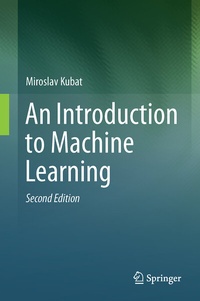
An Introduction to Machine Learning
Description

This textbook presents fundamental machine learning concepts in an easy to understand manner by providing practical advice, using straightforward examples, and offering engaging discussions of relevant applications. The main topics include Bayesian classifiers, nearest-neighbor classifiers, linear and polynomial classifiers, decision trees, neural networks, and support vector machines. Later chapters show how to combine these simple tools by way of "boosting," how to exploit them in more complicated domains, and how to deal with diverse advanced practical issues. One chapter is dedicated to the popular genetic algorithms.
This revised edition contains three entirely new chapters on critical topics regarding the pragmatic application of machine learning in industry. The chapters examine multi-label domains, unsupervised learning and its use in deep learning, and logical approaches to induction. Numerous chapters have been expanded, and the presentation of the material has been enhanced. The book contains many new exercises, numerous solved examples, thought-provoking experiments, and computer assignments for independent work.
Reviews / Votes
"The presentation is mainly empirical, but precise and pedagogical, as each concept introduced is followed by a set of questions which allows the reader to check immediately whether they understand the topic. Each chapter ends with a historical summary and a series of computer assignments. . this book could serve as textbook for an undergraduate introductory course on machine learning . ." (Gilles Teyssière, Mathematical Reviews, April, 2017)"This book describes ongoing human-computer interaction (HCI) research and practical applications. . These techniques can be very useful in AR/VR development projects, and some of these chapters can be used as examples and guides for future research." (Miguel A. Garcia-Ruiz, Computing Reviews, January, 2019)
More details
Other editions
New editions
Additional editions
Person
Miroslav Kubat, Associate Professor at the University of Miami, has been teaching and studying machine learning for over 25 years. He has published more than 100 peer-reviewed papers, co-edited two books, served on the program committees of over 60 conferences and workshops, and is an editorial board member of three scientific journals. He is widely credited with co-pioneering research in two major branches of the discipline: induction of time-varying concepts and learning from imbalanced training sets. He also contributed to research in induction from multi-label examples, induction of hierarchically organized classes, genetic algorithms, and initialization of neural networks.
