

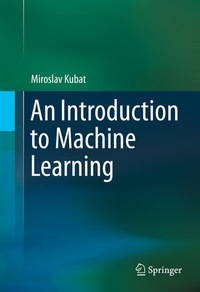
An Introduction to Machine Learning
Description

This book presents basic ideas of machine learning in a way that is easy to understand, by providing hands-on practical advice, using simple examples, and motivating students with discussions of interesting applications. The main topics include Bayesian classifiers, nearest-neighbor classifiers, linear and polynomial classifiers, decision trees, neural networks, and support vector machines. Later chapters show how to combine these simple tools by way of "boosting," how to exploit them in more complicated domains, and how to deal with diverse advanced practical issues. One chapter is dedicated to the popular genetic algorithms.
Reviews / Votes
"Miroslav Kubat's Introduction to Machine Learning is an excellent overview of a broad range of Machine Learning (ML) techniques. It fills a longstanding need for texts that cover the middle ground of neither oversimplifying nor too technical explanations of key concepts of key Machine Learning algorithms. . All in all it is a very informative and instructive read which is well suited for undergraduate students and aspiring data scientists." (Holger K. von Joua, Google+, plus.google.com, December, 2016)
"It is superbly organized: each section includes a 'what have you learned' summary, and every chapter has a short summary, accompanying (brief) historical remarks, and a slew of exercises. . In most of the chapters, there are very clear examples, well chosen and illustrated, that really help the reader understand each concept. . I did learn quite a bit about very basic machine learning by reading this book." (Jacques Carette, Computing Reviews, January, 2016)
More details
Other editions
Additional editions
Person
Miroslav Kubat, Associate Professor at the University of Miami, has been teaching and studying machine learning for more than a quarter century. Over the years, he has published more than 100 peer-reviewed papers, co-edited two books, served on the program committees of some 60 program conferences and workshops, and is the member of the editorial boards of three scientific journals. He is widely credited for having co-pioneered research in two major branches of the discipline: induction of time-varying concepts and learning from imbalanced training sets. Apart from that, he contributed to induction from multi-label examples, induction of hierarchically organized classes, genetic algorithms, initialization of neural networks, and other problems.
