

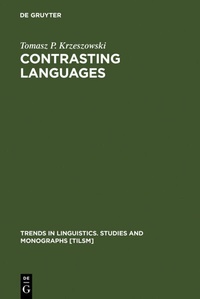
Contrasting Languages
The Scope of Contrastive Linguistics
1st Edition
Published on 1. June 2011
VIII, 286 pages
978-3-11-086014-6 (ISBN)
Description

No detailed description available for "Contrasting Languages".
More details
Series
Edition
Reprint 2011
Language
English
Place of publication
Berlin/Boston
Germany
Publishing group
de Gruyter Mouton
Target group
Professional and scholarly
US School Grade: College Graduate Student
Illustrations
14 Abbildungen, 3 s/w Tabellen
14 ill., 3 tbl.
File size
16,95 MB
ISBN-13
978-3-11-086014-6 (9783110860146)
Schweitzer Classification
Other editions
Additional editions
Book
12/1990
1st Edition
De Gruyter Mouton
€159.95
Shipment within 7-9 days
Book
01/1990
1st Edition
De Gruyter Mouton
€229.00
Article exhausted; check different version
Content
- Intro
- Introduction
- Chapter I. What is contrastive linguistics?
- Chapter II. Tertium comparationis
- Chapter III. Towards a classification of contrastive studies
- Chapter IV. Three steps in "classical" contrastive studies
- Chapter V. Contrastive studies at various levels of linguistic analysis
- Chapter VI. Linguistic models and contrastive studies
- Chapter VII. Towards a theory of semanto-syntactic equivalence
- Chapter VIII. Contrastive Generative Grammar
- Chapter IX. Error analysis, interlanguage, and Contrastive Generative Grammar
- Chapter X. Quantitative contrastive studies
- Chapter XI. Cognitive linguistics and contrastive studies
- Chapter XII. "Theoretical" and "applied" contrastive studies
- Notes
- References
- Index of subjects
- Index of authors
