

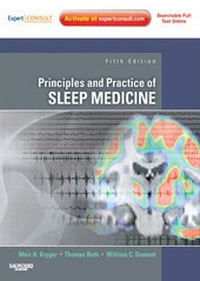
Principles and Practice of Sleep Medicine E-Book
Description

Principles and Practice of Sleep Medicine, 5th Edition, by Meir H. Kryger, MD, FRCPC, Thomas Roth, PhD, and William C. Dement, MD, PhD, delivers the comprehensive, dependable guidance you need to effectively diagnose and manage even the most challenging sleep disorders. Updates to genetics and circadian rhythms, occupational health, sleep in older people, memory and sleep, physical examination of the patient, comorbid insomnias, and much more keep you current on the newest areas of the field. A greater emphasis on evidence-based approaches helps you make the most well-informed clinical decisions. And, a new more user-friendly, full-color format, both in print and online, lets you find the answers you need more quickly and easily. Whether you are preparing for the new sleep medicine fellowship examination, or simply want to offer your patients today's best care, this is the one resource to use!
- Make optimal use of the newest scientific discoveries and clinical approaches that are advancing the diagnosis and management of sleep disorders.
More details
Other editions
Additional editions
Content
2 - Principles and Practice of Sleep Medicine [Seite 2]
3 - Copyright page [Seite 5]
4 - Dedication [Seite 6]
5 - Contributors [Seite 10]
6 - Foreword [Seite 24]
7 - Preface [Seite 28]
8 - Acknowledgments [Seite 30]
9 - Abbreviations [Seite 32]
10 - Instructions for online access [Seite 1805]
11 - Table of contents [Seite 36]
12 - Part I: Principles of Sleep Medicine [Seite 44]
12.1 - Chapter 1: History of Sleep Physiology and Medicine [Seite 46]
12.1.1 - Abstract [Seite 46]
12.1.2 - SLEEP AS A PASSIVE STATE [Seite 46]
12.1.3 - THE ELECTRICAL ACTIVITY OF THE BRAIN [Seite 47]
12.1.4 - THE ASCENDING RETICULAR SYSTEM [Seite 48]
12.1.5 - EARLY OBSERVATIONS OF SLEEP PATHOLOGY [Seite 48]
12.1.6 - SIGMUND FREUD AND THE INTERPRETATION OF DREAMS [Seite 49]
12.1.7 - CHRONOBIOLOGY [Seite 49]
12.1.8 - THE DISCOVERY OF REM SLEEP [Seite 49]
12.1.9 - ALL-NIGHT SLEEP RECORDINGS AND THE BASIC SLEEP CYCLE [Seite 50]
12.1.10 - REM SLEEP IN ANIMALS [Seite 51]
12.1.11 - THE DUALITY OF SLEEP [Seite 52]
12.1.12 - PREMONITIONS OF SLEEP MEDICINE [Seite 52]
12.1.13 - SLEEP-ONSET REM PERIODS AND CATAPLEXY [Seite 52]
12.1.14 - THE NARCOLEPSY CLINIC: A FALSE START [Seite 52]
12.1.15 - EUROPEAN INTEREST [Seite 52]
12.1.16 - BENZODIAZEPINES AND HYPNOTIC EFFICACY STUDIES [Seite 53]
12.1.17 - THE DISCOVERY OF SLEEP APNEA [Seite 53]
12.1.18 - ITALIAN SYMPOSIA [Seite 53]
12.1.19 - BIRTH PANGS [Seite 53]
12.1.20 - THE EARLY DEVELOPMENT OF SLEEP MEDICINE CLINICAL PRACTICE [Seite 54]
12.1.21 - CLINICAL SIGNIFICANCE OF EXCESSIVE DAYTIME SLEEPINESS [Seite 55]
12.1.22 - FURTHER DEVELOPMENT OF SLEEP MEDICINE [Seite 55]
12.1.23 - THE TURN OF THE CENTURY AND BEYOND [Seite 56]
12.1.24 - REFERENCES [Seite 57]
12.2 - Chapter 2: Normal Human Sleep: [Seite 59]
12.2.1 - Abstract [Seite 59]
12.2.2 - SLEEP DEFINITIONS [Seite 59]
12.2.3 - SLEEP ONSET [Seite 60]
12.2.4 - PROGRESSION OF SLEEP ACROSS THE NIGHT [Seite 63]
12.2.5 - REFERENCES [Seite 68]
12.3 - Chapter 3: Normal Aging [Seite 70]
12.3.1 - Abstract [Seite 70]
12.3.2 - SLEEP ARCHITECTURE [Seite 70]
12.3.3 - CIRCADIAN RHYTHMS IN AGING [Seite 73]
12.3.4 - CAUSES AND CONSEQUENCES OF POOR SLEEP IN OLD AGE [Seite 75]
12.3.5 - RESTLESS LEGS SYNDROME AND PERIODIC LIMB MOVEMENTS IN SLEEP [Seite 76]
12.3.6 - SLEEP-DISORDERED BREATHING [Seite 77]
12.3.7 - WHY DO OLDER PEOPLE NAP? [Seite 79]
12.3.8 - BASIC SCIENCE CONSIDERATIONS [Seite 79]
12.3.9 - SUMMARY [Seite 80]
12.3.10 - REFERENCES [Seite 80]
12.4 - Chapter 4: Daytime Sleepiness and Alertness [Seite 85]
12.4.1 - Abstract [Seite 85]
12.4.2 - INTRODUCTION [Seite 85]
12.4.3 - EPIDEMIOLOGY OF SLEEPINESS [Seite 85]
12.4.4 - NATURE OF SLEEPINESS [Seite 86]
12.4.5 - ASSESSMENT OF SLEEPINESS [Seite 88]
12.4.6 - DETERMINANTS OF SLEEPINESS [Seite 90]
12.4.7 - CLINICAL AND PUBLIC HEALTH SIGNIFICANCE OF SLEEPINESS [Seite 93]
12.4.8 - REFERENCES [Seite 94]
12.5 - Chapter 5: Acute Sleep Deprivation [Seite 97]
12.5.1 - Abstract [Seite 97]
12.5.2 - TOTAL SLEEP DEPRIVATION [Seite 97]
12.5.3 - PHYSIOLOGIC EFFECTS OF SLEEP DEPRIVATION [Seite 102]
12.5.4 - SLEEP FRAGMENTATION [Seite 104]
12.5.5 - RECOVERY SLEEP [Seite 105]
12.5.6 - CONCLUSIONS [Seite 107]
12.5.7 - Acknowledgements [Seite 107]
12.5.8 - REFERENCES [Seite 107]
12.6 - Chapter 6: Chronic Sleep Deprivation [Seite 110]
12.6.1 - Abstract [Seite 110]
12.6.2 - INCIDENCE OF CHRONIC SLEEP RESTRICTION [Seite 110]
12.6.3 - THEORETICAL PERSPECTIVES ON SLEEP NEED AND SLEEP DEBT [Seite 110]
12.6.4 - EFFECTS OF CHRONIC SLEEP RESTRICTION [Seite 112]
12.6.5 - PHYSIOLOGIC EFFECTS [Seite 116]
12.6.6 - Acknowledgments [Seite 116]
12.6.7 - REFERENCES [Seite 116]
12.7 - Chapter 7: Neural Control of Sleep in Mammals [Seite 119]
12.7.1 - Abstract [Seite 119]
12.7.2 - DIVERSE BRAIN REGIONS MODULATE WAKING AND NREM SLEEP [Seite 119]
12.7.3 - RETICULAR ACTIVATING SYSTEM AND DELINEATION OF AROUSAL SYSTEMS [Seite 120]
12.7.4 - WAKE-ON, REM-OFF AROUSAL SYSTEMS [Seite 121]
12.7.5 - WAKE-ON, REM-ON AROUSAL SYSTEMS [Seite 122]
12.7.6 - SLEEP-PROMOTING MECHANISMS [Seite 122]
12.7.7 - THE ORCHESTRATION OF SLEEP BY THE POA HYPNOGENIC SYSTEM [Seite 124]
12.7.8 - THALAMIC-CORTICAL INTERACTIONS AND THE GENERATION OF THE SLEEP EEG [Seite 125]
12.7.9 - INTEGRATION OF CIRCADIAN RHYTHMS AND SLEEP [Seite 129]
12.7.10 - THE POA, THERMOREGULATION, AND CONTROL OF SLEEP [Seite 129]
12.7.11 - HIERARCHICAL CONTROL MODEL [Seite 129]
12.7.12 - SLEEP-PROMOTING NEUROCHEMICAL AGENTS [Seite 130]
12.7.13 - SUMMARY [Seite 132]
12.7.14 - Acknowledgments [Seite 132]
12.7.15 - REFERENCES [Seite 132]
12.8 - Chapter 8: REM Sleep* [Seite 135]
12.8.1 - Abstract [Seite 135]
12.8.2 - CHARACTERISTICS OF REM SLEEP [Seite 135]
12.8.3 - REM GENERATION MECHANISMS [Seite 136]
12.8.4 - CONTROL OF MUSCLE TONE [Seite 144]
12.8.5 - NARCOLEPSY AND HYPOCRETIN [Seite 146]
12.8.6 - THE FUNCTIONS OF REM SLEEP [Seite 148]
12.8.7 - REFERENCES [Seite 151]
12.9 - Chapter 9: Phylogeny of Sleep Regulation [Seite 155]
12.9.1 - Abstract [Seite 155]
12.9.2 - SLEEP REGULATION IN MAMMALS [Seite 155]
12.9.3 - SLEEP REGULATION IN NONMAMMALIAN VERTEBRATES [Seite 162]
12.9.4 - SLEEP REGULATION IN INVERTEBRATES [Seite 163]
12.9.5 - OUTLOOK [Seite 165]
12.9.6 - REFERENCES [Seite 166]
12.10 - Chapter 10: Sleep in Animals: [Seite 169]
12.10.1 - Abstract [Seite 169]
12.10.2 - ADAPTIVE INACTIVITY [Seite 169]
12.10.3 - QUANTITATIVE ANALYSES OF THE CORRELATES OF SLEEP DURATION [Seite 170]
12.10.4 - THE DIVERSITY OF SLEEP [Seite 172]
12.10.5 - SLEEP IN MONOTREMES [Seite 173]
12.10.6 - REINDEER [Seite 175]
12.10.7 - BIRDS [Seite 175]
12.10.8 - WALRUS [Seite 176]
12.10.9 - SLEEP IN CETACEANS (DOLPHINS AND WHALES) [Seite 176]
12.10.10 - SLEEP IN OTARIIDS (EARED SEALS) [Seite 178]
12.10.11 - SLEEP REBOUND [Seite 178]
12.10.12 - CONCLUSION [Seite 179]
12.10.13 - Acknowledgment [Seite 179]
12.10.14 - REFERENCES [Seite 179]
12.11 - Chapter 11: Introduction [Seite 182]
12.11.1 - REFERENCES [Seite 183]
12.12 - Chapter 12: Circadian Clock Genes [Seite 184]
12.12.1 - Abstract [Seite 184]
12.12.2 - REFERENCES [Seite 191]
12.13 - Chapter 13: Genetics of Sleep in a Simple Model Organism: [Seite 194]
12.13.1 - Abstract [Seite 194]
12.13.2 - DROSOPHILA AS A MODEL SYSTEM FOR GENETICS [Seite 194]
12.13.3 - DROSOPHILA AS A MODEL FOR STUDIES OF SLEEP [Seite 195]
12.13.4 - DROSOPHILA CIRCADIAN BEHAVIOR REVEALS CONSERVED MECHANISMS BETWEEN FLIES AND HUMANS [Seite 196]
12.13.5 - CELLULAR AND MOLECULAR BASIS OF DROSOPHILA SLEEP [Seite 197]
12.13.6 - SPECIFIC NEURAL CIRCUITS ARE IMPORTANT FOR SLEEP-WAKE REGULATION [Seite 197]
12.13.7 - GENETICS AND PHARMACOLOGY OF SLEEP: WHICH MOLECULES REGULATE SLEEP? [Seite 198]
12.13.8 - WHICH GENES ARE REGULATED BY SLEEP-WAKE? [Seite 201]
12.13.9 - SUMMARY [Seite 201]
12.13.10 - REFERENCES [Seite 201]
12.14 - Chapter 14: Genetic Basis of Sleep in Rodents [Seite 204]
12.14.1 - Abstract [Seite 204]
12.14.2 - REFERENCES [Seite 214]
12.15 - Chapter 15: Genetic Basis of Sleep in Healthy Humans [Seite 218]
12.15.1 - Abstract [Seite 218]
12.15.2 - REFERENCES [Seite 225]
12.16 - Chapter 16: Genetics of Sleep and Sleep Disorders in Humans [Seite 227]
12.16.1 - Abstract [Seite 227]
12.16.2 - REFERENCES [Seite 238]
12.17 - Chapter 17: Relevance of Sleep Physiology for Sleep Medicine Clinicians [Seite 242]
12.17.1 - Abstract [Seite 242]
12.17.2 - REFERENCES [Seite 243]
12.18 - Chapter 18: What Brain Imaging Reveals about Sleep Generation and Maintenance [Seite 244]
12.18.1 - Abstract [Seite 244]
12.18.2 - REFERENCES [Seite 255]
12.19 - Chapter 19: Cardiovascular Physiology: [Seite 258]
12.19.1 - Abstract [Seite 258]
12.19.2 - REFERENCES [Seite 266]
12.20 - Chapter 20: Cardiovascular Physiology: [Seite 269]
12.20.1 - Abstract [Seite 269]
12.20.2 - INTRODUCTION [Seite 269]
12.20.3 - THE CARDIOVASCULAR AUTONOMIC NERVOUS SYSTEM: DEFINITION AND FUNCTIONS [Seite 269]
12.20.4 - MEASURES TO EXPLORE AUTONOMIC CHANGES DURING SLEEP AND THEIR PHYSIOLOGICAL SIGNIFICANCE [Seite 270]
12.20.5 - SLEEP RELATED CARDIOVASCULAR AUTONOMIC CHANGES [Seite 273]
12.20.6 - IMPACT OF AGING ON NEURAL CIRCULATORY RESPONSE TO NORMAL SLEEP [Seite 275]
12.20.7 - EFFECTS OF DISORDERED SLEEP AND PRIMARY AUTONOMIC DYSFUNCTION ON DAY-NIGHT AUTONOMIC CHANGES [Seite 276]
12.20.8 - SYMPATHETIC ACTIVATION IN OBSTRUCTIVE SLEEP APNEA [Seite 277]
12.20.9 - SUMMARY [Seite 278]
12.20.10 - REFERENCES [Seite 278]
12.21 - Chapter 21: Respiratory Physiology: [Seite 280]
12.21.1 - Abstract [Seite 280]
12.21.2 - RESPIRATORY NEUROBIOLOGY: BASIC OVERVIEW [Seite 280]
12.21.3 - SLEEP NEUROBIOLOGY: BASIC OVERVIEW [Seite 282]
12.21.4 - CONTROL OF RESPIRATORY MOTONEURONS [Seite 283]
12.21.5 - DETERMINANTS OF RESPIRATORY MOTONEURON ACTIVITY [Seite 284]
12.21.6 - NEUROMODULATION OF RESPIRATORY MOTONEURONS ACROSS SLEEP-WAKE STATES [Seite 286]
12.21.7 - CONTROL OF RESPIRATORY NEURONS [Seite 289]
12.21.8 - Acknowledgments [Seite 291]
12.21.9 - REFERENCES [Seite 291]
12.22 - Chapter 22: Respiratory Physiology: [Seite 293]
12.22.1 - Abstract [Seite 293]
12.22.2 - INTRODUCTION [Seite 293]
12.22.3 - PHYSIOLOGY OF VENTILATORY CONTROL DURING SLEEP [Seite 293]
12.22.4 - ADDED RESISTANCE AND AIRWAY OCCLUSION DURING SLEEP [Seite 295]
12.22.5 - AROUSAL RESPONSES [Seite 295]
12.22.6 - CONTROL OF BREATHING RHYTHM DURING SLEEP [Seite 297]
12.22.7 - UPPER AIRWAY-OPENING MUSCLES DURING SLEEP [Seite 297]
12.22.8 - FACTORS INFLUENCING RESPIRATORY CONTROL DURING SLEEP [Seite 297]
12.22.9 - CLINICAL SEQUELAE OF ABNORMAL VENTILATORY RESPONSES [Seite 298]
12.22.10 - REFERENCES [Seite 299]
12.23 - Chapter 23: Normal Physiology of the Upper and Lower Airways [Seite 302]
12.23.1 - Abstract [Seite 302]
12.23.2 - REFERENCES [Seite 309]
12.24 - Chapter 24: Respiratory Physiology: [Seite 312]
12.24.1 - Abstract [Seite 312]
12.24.2 - PHYSIOLOGIC ADJUSTMENT TO HIGH ALTITUDE [Seite 312]
12.24.3 - PERIODIC BREATHING [Seite 314]
12.24.4 - TREATMENT [Seite 319]
12.24.5 - SLEEP AT HIGH ALTITUDE AFTER LONG-TERM ADAPTATION [Seite 320]
12.24.6 - CONCLUSIONS [Seite 321]
12.24.7 - REFERENCES [Seite 321]
12.25 - Chapter 25: Sleep and Host Defense [Seite 324]
12.25.1 - Abstract [Seite 324]
12.25.2 - INTRODUCTION [Seite 324]
12.25.3 - THE ACUTE PHASE RESPONSE AND HOST DEFENSE [Seite 324]
12.25.4 - SLEEP CHANGES AFTER INFECTIOUS CHALLENGE [Seite 325]
12.25.5 - SLEEP LOSS EFFECTS ON IMMUNE FUNCTION [Seite 328]
12.25.6 - SLEEP AND IMMUNITY SHARE COMMON REGULATORY MOLECULES [Seite 329]
12.25.7 - Acknowledgments [Seite 331]
12.25.8 - REFERENCES [Seite 331]
12.26 - Chapter 26: Endocrine Physiology in Relation to Sleep and Sleep Disturbances [Seite 334]
12.26.1 - Abstract [Seite 334]
12.26.2 - MODULATION OF ENDOCRINE FUNCTION BY SLEEP-WAKE HOMEOSTASIS AND CIRCADIAN RHYTHMICITY [Seite 334]
12.26.3 - THE GROWTH HORMONE AXIS [Seite 335]
12.26.4 - THE CORTICOTROPIC AXIS [Seite 336]
12.26.5 - THE THYROID AXIS [Seite 337]
12.26.6 - PROLACTIN SECRETION [Seite 338]
12.26.7 - THE GONADAL AXIS [Seite 339]
12.26.8 - GLUCOSE REGULATION [Seite 339]
12.26.9 - SLEEP AND APPETITE REGULATION [Seite 340]
12.26.10 - WATER AND ELECTROLYTE BALANCE DURING SLEEP [Seite 341]
12.26.11 - CHRONIC SLEEP RESTRICTION: IMPACT ON ENDOCRINE AND METABOLIC FUNCTION [Seite 341]
12.26.12 - REDUCED SLEEP QUALITY AND SLEEP DISORDERS: IMPACT ON ENDOCRINE AND METABOLIC FUNCTION [Seite 344]
12.26.13 - OSA [Seite 346]
12.26.14 - AGE-RELATED SLEEP ALTERATIONS: IMPLICATIONS FOR ENDOCRINE FUNCTION [Seite 346]
12.26.15 - SLEEP DISTURBANCES IN METABOLIC AND ENDOCRINE DISORDERS [Seite 349]
12.26.16 - REFERENCES [Seite 350]
12.27 - Chapter 27: Gastrointestinal Physiology in Relation to Sleep [Seite 355]
12.27.1 - ABSTRACT [Seite 355]
12.27.2 - INTRODUCTION [Seite 355]
12.27.3 - HISTORICAL ASPECTS [Seite 355]
12.27.4 - GASTRIC FUNCTION DURING WAKE AND SLEEP [Seite 356]
12.27.5 - GASTRIC MOTOR FUNCTION DURING SLEEP [Seite 357]
12.27.6 - SWALLOWING AND ESOPHAGEAL FUNCTION [Seite 358]
12.27.7 - INTESTINAL MOTILITY DURING SLEEP [Seite 360]
12.27.8 - SLEEP, ABDOMINAL PAIN, AND IRRITABLE BOWEL SYNDROME [Seite 361]
12.27.9 - EFFECT OF INTESTINAL MOTILITY ON SLEEP [Seite 361]
12.27.10 - COLONIC AND ANORECTAL FUNCTION DURING SLEEP [Seite 362]
12.27.11 - CONCLUSIONS [Seite 363]
12.27.12 - REFERENCES [Seite 363]
12.28 - Chapter 28: Body Temperature, Sleep, and Hibernation [Seite 366]
12.28.1 - Abstract [Seite 366]
12.28.2 - INTRODUCTION [Seite 366]
12.28.3 - CIRCADIAN REGULATION OF CORE BODY TEMPERATURE [Seite 366]
12.28.4 - RELATIONSHIP BETWEEN THE SLEEP REGULATORY AND THE THERMOREGULATORY SYSTEM [Seite 367]
12.28.5 - HIBERNATION [Seite 373]
12.28.6 - REFERENCES [Seite 374]
12.29 - Chapter 29: Memory Processing in Relation to Sleep [Seite 378]
12.29.1 - Abstract [Seite 378]
12.29.2 - MEMORY SYSTEMS AND MEMORY CONSOLIDATION [Seite 379]
12.29.3 - METHODS FOR STUDYING THE ROLE OF SLEEP FOR MEMORY CONSOLIDATION [Seite 380]
12.29.4 - SLEEP AND DECLARATIVE MEMORY [Seite 382]
12.29.5 - SLEEP AND NONDECLARATIVE MEMORIES [Seite 383]
12.29.6 - SLEEP-DEPENDENT MECHANISMS OF BRAIN PLASTICITY AND MEMORY CONSOLIDATION [Seite 385]
12.29.7 - Conclusions [Seite 386]
12.29.8 - REFERENCES [Seite 387]
12.30 - Chapter 30: Sensory and Motor Processing during Sleep and Wakefulness [Seite 391]
12.30.1 - Abstract [Seite 391]
12.30.2 - MODULATION OF SENSORY PROCESSES DURING SLEEP AND WAKEFULNESS [Seite 391]
12.30.3 - MODULATION OF SENSORIMOTOR PROCESSES DURING SLEEP AND WAKEFULNESS [Seite 395]
12.30.4 - RESPIRATORY REFLEXES DURING SLEEP AND WAKEFULNESS [Seite 397]
12.30.5 - REFERENCES [Seite 401]
12.31 - Chapter 31: Introduction: [Seite 403]
12.31.1 - INTEGRATION OF THE CIRCADIAN CLOCK AND SLEEP-WAKE SYSTEMS [Seite 403]
12.31.2 - REGULATING SLEEP AMOUNT: A HOMEOSTATIC AND A CIRCADIAN INPUT [Seite 404]
12.31.3 - REFERENCES [Seite 405]
12.32 - Chapter 32: Circadian Rhythms in Mammals: [Seite 406]
12.32.1 - Abstract [Seite 406]
12.32.2 - THE NATURE OF CIRCADIAN RHYTHMS [Seite 406]
12.32.3 - PARAMETERS AND MEASUREMENT OF CIRCADIAN RHYTHMS [Seite 407]
12.32.4 - ADAPTIVE SIGNIFICANCE OF CIRCADIAN RHYTHMS [Seite 408]
12.32.5 - ENVIRONMENTAL INFLUENCES [Seite 409]
12.32.6 - CIRCADIAN RHYTHMS ACROSS THE LIFESPAN [Seite 415]
12.32.7 - CONCLUSION [Seite 416]
12.32.8 - REFERENCES [Seite 416]
12.33 - Chapter 33: Anatomy of the Mammalian Circadian System [Seite 419]
12.33.1 - Abstract [Seite 419]
12.33.2 - REFERENCES [Seite 429]
12.34 - Chapter 34: Physiology of the Mammalian Circadian System [Seite 433]
12.34.1 - Abstract [Seite 433]
12.34.2 - THE SUPRACHIASMATIC NUCLEUS: MASTER CIRCADIAN PACEMAKER [Seite 433]
12.34.3 - MULTIPLE-OSCILLATOR NATURE OF THE CIRCADIAN SYSTEM [Seite 437]
12.34.4 - SUMMARY AND CONCLUSIONS [Seite 441]
12.34.5 - Acknowledgments [Seite 441]
12.34.6 - REFERENCES [Seite 441]
12.35 - Chapter 35: The Human Circadian Timing System and Sleep-Wake Regulation [Seite 445]
12.35.1 - Abstract [Seite 445]
12.35.2 - IDENTIFYING THE MAMMALIAN CIRCADIAN PACEMAKER [Seite 445]
12.35.3 - INFLUENCE OF SLEEP AND CIRCADIAN RHYTHMS ON HUMAN PHYSIOLOGY [Seite 445]
12.35.4 - EFFECTS OF LIGHT ON HUMAN CIRCADIAN RHYTHMS [Seite 447]
12.35.5 - NONPHOTIC CIRCADIAN PHASE RESETTING AND REENTRAINMENT [Seite 450]
12.35.6 - INVESTIGATING CIRCADIAN AND SLEEP-WAKE DEPENDENT MODULATION [Seite 451]
12.35.7 - AGING AND CIRCADIAN SLEEP-WAKE REGULATION [Seite 457]
12.35.8 - INFLUENCE OF SOCIAL FACTORS [Seite 458]
12.35.9 - CONCLUSION [Seite 458]
12.35.10 - Acknowledgments [Seite 458]
12.35.11 - REFERENCES [Seite 459]
12.36 - Chapter 36: Melatonin and the Regulation of Sleep and Circadian Rhythms [Seite 463]
12.36.1 - Abstract [Seite 463]
12.36.2 - MELATONIN: SYNTHESIS, RECEPTORS, AND CIRCADIAN SECRETION PATTERN [Seite 463]
12.36.3 - PHYSIOLOGIC ROLE OF MELATONIN IN THE REST-ACTIVITY CYCLE: CONSEQUENCES FOR SLEEP [Seite 465]
12.36.4 - CIRCADIAN RHYTHM SLEEP DISORDERS OF EXOGENOUS CAUSES ASSOCIATED WITH ALTERED MELATONIN SECRETION PATTERN [Seite 466]
12.36.5 - CIRCADIAN RHYTHM SLEEP DISORDERS OF ENDOGENOUS ORIGIN [Seite 468]
12.36.6 - CENTRAL NERVOUS SYSTEM DISORDERS ASSOCIATED WITH ALTERATION OF MELATONIN SECRETION PATTERNS [Seite 469]
12.36.7 - CONCLUSION [Seite 469]
12.36.8 - REFERENCES [Seite 470]
12.37 - Chapter 37: Sleep Homeostasis and Models of Sleep Regulation [Seite 474]
12.37.1 - Abstract [Seite 474]
12.37.2 - REFERENCES [Seite 484]
12.38 - Chapter 38: Circadian Rhythms in Sleepiness, Alertness, and Performance [Seite 488]
12.38.1 - Abstract [Seite 488]
12.38.2 - REFERENCES [Seite 495]
12.39 - Chapter 39: Animal Models for Disorders of Circadian Functions: [Seite 499]
12.39.1 - Abstract [Seite 499]
12.39.2 - DESTROYING THE MASTER CIRCADIAN CLOCK IN THE SCN: EFFECTS ON HEALTH AND WELL-BEING [Seite 499]
12.39.3 - IMPORTANCE OF "RESONANCE" OF THE TIMING OF THE INTERNAL CIRCADIAN CLOCK WITH THAT OF THE ENTRAINING LD CYCLE [Seite 500]
12.39.4 - HEALTH AND LONGEVITY IN ANIMAL MODELS OF SHIFT-WORK CONDITIONS [Seite 501]
12.39.5 - GENETIC MODELS FOR EXAMINING THE EFFECTS OF DISRUPTED RHYTHMS AND DISEASE [Seite 503]
12.39.6 - CONCLUSIONS [Seite 503]
12.39.7 - REFERENCES [Seite 504]
12.40 - Chapter 40: Animal Models for Disorders of Chronobiology: [Seite 506]
12.40.1 - Abstract [Seite 506]
12.40.2 - REFERENCES [Seite 510]
12.41 - Chapter 41: Circadian Disorders of the Sleep-Wake Cycle [Seite 513]
12.41.1 - Abstract [Seite 513]
12.41.2 - REFERENCES [Seite 522]
12.42 - Chapter 42: Hypnotic Medications: [Seite 526]
12.42.1 - Abstract [Seite 526]
12.42.2 - REFERENCES [Seite 533]
12.43 - Chapter 43: Clinical Pharmacology of Other Drugs Used as Hypnotics [Seite 535]
12.43.1 - Abstract [Seite 535]
12.43.2 - REFERENCES [Seite 548]
12.44 - Chapter 44: Wake-Promoting Medications: Basic Mechanisms and Pharmacology [Seite 553]
12.44.1 - Abstract [Seite 553]
12.44.2 - CENTRAL NERVOUS STIMULANTS: DEFINITIONS [Seite 553]
12.44.3 - AMPHETAMINES AND AMPHETAMINE-LIKE COMPOUNDS [Seite 553]
12.44.4 - MODAFINIL AND ARMODAFINIL [Seite 563]
12.44.5 - MAZINDOL [Seite 565]
12.44.6 - BUPROPION [Seite 565]
12.44.7 - SELEGILINE (l-DEPRENYL) [Seite 565]
12.44.8 - ATOMOXETINE AND REBOXETINE [Seite 565]
12.44.9 - CAFFEINE [Seite 565]
12.44.10 - FUTURE STIMULANT TREATMENTS [Seite 566]
12.44.11 - CONCLUSION [Seite 567]
12.44.12 - REFERENCES [Seite 567]
12.45 - Chapter 45: Wake-Promoting Medications: [Seite 570]
12.45.1 - Abstract [Seite 570]
12.45.2 - THE HISTORY OF WAKE-PROMOTING MEDICATIONS [Seite 570]
12.45.3 - CAFFEINE [Seite 571]
12.45.4 - SYMPATHOMIMETIC ALERTING AGENTS [Seite 573]
12.45.5 - MODAFINIL AND ARMODAFINIL [Seite 577]
12.45.6 - SODIUM OXYBATE [Seite 578]
12.45.7 - IS ALL WAKEFULNESS THE SAME? [Seite 579]
12.45.8 - SPECIFIC USE OF WAKE-PROMOTING MEDICATIONS [Seite 580]
12.45.9 - CHANGING OR COMBINING MEDICATIONS [Seite 580]
12.45.10 - RECOMMENDATIONS AND TREATMENT PLANNING [Seite 581]
12.45.11 - CONCLUSIONS [Seite 582]
12.45.12 - REFERENCES [Seite 582]
12.46 - Chapter 46: Drugs That Disturb Sleep and Wakefulness [Seite 585]
12.46.1 - Abstract [Seite 585]
12.46.2 - PSYCHOTHERAPEUTIC DRUGS [Seite 585]
12.46.3 - ANTIEPILEPTIC DRUGS [Seite 592]
12.46.4 - ANTIPARKINSONIAN DRUGS [Seite 592]
12.46.5 - CARDIOVASCULAR DRUGS [Seite 594]
12.46.6 - HISTAMINE ANTAGONISTS [Seite 596]
12.46.7 - PAIN MEDICATIONS [Seite 596]
12.46.8 - OTHER DRUGS [Seite 597]
12.46.9 - CONCLUSION [Seite 598]
12.46.10 - REFERENCES [Seite 598]
12.47 - Chapter 47: Introduction: [Seite 604]
12.47.1 - REFERENCES [Seite 605]
12.48 - Chapter 48: The Neurobiology of Dreaming [Seite 606]
12.48.1 - Abstract [Seite 606]
12.48.2 - REFERENCES [Seite 616]
12.49 - Chapter 49: Ultradian, Circadian, and Sleep-Dependent Features of Dreaming [Seite 619]
12.49.1 - Abstract [Seite 619]
12.49.2 - REFERENCES [Seite 626]
12.50 - Chapter 50: Dream Content: [Seite 628]
12.50.1 - Abstract [Seite 628]
12.50.2 - METHODS FOR COLLECTING DREAM REPORTS [Seite 628]
12.50.3 - ANALYZING DREAM CONTENT: INSTRUMENTS AND ISSUES [Seite 630]
12.50.4 - QUANTITATIVE FINDINGS ON DREAM CONTENT [Seite 631]
12.50.5 - REFERENCES [Seite 635]
12.51 - Chapter 51: Dream Analysis and Classification: [Seite 638]
12.51.1 - Abstract [Seite 638]
12.51.2 - REFERENCES [Seite 645]
12.52 - Chapter 52: Dreams in Patients with Sleep Disorders [Seite 647]
12.52.1 - Abstract [Seite 647]
12.52.2 - REFERENCES [Seite 653]
12.53 - Chapter 53: Dreams and Nightmares in Posttraumatic Stress Disorder [Seite 656]
12.53.1 - Abstract [Seite 656]
12.53.2 - REPLICATIVE-TRAUMA NIGHTMARES: HALLMARK OF A DISORDER? [Seite 656]
12.53.3 - DREAM CONTENT WITH STRESS AND TRAUMA: BEYOND REPLICATION [Seite 657]
12.53.4 - POLYSOMNOGRAPHIC CORRELATES OF NIGHTMARES IN PTSD [Seite 658]
12.53.5 - SUMMARY AND THEORETICAL IMPLICATIONS [Seite 659]
12.53.6 - TREATMENT OF POSTTRAUMATIC NIGHTMARES AND RELATED SLEEP DISTURBANCES [Seite 659]
12.53.7 - REFERENCES [Seite 660]
12.54 - Chapter 54: Dreaming as a Mood-Regulation System [Seite 663]
12.54.1 - Abstract [Seite 663]
12.54.2 - MOOD-REGULATION FUNCTION OF DREAMING IN NORMAL PERSONS [Seite 663]
12.54.3 - MOOD REGULATION FUNCTION OF DREAMING IN PATIENTS WITH PARASOMNIAS [Seite 668]
12.54.4 - CLINICAL APPLICATIONS [Seite 668]
12.54.5 - REFERENCES [Seite 669]
12.55 - Chapter 55: Why We Dream [Seite 671]
12.55.1 - Abstract [Seite 671]
12.55.2 - BRAIN ACTIVITY DURING SLEEP [Seite 671]
12.55.3 - SLEEP-DEPENDENT MEMORY CONSOLIDATION [Seite 671]
12.55.4 - SLEEP STAGES AND DREAM CONTENT [Seite 672]
12.55.5 - DREAMS AND MEMORY SYSTEMS [Seite 672]
12.55.6 - ASSOCIATIVE NETWORKS IN SLEEP [Seite 673]
12.55.7 - DREAMING AND DECLARATIVE MEMORY PROCESSING DURING SLEEP [Seite 674]
12.55.8 - INCORPORATION OF WAKING EVENTS INTO DREAMS [Seite 675]
12.55.9 - EMOTION IN THE SLEEPING BRAIN [Seite 676]
12.55.10 - A NEUROCOGNITIVE MODEL OF DREAM CONSTRUCTION AND FUNCTION [Seite 677]
12.55.11 - Acknowledgments [Seite 678]
12.55.12 - REFERENCES [Seite 678]
13 - Part II: Practice of Sleep Medicine [Seite 682]
13.1 - Chapter 56: Approach to the Patient with Disordered Sleep [Seite 684]
13.1.1 - Abstract [Seite 684]
13.1.2 - REFERENCES [Seite 689]
13.2 - Chapter 57: Cardinal Manifestations of Sleep Disorders [Seite 690]
13.2.1 - Abstract [Seite 690]
13.2.2 - REFERENCES [Seite 700]
13.3 - Chapter 58: Physical Examination in Sleep Medicine [Seite 701]
13.3.1 - Abstract [Seite 701]
13.3.2 - REFERENCES [Seite 707]
13.4 - Chapter 59: Use of Clinical Tools and Tests in Sleep Medicine [Seite 709]
13.4.1 - Abstract [Seite 709]
13.4.2 - REFERENCES [Seite 720]
13.5 - Chapter 60: Classification of Sleep Disorders [Seite 723]
13.5.1 - Abstract [Seite 723]
13.5.2 - INSOMNIAS [Seite 723]
13.5.3 - SLEEP-RELATED BREATHING DISORDERS [Seite 726]
13.5.4 - HYPERSOMNIA OF CENTRAL ORIGIN [Seite 727]
13.5.5 - CIRCADIAN RHYTHM SLEEP DISORDERS [Seite 728]
13.5.6 - PARASOMNIAS [Seite 728]
13.5.7 - SLEEP-RELATED MOVEMENT DISORDERS [Seite 729]
13.5.8 - OTHER SLEEP DISORDERS [Seite 730]
13.5.9 - CURRENT AND FUTURE CLASSIFICATION CONSIDERATIONS [Seite 730]
13.5.10 - REFERENCES [Seite 733]
13.6 - Chapter 61: Epidemiology of Sleep Disorders [Seite 737]
13.6.1 - Abstract [Seite 737]
13.6.2 - SLEEP DURATION [Seite 737]
13.6.3 - INSOMNIA AND USE OF HYPNOTIC AGENTS [Seite 738]
13.6.4 - CIRCADIAN RHYTHMS AND THEIR DISORDERS [Seite 741]
13.6.5 - EXCESSIVE SLEEPINESS AND HYPERSOMNIA [Seite 741]
13.6.6 - NARCOLEPSY AND NARCOLEPSY-LIKE SYMPTOMS [Seite 744]
13.6.7 - SNORING, SLEEP-DISORDERED BREATHING, AND SLEEP APNEA SYNDROME [Seite 745]
13.6.8 - RESTLESS LEGS SYNDROME [Seite 751]
13.6.9 - REM SLEEP BEHAVIOR DISORDER [Seite 751]
13.6.10 - PARASOMNIAS [Seite 751]
13.6.11 - REFERENCES [Seite 752]
13.7 - Chapter 62: Sleep Medicine, Public Policy, and Public Health [Seite 759]
13.7.1 - Abstract [Seite 759]
13.7.2 - SLEEP IN MODERN SOCIETY [Seite 759]
13.7.3 - THE CHALLENGE [Seite 760]
13.7.4 - KEY AREAS FOR EDUCATION AND AWARENESS [Seite 760]
13.7.5 - MAKING SLEEP A MATTER OF PUBLIC HEALTH AND PUBLIC POLICY [Seite 764]
13.7.6 - CONCLUSION [Seite 765]
13.7.7 - REFERENCES [Seite 766]
13.8 - Chapter 63: Sleep Forensics [Seite 768]
13.8.1 - EVOLUTION OF LEGAL THOUGHT [Seite 768]
13.8.2 - EVOLUTION OF CONSCIOUSNESS THOUGHT [Seite 769]
13.8.3 - COMPLEX BEHAVIOR ARISING FROM SLEEP [Seite 771]
13.8.4 - THE DEVELOPMENT OF SLEEP FORENSICS [Seite 773]
13.8.5 - CLINICAL GUIDELINES TO ASSIST IN DETERMINING PURPORTED VIOLENCE ARISING FROM SLEEP [Seite 773]
13.8.6 - THE ROLE OF THE SLEEP MEDICINE SPECIALIST [Seite 774]
13.8.7 - CONCLUSION [Seite 774]
13.8.8 - REFERENCES [Seite 775]
13.9 - Chapter 64: Introduction [Seite 777]
13.9.1 - Abstract [Seite 777]
13.9.2 - FATIGUE AS A FUNCTION OF SLEEP-WAKE HISTORY, CIRCADIAN RHYTHM, AND WORK LOAD [Seite 777]
13.9.3 - MANAGING SLEEP AND CIRCADIAN RHYTHM-RELATED FATIGUE RISK [Seite 778]
13.9.4 - DROWSY DRIVING [Seite 778]
13.9.5 - MONITORING SLEEP AND WORKPLACE PERFORMANCE [Seite 779]
13.9.6 - SHIFT WORK, SHIFT-WORK SLEEP DISORDER, AND JET LAG [Seite 779]
13.9.7 - POLICE, FIRST RESPONDERS, AND THE MILITARY [Seite 779]
13.9.8 - PHARMACOLOGIC MANAGEMENT OF SLEEP AND FATIGUE [Seite 779]
13.9.9 - SLEEP, STRESS, AND BURNOUT [Seite 779]
13.9.10 - THE SCIENCE AND ART OF OCCUPATIONAL SLEEP MEDICINE [Seite 780]
13.9.11 - REFERENCES [Seite 780]
13.10 - Chapter 65: Performance Deficits during Sleep Loss: [Seite 781]
13.10.1 - Abstract [Seite 781]
13.10.2 - THE NATURE OF SLEEPINESS-INDUCED PERFORMANCE DEFICITS [Seite 781]
13.10.3 - FUNCTIONAL BRAIN IMAGING STUDIES OF SLEEPINESS AND PERFORMANCE [Seite 782]
13.10.4 - INFLUENCE OF THE CIRCADIAN RHYTHM OF ALERTNESS ON PERFORMANCE [Seite 783]
13.10.5 - TIME ON TASK (FATIGUE) EFFECTS [Seite 783]
13.10.6 - THE NONSPECIFICITY OF SLEEP LOSS-INDUCED PERFORMANCE DEFICITS [Seite 785]
13.10.7 - PERFORMANCE PREDICTION MODELING [Seite 785]
13.10.8 - CONCLUSION [Seite 786]
13.10.9 - Disclaimer [Seite 786]
13.10.10 - REFERENCES [Seite 786]
13.11 - Chapter 66: Fatigue and Performance Modeling [Seite 788]
13.11.1 - Abstract [Seite 788]
13.11.2 - COMPONENTS OF A FATIGUE MODEL [Seite 788]
13.11.3 - MODULATION OF PERFORMANCE [Seite 789]
13.11.4 - RECUPERATION DURING SLEEP [Seite 789]
13.11.5 - SLEEP ESTIMATION [Seite 791]
13.11.6 - ADAPTATION OF CIRCADIAN PHASE [Seite 791]
13.11.7 - PREDICTING PERFORMANCE [Seite 791]
13.11.8 - FATIGUE MODELING APPLIED TO OPERATIONAL SETTINGS [Seite 792]
13.11.9 - LIMITATIONS AND ENHANCEMENTS OF FATIGUE MODELS [Seite 793]
13.11.10 - REFERENCES [Seite 794]
13.12 - Chapter 67: Fatigue, Performance, Errors, and Accidents [Seite 796]
13.12.1 - Abstract [Seite 796]
13.12.2 - SLEEP, CIRCADIAN, AND TIME-ON-TASK FACTORS MODULATING RISK OF ERRORS AND ACCIDENTS [Seite 796]
13.12.3 - FATIGUE, PERFORMANCE IMPAIRMENT, AND WAKE- STATE INSTABILITY [Seite 797]
13.12.4 - PREDICTING ACCIDENTS [Seite 798]
13.12.5 - MODELING SLEEP-WAKE-WORK AND ACCIDENT RISK [Seite 799]
13.12.6 - CONCLUSION [Seite 801]
13.12.7 - REFERENCES [Seite 801]
13.13 - Chapter 68: Fatigue Risk Management [Seite 803]
13.13.1 - Abstract [Seite 803]
13.13.2 - A THEORETICAL FRAMEWORK [Seite 803]
13.13.3 - DYNAMICS OF SLEEP LOSS AND RECOVERY [Seite 804]
13.13.4 - MANAGING FATIGUE RISK [Seite 806]
13.13.5 - CHALLENGES [Seite 808]
13.13.6 - CONCLUSIONS [Seite 809]
13.13.7 - Acknowledgement [Seite 809]
13.13.8 - REFERENCES [Seite 809]
13.14 - Chapter 69: Drowsy Driving [Seite 812]
13.14.1 - Abstract [Seite 812]
13.14.2 - PREVALENCE AND ASSOCIATED RISKS [Seite 812]
13.14.3 - EVALUATION OF RISK IN PATIENTS WITH SLEEPINESS WHILE DRIVING [Seite 814]
13.14.4 - IMPACT OF TREATMENT AND COUNTERMEASURES ON ACCIDENT RISK [Seite 814]
13.14.5 - DRIVING LICENSE REGULATIONS [Seite 814]
13.14.6 - FUTURE CONSIDERATIONS [Seite 815]
13.14.7 - REFERENCES [Seite 816]
13.15 - Chapter 70: Sleep and Performance Monitoring in the Workplace: [Seite 818]
13.15.1 - Abstract [Seite 818]
13.15.2 - SLEEP, CIRCADIAN RHYTHM, WORKLOAD, AND OPERATIONAL PERFORMANCE [Seite 818]
13.15.3 - TECHNIQUES FOR MEASURING SLEEP AND PERFORMANCE IN THE OPERATIONAL ENVIRONMENT [Seite 820]
13.15.4 - A REVIEW OF FIELD SLEEP AND PERFORMANCE STUDIES [Seite 821]
13.15.5 - METHODOLOGICAL FACTORS IN FIELD STUDIES OF SLEEP AND PERFORMANCE [Seite 821]
13.15.6 - USEFULNESS OF FIELD STUDIES OF SLEEP AND PERFORMANCE [Seite 824]
13.15.7 - SLEEP AND PERFORMANCE STUDIES AND THE MANAGEMENT OF FATIGUE-ASSOCIATED RISK OF ERROR, INCIDENT, AND ACCIDENT [Seite 824]
13.15.8 - THE FUTURE OF SLEEP AND PERFORMANCE MONITORING IN THE WORKPLACE [Seite 824]
13.15.9 - REFERENCES [Seite 824]
13.16 - Chapter 71: Shift Work, Shift-Work Disorder, and Jet Lag [Seite 827]
13.16.1 - Abstract [Seite 827]
13.16.2 - SHIFT WORK [Seite 827]
13.16.3 - SHIFT-WORK DISORDER [Seite 830]
13.16.4 - JET LAG [Seite 834]
13.16.5 - CONCLUSIONS [Seite 837]
13.16.6 - Acknowledgments [Seite 838]
13.16.7 - REFERENCES [Seite 838]
13.17 - Chapter 72: Sleep Problems in First Responders and the Military [Seite 842]
13.17.1 - Abstract [Seite 842]
13.17.2 - REFERENCES [Seite 850]
13.18 - Chapter 73: Pharmacologic Management of Performance Deficits Resulting from Sleep Loss and Circadian Desynchrony [Seite 852]
13.18.1 - Abstract [Seite 852]
13.18.2 - PHARMACOLOGIC STRATEGIES FOR IMPROVING COGNITIVE PERFORMANCE [Seite 853]
13.18.3 - PHARMACOLOGIC STRATEGIES FOR IMPROVING SLEEP [Seite 854]
13.18.4 - CONCLUSION [Seite 855]
13.18.5 - REFERENCES [Seite 855]
13.19 - Chapter 74: Sleep, Stress, and Burnout [Seite 857]
13.19.1 - Abstract [Seite 857]
13.19.2 - THE CROSS-SECTIONAL CONNECTION BETWEEN STRESS AND SLEEP [Seite 857]
13.19.3 - THE PROSPECTIVE CONNECTION BETWEEN STRESS AND SLEEP [Seite 858]
13.19.4 - RUMINATION AND ANTICIPATION [Seite 859]
13.19.5 - POSTTRAUMATIC STRESS [Seite 859]
13.19.6 - SLEEP PHYSIOLOGY THAT SEEMS TO LINK SLEEP WITH STRESS [Seite 859]
13.19.7 - SIMILARITY OF MORBIDITY DUE TO STRESS AND SLEEP LOSS [Seite 860]
13.19.8 - BURNOUT AND SLEEP [Seite 860]
13.19.9 - MEASURING STRESS [Seite 861]
13.19.10 - CONCLUSION [Seite 861]
13.19.11 - REFERENCES [Seite 861]
13.20 - Chapter 75: Insomnia: [Seite 865]
13.20.1 - EPIDEMIOLOGY [Seite 865]
13.20.2 - DIAGNOSIS AND ASSESSMENT [Seite 865]
13.20.3 - PATHOPHYSIOLOGY AND BIOLOGICAL FINDINGS [Seite 866]
13.20.4 - TREATMENT [Seite 867]
13.20.5 - DEVELOPMENT OF TREATMENT GUIDELINES [Seite 868]
13.20.6 - FUTURE DIRECTIONS [Seite 868]
13.20.7 - Acknowledgments [Seite 868]
13.20.8 - REFERENCES [Seite 868]
13.21 - Chapter 76: Insomnia: [Seite 870]
13.21.1 - Abstract [Seite 870]
13.21.2 - EPIDEMIOLOGY [Seite 870]
13.21.3 - RISK FACTORS [Seite 876]
13.21.4 - CONCLUSIONS [Seite 878]
13.21.5 - REFERENCES [Seite 878]
13.22 - Chapter 77: Insomnia: [Seite 881]
13.22.1 - Abstract [Seite 881]
13.22.2 - REFERENCES [Seite 890]
13.23 - Chapter 78: Models of Insomnia [Seite 893]
13.23.1 - THE DEFINITION OF INSOMNIA [Seite 893]
13.23.2 - THE STIMULUS CONTROL MODEL [Seite 893]
13.23.3 - THE 3P MODEL [Seite 894]
13.23.4 - THE NEUROCOGNITIVE MODEL [Seite 896]
13.23.5 - THE PSYCHOBIOLOGICAL INHIBITION MODEL [Seite 898]
13.23.6 - THE DROSOPHILA MODEL [Seite 901]
13.23.7 - THE CAGE EXCHANGE MODEL OF ACUTE INSOMNIA [Seite 903]
13.23.8 - CONCLUSION [Seite 905]
13.23.9 - Acknowledgement [Seite 906]
13.23.10 - REFERENCES [Seite 906]
13.24 - Chapter 79: Psychological and Behavioral Treatments for Insomnia I: [Seite 909]
13.24.1 - Abstract [Seite 909]
13.24.2 - CURRENT TREATMENT PRACTICES [Seite 909]
13.24.3 - TREATMENTS [Seite 909]
13.24.4 - TREATMENT OUTCOME EVIDENCE [Seite 912]
13.24.5 - SUMMARY AND CONCLUSION [Seite 924]
13.24.6 - Acknowledgment [Seite 925]
13.24.7 - REFERENCES [Seite 925]
13.25 - Chapter 80: Psychological and Behavioral Treatments for Insomnia II: [Seite 927]
13.25.1 - Abstract [Seite 927]
13.25.2 - INTERVENTION TOOLS [Seite 927]
13.25.3 - METHODS OF DELIVERING TREATMENT [Seite 933]
13.25.4 - TREATMENT DOSING [Seite 936]
13.25.5 - TREATMENT ACCEPTABILITY AND ADHERENCE ISSUES [Seite 937]
13.25.6 - APPLICATIONS TO PATIENTS WITH COMORBID PSYCHIATRIC CONDITIONS [Seite 939]
13.25.7 - APPLICATIONS TO PATIENTS WITH COMORBID MEDICAL CONDITIONS [Seite 940]
13.25.8 - USE WITH YOUNGER AND OLDER ADULTS [Seite 942]
13.25.9 - SUMMARY AND CONCLUSIONS [Seite 943]
13.25.10 - REFERENCES [Seite 943]
13.26 - Chapter 81: Pharmacologic Treatment of Insomnia: [Seite 948]
13.26.1 - Abstract [Seite 948]
13.26.2 - EFFICACY AND EFFECTIVENESS [Seite 948]
13.26.3 - SAFETY [Seite 953]
13.26.4 - CONSIDERATIONS FOR PHARMACOTHERAPY [Seite 955]
13.26.5 - CONCLUSION [Seite 956]
13.26.6 - REFERENCES [Seite 956]
13.27 - Chapter 82: Pharmacologic Treatment: [Seite 959]
13.27.1 - Abstract [Seite 959]
13.27.2 - MELATONIN AND MELATONIN RECEPTOR AGONISTS [Seite 959]
13.27.3 - SEDATING ANTIDEPRESSANTS [Seite 964]
13.27.4 - ANTIPSYCHOTICS [Seite 966]
13.27.5 - ANTICONVULSANTS [Seite 967]
13.27.6 - ANTIHISTAMINES [Seite 967]
13.27.7 - CHLORAL HYDRATE [Seite 968]
13.27.8 - SODIUM OXYBATE [Seite 968]
13.27.9 - HERBALS [Seite 969]
13.27.10 - SUMMARY OF CLINICAL CIRCUMSTANCES WHERE OTHER AGENTS MIGHT BE PREFERRED [Seite 969]
13.27.11 - SUMMARY AND CONCLUSIONS [Seite 970]
13.27.12 - Acknowledgments [Seite 971]
13.27.13 - REFERENCES [Seite 971]
13.28 - Chapter 83: Treatment Guidelines for Insomnia [Seite 974]
13.28.1 - Abstract [Seite 974]
13.28.2 - THE ROLE OF CLINICAL PRACTICE GUIDELINES [Seite 974]
13.28.3 - DEVELOPMENT OF INSOMNIA CLINICAL GUIDELINES [Seite 975]
13.28.4 - OPEN QUESTIONS, CHALLENGES, AND FUTURE DIRECTIONS [Seite 979]
13.28.5 - REFERENCES [Seite 979]
13.29 - Chapter 84: Narcolepsy: [Seite 981]
13.29.1 - Abstract [Seite 981]
13.29.2 - ANIMAL MODELS OF NARCOLEPSY [Seite 982]
13.29.3 - PHARMACOLOGY OF NARCOLEPSY [Seite 983]
13.29.4 - HYPOCRETIN AND INVOLVEMENT IN NARCOLEPSY [Seite 985]
13.29.5 - GENETIC ASPECTS OF HUMAN NARCOLEPSY [Seite 987]
13.29.6 - CLINICAL OVERLAPS OF THE HYPOCRETIN DEFICIENCY SYNDROME [Seite 989]
13.29.7 - HYPOCRETIN COMPOUNDS AS POTENTIAL THERAPEUTIC TARGETS [Seite 994]
13.29.8 - CONCLUSION [Seite 995]
13.29.9 - REFERENCES [Seite 995]
13.30 - Chapter 85: Narcolepsy: [Seite 1000]
13.30.1 - Abstract [Seite 1000]
13.30.2 - CLINICAL FEATURES [Seite 1000]
13.30.3 - ONSET OF CLINICAL SYMPTOMS [Seite 1002]
13.30.4 - DIAGNOSTIC PROCEDURES [Seite 1002]
13.30.5 - TREATMENT [Seite 1004]
13.30.6 - REFERENCES [Seite 1009]
13.31 - Chapter 86: Idiopathic Hypersomnia [Seite 1012]
13.31.1 - Abstract [Seite 1012]
13.31.2 - HISTORY [Seite 1012]
13.31.3 - EPIDEMIOLOGY [Seite 1012]
13.31.4 - PATHOGENESIS [Seite 1012]
13.31.5 - CLINICAL FEATURES [Seite 1013]
13.31.6 - DIAGNOSIS [Seite 1014]
13.31.7 - DIFFERENTIAL DIAGNOSIS [Seite 1017]
13.31.8 - TREATMENT [Seite 1020]
13.31.9 - CLINICAL COURSE AND PREVENTION [Seite 1021]
13.31.10 - PITFALLS [Seite 1021]
13.31.11 - REFERENCES [Seite 1021]
13.32 - Chapter 87: Parkinsonism [Seite 1023]
13.32.1 - Abstract [Seite 1023]
13.32.2 - DEFINITION [Seite 1023]
13.32.3 - HISTORICAL ASPECTS [Seite 1024]
13.32.4 - CLINICAL FEATURES [Seite 1024]
13.32.5 - EPIDEMIOLOGY [Seite 1027]
13.32.6 - PATHOGENESIS [Seite 1028]
13.32.7 - DIAGNOSIS [Seite 1029]
13.32.8 - TREATMENT [Seite 1031]
13.32.9 - REFERENCES [Seite 1033]
13.33 - Chapter 88: Sleep and Stroke [Seite 1036]
13.33.1 - Abstract [Seite 1036]
13.33.2 - REFERENCES [Seite 1053]
13.34 - Chapter 89: Sleep and Neuromuscular Diseases [Seite 1059]
13.34.1 - Abstract [Seite 1059]
13.34.2 - REFERENCES [Seite 1065]
13.35 - Chapter 90: Restless Legs Syndrome and Periodic Limb Movements during Sleep [Seite 1069]
13.35.1 - Abstract [Seite 1069]
13.35.2 - REFERENCES [Seite 1077]
13.36 - Chapter 91 [Seite 1081]
13.37 - Chapter 92: Epilepsy, Sleep, and Sleep Disorders [Seite 1091]
13.37.1 - HISTORICAL ASPECTS [Seite 1091]
13.37.2 - EPIDEMIOLOGY [Seite 1091]
13.37.3 - PATHOGENESIS [Seite 1092]
13.37.4 - CLINICAL FEATURES [Seite 1093]
13.37.5 - DIAGNOSTIC EVALUATION [Seite 1101]
13.37.6 - TREATMENT [Seite 1102]
13.37.7 - CLINICAL COURSE [Seite 1102]
13.37.8 - PITFALLS AND CONTROVERSIES [Seite 1102]
13.37.9 - Acknowledgments [Seite 1102]
13.37.10 - REFERENCES [Seite 1102]
13.38 - Chapter 93: Other Neurologic Disorders [Seite 1107]
13.38.1 - Abstract [Seite 1107]
13.38.2 - HEADACHE [Seite 1107]
13.38.3 - MANAGEMENT [Seite 1110]
13.38.4 - HEAD TRAUMA [Seite 1110]
13.38.5 - MULTIPLE SCLEROSIS [Seite 1111]
13.38.6 - HEREDITARY NEURODEGENERATIVE AND METABOLIC DISORDERS [Seite 1112]
13.38.7 - ACUTE ENCEPHALITIDES [Seite 1113]
13.38.8 - BRAIN TUMORS [Seite 1114]
13.38.9 - SPINAL CORD DISEASE [Seite 1114]
13.38.10 - REFERENCES [Seite 1115]
13.39 - Chapter 94: Non-REM Arousal Parasomnias [Seite 1118]
13.39.1 - Abstract [Seite 1118]
13.39.2 - EPIDEMIOLOGY AND RISK FACTORS [Seite 1119]
13.39.3 - PATHOGENESIS [Seite 1119]
13.39.4 - CLINICAL FEATURES [Seite 1120]
13.39.5 - DIAGNOSIS [Seite 1122]
13.39.6 - DIFFERENTIAL DIAGNOSIS [Seite 1122]
13.39.7 - TREATMENT [Seite 1122]
13.39.8 - CLINICAL COURSE AND PREVENTION [Seite 1123]
13.39.9 - PITFALLS AND CONTROVERSIES [Seite 1123]
13.39.10 - REFERENCES [Seite 1123]
13.40 - Chapter 95: REM Sleep Parasomnias [Seite 1126]
13.40.1 - Abstract [Seite 1126]
13.40.2 - REFERENCES [Seite 1135]
13.41 - Chapter 96: Other Parasomnias [Seite 1141]
13.41.1 - Abstract [Seite 1141]
13.41.2 - NORMAL SLEEP PHENOMENA [Seite 1141]
13.41.3 - MISCELLANEOUS PRIMARY SLEEP PARASOMNIAS [Seite 1141]
13.41.4 - SECONDARY SLEEP PARASOMNIAS [Seite 1143]
13.41.5 - FUNCTIONAL DISORDERS [Seite 1145]
13.41.6 - REFERENCES [Seite 1145]
13.42 - Chapter 97: Idiopathic Nightmares and Dream Disturbances Associated with Sleep-Wake Transitions [Seite 1149]
13.42.1 - Abstract [Seite 1149]
13.42.2 - REFERENCES [Seite 1156]
13.43 - Chapter 98: Disturbed Dreaming as a Factor in Medical Conditions [Seite 1159]
13.43.1 - Abstract [Seite 1159]
13.43.2 - REFERENCES [Seite 1168]
13.44 - Chapter 99: Sleep Bruxism [Seite 1171]
13.44.1 - Abstract [Seite 1171]
13.44.2 - ETIOLOGY [Seite 1171]
13.44.3 - EPIDEMIOLOGY AND RISK FACTORS [Seite 1171]
13.44.4 - PATHOPHYSIOLOGY [Seite 1172]
13.44.5 - CLINICAL FEATURES [Seite 1175]
13.44.6 - DIAGNOSTIC EVALUATION [Seite 1176]
13.44.7 - TREATMENT/MANAGEMENT [Seite 1178]
13.44.8 - PITFALLS AND CONTROVERSIES [Seite 1180]
13.44.9 - Acknowledgments [Seite 1180]
13.44.10 - REFERENCES [Seite 1180]
13.45 - Chapter 100: Central Sleep Apnea and Periodic Breathing [Seite 1183]
13.45.1 - Abstract [Seite 1183]
13.45.2 - PATHOPHYSIOLOGY [Seite 1184]
13.45.3 - EPIDEMIOLOGY [Seite 1189]
13.45.4 - CLINICAL FEATURES AND CONSEQUENCES [Seite 1189]
13.45.5 - DIAGNOSTIC EVALUATION [Seite 1191]
13.45.6 - TREATMENT [Seite 1191]
13.45.7 - SUMMARY [Seite 1192]
13.45.8 - REFERENCES [Seite 1193]
13.46 - Chapter 101: Anatomy and Physiology of Upper Airway Obstruction [Seite 1196]
13.46.1 - Abstract [Seite 1196]
13.46.2 - UPPER AIRWAY FUNCTION [Seite 1196]
13.46.3 - NORMAL UPPER AIRWAY ANATOMY [Seite 1196]
13.46.4 - STATIC AND DYNAMIC PROPERTIES OF THE NORMAL PHARYNGEAL AIRWAY [Seite 1196]
13.46.5 - PHARYNGEAL MUSCLES [Seite 1200]
13.46.6 - DIFFERENCES IN STATIC UPPER AIRWAY ANATOMY IN PATIENTS WITH SLEEP APNEA [Seite 1203]
13.46.7 - DYNAMIC PHYSIOLOGIC CHANGES IN UPPER AIRWAY STRUCTURES [Seite 1207]
13.46.8 - OBSTRUCTION OF THE PHARYNX DURING SLEEP [Seite 1208]
13.46.9 - EFFECT OF TREATMENT OF OBSTRUCTIVE SLEEP ON UPPER AIRWAY CALIBER [Seite 1208]
13.46.10 - INTERACTION OF ANATOMIC AND NEUROLOGIC FACTORS ON PHARYNGEAL AIRWAY CLOSURE DURING SLEEP: A SCHEMATIC MODEL [Seite 1210]
13.46.11 - REFERENCES [Seite 1212]
13.47 - Chapter 102: Snoring [Seite 1215]
13.47.1 - Abstract [Seite 1215]
13.47.2 - HISTORICAL PERSPECTIVE [Seite 1215]
13.47.3 - DEFINITIONS [Seite 1215]
13.47.4 - PATHOPHYSIOLOGY AND MEASUREMENT OF SNORING [Seite 1215]
13.47.5 - EPIDEMIOLOGY OF SNORING [Seite 1216]
13.47.6 - HEALTH EFFECTS OF NONAPNEIC SNORING [Seite 1216]
13.47.7 - CLINICAL FEATURES AND DIAGNOSTIC ASSESSMENT [Seite 1217]
13.47.8 - TREATMENT [Seite 1219]
13.47.9 - CONCLUSION [Seite 1223]
13.47.10 - REFERENCES [Seite 1223]
13.48 - Chapter 103: Genetics of Obstructive Sleep Apnea [Seite 1226]
13.48.1 - Abstract [Seite 1226]
13.48.2 - REFERENCES [Seite 1234]
13.49 - Chapter 104: Cognition and Performance in Patients with Obstructive Sleep Apnea [Seite 1237]
13.49.1 - Abstract [Seite 1237]
13.49.2 - REFERENCES [Seite 1246]
13.50 - Chapter 105: Clinical Features and Evaluation of Obstructive Sleep Apnea and Upper Airway Resistance Syndrome [Seite 1249]
13.50.1 - Abstract [Seite 1249]
13.50.2 - EPIDEMIOLOGY [Seite 1249]
13.50.3 - DEFINITION OF ABNORMAL BREATHING EVENTS [Seite 1250]
13.50.4 - CLINICAL SIGNS AND SYMPTOMS [Seite 1250]
13.50.5 - UPPER AIRWAY RESISTANCE SYNDROME [Seite 1255]
13.50.6 - RISK FACTORS [Seite 1256]
13.50.7 - CLINICAL EXAMINATION [Seite 1256]
13.50.8 - SUMMARY [Seite 1259]
13.50.9 - REFERENCES [Seite 1259]
13.51 - Chapter 106: Medical Therapy for Obstructive Sleep Apnea [Seite 1262]
13.51.1 - Abstract [Seite 1262]
13.51.2 - BEHAVIORAL INTERVENTIONS [Seite 1262]
13.51.3 - ENDOCRINE CONSIDERATIONS [Seite 1266]
13.51.4 - PHARMACOLOGIC INTERVENTIONS [Seite 1266]
13.51.5 - MECHANICAL THERAPY [Seite 1269]
13.51.6 - PITFALLS AND CONTROVERISES [Seite 1272]
13.51.7 - Acknowledgments [Seite 1272]
13.51.8 - REFERENCES [Seite 1272]
13.52 - Chapter 107: Positive Airway Pressure Treatment for Obstructive Sleep Apnea- Hypopnea Syndrome [Seite 1276]
13.52.1 - Abstract [Seite 1276]
13.52.2 - NASAL CONTINUOUS POSITIVE AIRWAY PRESSURE [Seite 1276]
13.52.3 - PRACTICAL ASPECTS OF TREATMENT [Seite 1277]
13.52.4 - PROBLEMS AND SIDE EFFECTS [Seite 1280]
13.52.5 - ADHERENCE [Seite 1282]
13.52.6 - AUTOTITRATING CPAP [Seite 1284]
13.52.7 - MANAGEMENT OF CPAP FAILURE [Seite 1284]
13.52.8 - COMPLEX SLEEP APNEA [Seite 1288]
13.52.9 - HEALTH OUTCOMES AND NASAL CPAP [Seite 1288]
13.52.10 - CPAP AND HEART FAILURE [Seite 1288]
13.52.11 - Acknowledgments [Seite 1288]
13.52.12 - REFERENCES [Seite 1289]
13.53 - Chapter 108: Surgical Management for Obstructive Sleep-Disordered Breathing [Seite 1293]
13.53.1 - Abstract [Seite 1293]
13.53.2 - HISTORICAL PROSPECTIVE [Seite 1293]
13.53.3 - RATIONALE [Seite 1293]
13.53.4 - INDICATIONS AND CONTRAINDICATIONS [Seite 1293]
13.53.5 - PRETREATMENT RECOMMENDATIONS AND CONCERNS [Seite 1293]
13.53.6 - CLINICAL EVALUATION IN ASSESSING SURGICAL CANDIDACY [Seite 1294]
13.53.7 - APPROACH TO SURGICAL TREATMENT [Seite 1295]
13.53.8 - ISSUES IN EVIDENCE- BASED MEDICINE [Seite 1295]
13.53.9 - TWO-PHASED SURGICAL PROTOCOL [Seite 1296]
13.53.10 - AASM SURGICAL PRACTICE PARAMETERS [Seite 1304]
13.53.11 - SURGICAL RISK MANAGEMENT FOR OBSTRUCTIVE SLEEP-DISORDERED BREATHING [Seite 1306]
13.53.12 - REFERENCES [Seite 1306]
13.54 - Chapter 109: Oral Appliances for Sleep- Disordered Breathing [Seite 1309]
13.54.1 - Abstract [Seite 1309]
13.54.2 - TYPES OF APPLIANCES [Seite 1309]
13.54.3 - MECHANISM OF ACTION [Seite 1309]
13.54.4 - CLINICAL OUTCOMES [Seite 1311]
13.54.5 - PREDICTORS OF TREATMENT OUTCOME [Seite 1314]
13.54.6 - SIDE EFFECTS AND COMPLICATIONS [Seite 1315]
13.54.7 - TREATMENT COMPLIANCE [Seite 1315]
13.54.8 - CLINICAL PROTOCOL FOR ORAL APPLIANCE THERAPY [Seite 1316]
13.54.9 - SUMMARY [Seite 1317]
13.54.10 - FUTURE DIRECTIONS [Seite 1317]
13.54.11 - REFERENCES [Seite 1318]
13.55 - Chapter 110: Management of Obstructive Sleep Apnea-Hypopnea Syndrome [Seite 1321]
13.55.1 - Abstract [Seite 1321]
13.55.2 - EPIDEMIOLOGY AND RISK FACTORS [Seite 1321]
13.55.3 - PATHOGENESIS [Seite 1322]
13.55.4 - CLINICAL FEATURES [Seite 1322]
13.55.5 - DIAGNOSIS [Seite 1323]
13.55.6 - CLINICAL COURSE AND PREVENTION [Seite 1327]
13.55.7 - TREATMENT [Seite 1327]
13.55.8 - COMMON CLINICAL PROBLEMS ENCOUNTERED IN MANAGING PATIENTS WITH OSAH [Seite 1330]
13.55.9 - REFERENCES [Seite 1333]
13.56 - Chapter 111: Sleep in Patients with Asthma and Chronic Obstructive Pulmonary Disease [Seite 1337]
13.56.1 - Abstract [Seite 1337]
13.56.2 - NOCTURNAL ASTHMA [Seite 1337]
13.56.3 - CHRONIC OBSTRUCTIVE PULMONARY DISEASE [Seite 1342]
13.56.4 - REFERENCES [Seite 1347]
13.57 - Chapter 112: Restrictive Lung Disorders [Seite 1351]
13.57.1 - Abstract [Seite 1351]
13.57.2 - OBESITY [Seite 1351]
13.57.3 - OBESITY-HYPOVENTILATION SYNDROME [Seite 1353]
13.57.4 - KYPHOSCOLIOSIS [Seite 1355]
13.57.5 - INTERSTITIAL LUNG DISEASE [Seite 1357]
13.57.6 - REFERENCES [Seite 1359]
13.58 - Chapter 113: Noninvasive Ventilation to Treat Chronic Ventilatory Failure [Seite 1361]
13.58.1 - Abstract [Seite 1361]
13.58.2 - INDICATIONS FOR NOCTURNAL NPPV [Seite 1361]
13.58.3 - TECHNICAL CONSIDERATIONS FOR NPPV [Seite 1364]
13.58.4 - MANAGEMENT OF COMPLICATIONS DURING NPPV [Seite 1368]
13.58.5 - OUTCOMES OF NOCTURNAL NPPV [Seite 1368]
13.58.6 - CONCLUSION [Seite 1371]
13.58.7 - REFERENCES [Seite 1371]
13.59 - Chapter 114: Obstructive Sleep Apnea and Metabolic Dysfunction [Seite 1374]
13.59.1 - Abstract [Seite 1374]
13.59.2 - REFERENCES [Seite 1379]
13.60 - Chapter 115: Obstructive Sleep Apnea, Obesity, and Bariatric Surgery [Seite 1382]
13.60.1 - Abstract [Seite 1382]
13.60.2 - REFERENCES [Seite 1389]
13.61 - Chapter 116: Sleep and Cardiovascular Disease: [Seite 1392]
13.61.1 - Abstract [Seite 1392]
13.61.2 - REFERENCES [Seite 1395]
13.62 - Chapter 117: Sleep-Related Cardiac Risk [Seite 1396]
13.62.1 - Abstract [Seite 1396]
13.62.2 - REFERENCES [Seite 1403]
13.63 - Chapter 118: Cardiac Arrhythmogenesis during Sleep: [Seite 1406]
13.63.1 - Abstract [Seite 1406]
13.63.2 - VENTRICULAR ARRHYTHMIAS [Seite 1406]
13.63.3 - NOCTURNAL ASYSTOLE AND QT-INTERVAL PROLONGATION [Seite 1407]
13.63.4 - ATRIAL FIBRILLATION [Seite 1407]
13.63.5 - SUDDEN INFANT DEATH SYNDROME [Seite 1409]
13.63.6 - THE BRUGADA SYNDROME AND SUDDEN UNEXPLAINED NOCTURNAL DEATH [Seite 1409]
13.63.7 - SLEEP-DISRUPTING EFFECTS OF CARDIAC MEDICATIONS [Seite 1410]
13.63.8 - REFERENCES [Seite 1411]
13.64 - Chapter 119: Cardiovascular Effects of Sleep- Related Breathing Disorders [Seite 1413]
13.64.1 - Abstract [Seite 1413]
13.64.2 - ARTERIAL BLOOD GAS ABNORMALITIES AND THEIR CONSEQUENCES [Seite 1413]
13.64.3 - ACUTE HEMODYNAMIC EFFECTS OF SLEEP APNEA [Seite 1416]
13.64.4 - SUMMARY [Seite 1421]
13.64.5 - REFERENCES [Seite 1421]
13.65 - Chapter 120: Systemic and Pulmonary Hypertension in Obstructive Sleep Apnea [Seite 1424]
13.65.1 - Abstract [Seite 1424]
13.65.2 - SYSTEMIC HYPERTENSION [Seite 1424]
13.65.3 - PULMONARY HYPERTENSION [Seite 1431]
13.65.4 - REFERENCES [Seite 1433]
13.66 - Chapter 121 [Seite 1436]
13.66.1 - Abstract [Seite 1436]
13.66.2 - EPIDEMIOLOGY [Seite 1436]
14 - Chapter 122: Heart Failure [Seite 1443]
14.1 - Abstract [Seite 1443]
14.2 - EPIDEMIOLOGY OF HEART FAILURE AND SLEEP-RELATED BREATHING DISORDERS [Seite 1443]
14.3 - MECHANISMS OF SLEEP-RELATED BREATHING DISORDERS IN HEART FAILURE [Seite 1446]
14.4 - PATHOLOGIC CONSEQUENCES AND PROGNOSTIC SIGNIFICANCE OF SLEEP-RELATED BREATHING DISORDERS [Seite 1447]
14.5 - CLINICAL PRESENTATION OF OBSTRUCTIVE AND CENTRAL SLEEP APNEA IN PATIENTS WITH HEART FAILURE [Seite 1449]
14.6 - TREATMENT OF SLEEP-RELATED BREATHING DISORDERS IN PATIENTS WITH HEART FAILURE [Seite 1450]
14.7 - REFERENCES [Seite 1455]
15 - Chapter 123: Sleep and Fatigue in Cancer Patients [Seite 1459]
15.1 - Abstract [Seite 1459]
15.2 - EPIDEMIOLOGY [Seite 1459]
15.3 - PATHOGENESIS [Seite 1461]
15.4 - TREATMENT [Seite 1462]
15.5 - DIFFERENTIAL DIAGNOSIS: IS IT SLEEPINESS, FATIGUE, OR SOMETHING ELSE? [Seite 1463]
15.6 - PITFALLS AND CONTROVERSIES [Seite 1463]
15.7 - Acknowledgements [Seite 1463]
15.8 - REFERENCES [Seite 1463]
16 - Chapter 124: Fibromyalgia and Chronic Fatigue Syndromes [Seite 1465]
16.1 - Abstract [Seite 1465]
16.2 - EPIDEMIOLOGY [Seite 1466]
16.3 - PATHOGENESIS [Seite 1466]
16.4 - CLINICAL FEATURES [Seite 1467]
16.5 - DIAGNOSIS [Seite 1468]
16.6 - TREATMENT [Seite 1470]
16.7 - PITFALLS AND CONTROVERSIES [Seite 1472]
16.8 - CLINICAL COURSE AND PREVENTION [Seite 1473]
16.9 - TECHNICAL CONSIDERATIONS AND SCORING CRITERIA [Seite 1473]
16.10 - REFERENCES [Seite 1476]
17 - Chapter 125: Endocrine Disorders [Seite 1478]
17.1 - Abstract [Seite 1478]
17.2 - ACROMEGALY AND OTHER GROWTH HORMONE DISORDERS [Seite 1478]
17.3 - SEX HORMONE DISORDERS [Seite 1480]
17.4 - THYROID DISORDERS [Seite 1481]
17.5 - DISORDERED CORTICOSTEROID SECRETION AND SLEEP [Seite 1481]
17.6 - DIABETES AND CENTRAL OBESITY [Seite 1482]
17.7 - Acknowledgment [Seite 1483]
17.8 - REFERENCES [Seite 1483]
18 - Chapter 126: Pain and Sleep [Seite 1485]
18.1 - Abstract [Seite 1485]
18.2 - PAIN AND SLEEP [Seite 1485]
18.3 - PATHOGENESIS [Seite 1487]
18.4 - CLINICAL FEATURES [Seite 1489]
18.5 - DIAGNOSIS [Seite 1489]
18.6 - TREATMENT/MANAGEMENT [Seite 1491]
18.7 - CONCLUSION [Seite 1492]
18.8 - PITFALLS AND CONTROVERSIES [Seite 1492]
18.9 - Acknowledgments [Seite 1492]
18.10 - REFERENCES [Seite 1492]
19 - Chapter 127: Gastrointestinal Disorders [Seite 1495]
19.1 - Abstract [Seite 1495]
19.2 - NOCTURNAL GASTROINTESTINAL SYMPTOMS [Seite 1495]
19.3 - NOCTURNAL ACID SECRETION IN DUODENAL ULCER DISEASE [Seite 1495]
19.4 - GASTROESOPHAGEAL REFLUX DURING SLEEP [Seite 1496]
19.5 - ESOPHAGEAL ACID CLEARANCE DURING SLEEP [Seite 1497]
19.6 - PULMONARY COMPLICATIONS OF SLEEP-RELATED GASTROESOPHAGEAL REFLUX [Seite 1500]
19.7 - INTESTINAL MOTILITY DURING SLEEP AND IRRITABLE BOWEL SYNDROME [Seite 1501]
19.8 - CONCLUSIONS [Seite 1502]
19.9 - REFERENCES [Seite 1503]
20 - Chapter 128: Sleep in Chronic Kidney Disease [Seite 1505]
20.1 - Abstract [Seite 1505]
20.2 - REFERENCES [Seite 1513]
21 - Chapter 129: Anxiety Disorders [Seite 1516]
21.1 - Abstract [Seite 1516]
21.2 - PANIC DISORDER [Seite 1517]
21.3 - GENERALIZED ANXIETY DISORDER [Seite 1520]
21.4 - SOCIAL PHOBIA [Seite 1521]
21.5 - OBSESSIVE-COMPULSIVE DISORDER [Seite 1523]
21.6 - POSTTRAUMATIC STRESS DISORDER [Seite 1524]
21.7 - PITFALLS AND CONTROVERSIES [Seite 1526]
21.8 - REFERENCES [Seite 1527]
22 - Chapter 130: Mood Disorders [Seite 1531]
22.1 - Abstract [Seite 1531]
22.2 - CLASSIFICATION AND DIAGNOSIS [Seite 1531]
22.3 - EPIDEMIOLOGY AND RISK FACTORS [Seite 1531]
22.4 - PATHOGENESIS [Seite 1533]
22.5 - CLINICAL FEATURES [Seite 1533]
22.6 - TREATMENT [Seite 1537]
22.7 - CLINICAL COURSE AND PREVENTION [Seite 1541]
22.8 - PITFALLS AND CONTROVERSIES [Seite 1541]
22.9 - REFERENCES [Seite 1541]
23 - Chapter 131: Schizophrenia [Seite 1544]
23.1 - Abstract [Seite 1544]
23.2 - EPIDEMIOLOGY AND RISK FACTORS [Seite 1544]
23.3 - DIAGNOSIS [Seite 1545]
23.4 - PATHOGENESIS [Seite 1546]
23.5 - CLINICAL COURSE AND PREVENTION [Seite 1546]
23.6 - SLEEP-RELATED FEATURES [Seite 1546]
23.7 - TREATMENT [Seite 1548]
23.8 - CONTROVERSIES [Seite 1551]
23.9 - REFERENCES [Seite 1552]
24 - Chapter 132: Medication and Substance Abuse [Seite 1555]
24.1 - Abstract [Seite 1555]
24.2 - SUBSTANCE ABUSE AND DEPENDENCE [Seite 1555]
24.3 - DRUG DEPENDENCE AND SLEEP MEDICINE [Seite 1555]
24.4 - UNDERSTANDING SUBSTANCE ABUSE [Seite 1556]
24.5 - SLEEP-WAKE ALTERATIONS AND SPECIFIC SUBSTANCES [Seite 1558]
24.6 - DRUG SEEKING VERSUS THERAPY SEEKING [Seite 1563]
24.7 - Acknowledgment [Seite 1564]
24.8 - REFERENCES [Seite 1564]
25 - Chapter 133: Medical and Psychiatric Disorders and the Medications Used to Treat Them [Seite 1567]
25.1 - Abstract [Seite 1567]
25.2 - PSYCHIATRIC CONDITIONS AND SLEEP IN THE OLDER ADULT [Seite 1568]
25.3 - MEDICAL CONDITIONS AND SLEEP IN THE OLDER ADULT [Seite 1569]
25.4 - EFFECT OF MEDICATIONS ON SLEEP [Seite 1571]
25.5 - SUBSTANCE ABUSE IN OLDER ADULTS [Seite 1573]
25.6 - SPECIAL CONDITIONS [Seite 1573]
25.7 - SUMMARY [Seite 1575]
25.8 - REFERENCES [Seite 1576]
26 - Chapter 134: Obstructive Sleep Apnea in the Elderly [Seite 1579]
26.1 - Abstract [Seite 1579]
26.2 - EPIDEMIOLOGY AND DEFINITIONS [Seite 1579]
26.3 - CLINICAL MANIFESTATIONS AND PRESENTATION [Seite 1579]
26.4 - PATHOPHYSIOLOGY [Seite 1580]
26.5 - CLINICAL CONSEQUENCES [Seite 1580]
26.6 - TREATMENT [Seite 1582]
26.7 - DRIVING AND THE OLDER PATIENT WITH OSAH [Seite 1583]
26.8 - SUMMARY [Seite 1583]
26.9 - REFERENCES [Seite 1584]
27 - Chapter 135: Insomnia in Older Adults [Seite 1587]
27.1 - Abstract [Seite 1587]
27.2 - EPIDEMIOLOGY AND RISK FACTORS [Seite 1587]
27.3 - CONSEQUENCES OF INSOMNIA [Seite 1588]
27.4 - ETIOLOGY [Seite 1588]
27.5 - EVALUATION AND DIAGNOSIS [Seite 1590]
27.6 - TREATMENT [Seite 1590]
27.7 - SUMMARY [Seite 1592]
27.8 - Acknowledgments [Seite 1592]
27.9 - REFERENCES [Seite 1592]
28 - Chapter 136: Sleep in Independently Living and Institutionalized Elderly [Seite 1594]
28.1 - Abstract [Seite 1594]
28.2 - REFERENCES [Seite 1601]
29 - Chapter 137: Sex Differences and Menstrual-Related Changes in Sleep and Circadian Rhythms [Seite 1605]
29.1 - Abstract [Seite 1605]
29.2 - REFERENCES [Seite 1613]
30 - Chapter 138: Sleep Disturbances and Sleep-Related Disorders in Pregnancy [Seite 1615]
30.1 - Abstract [Seite 1615]
30.2 - REFERENCES [Seite 1627]
31 - Chapter 139: The Postpartum Period [Seite 1630]
31.1 - Abstract [Seite 1630]
31.2 - REFERENCES [Seite 1634]
32 - Chapter 140: Menopause [Seite 1635]
32.1 - Abstract [Seite 1635]
32.2 - PHASES OF THE MENOPAUSAL TRANSITION [Seite 1635]
32.3 - NORMAL SLEEP PATTERNS DURING MENOPAUSE [Seite 1635]
32.4 - COMMON CLINICAL CONDITIONS IN MIDLIFE WOMEN [Seite 1637]
32.5 - SUMMARY [Seite 1641]
32.6 - PITFALLS AND CONTROVERSIES [Seite 1642]
32.7 - REFERENCES [Seite 1642]
33 - Chapter 141: Monitoring and Staging Human Sleep [Seite 1645]
33.1 - Abstract [Seite 1645]
33.2 - REFERENCES [Seite 1652]
34 - Chapter 142: Monitoring Techniques for Evaluating Suspected Sleep-Disordered Breathing [Seite 1653]
34.1 - Abstract [Seite 1653]
34.2 - REFERENCES [Seite 1666]
35 - Chapter 143: Evaluating Sleepiness [Seite 1667]
35.1 - Abstract [Seite 1667]
35.2 - REFERENCES [Seite 1673]
36 - Chapter 144: Assessment Techniques for Insomnia [Seite 1675]
36.1 - MODELS OF THE PATHOGENESIS OF INSOMNIA [Seite 1675]
36.2 - ASSESSMENT METHODS OF SLEEP DISORDERS CENTERS [Seite 1677]
36.3 - SLEEP AND MEDICAL HISTORY QUESTIONNAIRES [Seite 1678]
36.4 - PSYCHOPATHOLOGY AND PERSONALITY QUESTIONNAIRES [Seite 1678]
36.5 - INVENTORIES OF COGNITIVE AND SOMATIC AROUSAL [Seite 1679]
36.6 - ASSESSMENT OF SLEEP HYGIENE AND PREFERRED SLEEP PHASE [Seite 1680]
36.7 - SLEEP DISTURBANCE, WAKE DISTURBANCE, AND FATIGUE [Seite 1680]
36.8 - PROSPECTIVE SLEEP DIARIES [Seite 1680]
36.9 - SUMMARY [Seite 1686]
36.10 - REFERENCES [Seite 1687]
37 - Chapter 145: Neurologic Monitoring Techniques [Seite 1689]
37.1 - Abstract [Seite 1689]
37.2 - METHODOLOGY [Seite 1689]
37.3 - ARTIFACTS AND PITFALLS [Seite 1694]
37.4 - RELATIVE INDICATIONS, ADVANTAGES, DISADVANTAGES, AND LIMITATIONS [Seite 1694]
37.5 - REFERENCES [Seite 1698]
38 - Chapter 146: Chronobiologic Monitoring Techniques [Seite 1700]
38.1 - Abstract [Seite 1700]
38.2 - BASIC CONCEPTS AND TERMINOLOGY [Seite 1700]
38.3 - METHODOLOGIC QUESTIONS IN THE FIELD OF CIRCADIAN RHYTHMS [Seite 1700]
38.4 - PARADIGMS [Seite 1701]
38.5 - ACTIGRAPHY [Seite 1705]
38.6 - MEASURING CIRCADIAN RHYTHM PARAMETERS IN GENE EXPRESSION [Seite 1706]
38.7 - FUTURE DIRECTIONS [Seite 1708]
38.8 - DISCUSSION [Seite 1708]
38.9 - REFERENCES [Seite 1709]
39 - Chapter 147: Actigraphy [Seite 1711]
39.1 - Abstract [Seite 1711]
39.2 - HISTORY OF WRIST ACTIGRAPHY [Seite 1711]
39.3 - APPLICATIONS OF WRIST ACTIGRAPHY [Seite 1713]
39.4 - TRICKS OF THE TRADE [Seite 1715]
39.5 - EDITING ACTIGRAPHY DATA [Seite 1715]
39.6 - LIMITATIONS [Seite 1716]
39.7 - SUMMARY [Seite 1716]
39.8 - Acknowledgments [Seite 1717]
39.9 - REFERENCES [Seite 1717]
40 - Chapter 148: Gastrointestinal Monitoring Techniques [Seite 1719]
40.1 - Abstract [Seite 1719]
40.2 - AMBULATORY pH MONITORING [Seite 1719]
40.3 - POLYSOMNOGRAPHIC RECORDING [Seite 1721]
40.4 - CLINICAL INTERPRETATION [Seite 1722]
40.5 - REFERENCES [Seite 1723]
41 - Chapter 149: Light Therapy [Seite 1725]
41.1 - Abstract [Seite 1725]
41.2 - LIGHT DELIVERY [Seite 1725]
41.3 - CASE MANAGEMENT, TIMING, AND DOSING [Seite 1727]
41.4 - INDICATIONS FOR TREATMENT [Seite 1729]
41.5 - TOWARD AN INTEGRATED CHRONOTHERAPEUTICS [Seite 1735]
41.6 - RESOURCES [Seite 1736]
41.7 - Acknowledgments [Seite 1736]
41.8 - REFERENCES [Seite 1736]
42 - Index [Seite 1740]
43 - Kryger's Atlas of Clinical Sleep Medicine: [Seite 1768]
43.1 - Cardiac Rhythm Abnormalities [Seite 1768]
43.2 - Neurologic Diseases [Seite 1768]
43.2.1 - Movement Disorders [Seite 1771]
43.2.2 - Seizure [Seite 1771]
43.3 - Artifacts in Sleep Recordings [Seite 1774]
43.4 - New Web-Only Sections [Seite 1775]
43.4.1 - Sleep Staging [Seite 1776]
43.4.2 - Rapid Review of Polysomnographs [Seite 1776]
Foreword
Medicine has only recently discovered the importance of sleep, and how sleep symptoms can be the canary in the mine of serious medical and psychiatric problems that can affect all people. I can attest firsthand about the importance of sleep, and how symptoms affecting sleep can impact a person’s life. I was the Canadian Force Commander of the United Nations Assistance Mission for Rwanda between October 1993 and August 1994. During that time, a genocide resulted in the deaths of 800,000 people and I was an eyewitness having heard, smelled, seen, and touched thousands and thousands of mutilated bloated bodies of innocent civilians while trying to arrange a peace during a civil war while much of the world stood idly by. My sleep suffered, my health suffered, and I developed the symptoms of posttraumatic stress disorder. As the mission was winding down …
“After prayers, I climbed into my vehicle and took off without telling anyone. It wasn’t the first time. I had begun to suffocate in the headquarters, with its endless stream of problems and demands. I had been inventing trips to get me away from it, deciding that I had to see the troops in the field or just tour the country. In every village, along every road, in every church, in every school were unburied corpses. My dreams at night became my reality of the day, and increasingly I could not distinguish between the two.
By this point, I wasn’t bothering to make excuses anymore to disguise my quest for solitude. I would just sneak away and then drive around thinking all manner of black thoughts that I couldn’t permit myself to say to anyone for fear of the effect on the morale of my troops. Without my marking the moment, death became a desired option. I hoped I would hit a mine or run into an ambush and just end it all. I think some part of me wanted to join the legions of the dead, whom I felt I had failed. I could not face the thought of leaving Rwanda alive after so many people had died. On my travels around the country, whole roads and villages were empty, as if they’d been hit by a nuclear bomb or the bubonic plague. You could drive for miles without seeing a single human being or a single living creature. Everything seemed so dead.”
From, Roméo A. Dallaire, Shake Hands with the Devil: The Failure of Humanity in Rwanda. Carroll & Graf Publishers, New York. 2003. pp 499-500.
This is the first medical textbook that focuses on the sleep disorders that affect everyone, and that also includes the problems of first responders and the military and teaches doctors about how post traumatic stress disorder impacts sleep. I congratulate the editors.
—Lt. Gen the Hon. Roméo Dallaire, OC, CMM, GOQ, MSC, CD, (Ret’d), Senator, Canada
It is an honor for us, representing the Sleep Research Society, to help introduce the 5th edition of Principles and Practice of Sleep Medicine. This volume appears nearly fifty years after the first professional sleep research meeting in the United States on March 25 and 26, 1961, a meeting which directly led to the formation of the Sleep Research Society. According to records of Al Rechtschaffen, maintained in the University of Chicago Library, the first meeting was titled the “Conference on Research in EEG, Sleep and Dreams.” Two days of scientific sessions included topics such as: “Methods and Merits of Various Systems of Scoring,” “Equipment and Technical Problems” and “The Relation of EEG to Verbal Report.” As the session titles suggest, in 1961 sleep scientists were necessarily focused upon some of the most basic tenants of research: observation, measurement, standardization, and technology. It seems very unlikely that any of the thirty-six scientists in attendance, including Bill Dement, would have envisioned the exponential growth of knowledge about sleep and its disorders represented in the many pages of the current volume.
Sleep research has evolved to include the breadth of modern scientific approaches, and sleep medicine is germane to most medical specialties and public health concerns. In the 149 chapters of this text (including more than 50 new chapters and new sections on Genetics, Occupational Sleep Medicine, Sleep Medicine in Older People) experts describe the intricate mechanisms of biological timing, the genetic polymorphisms conferring risk for sleep disorders, sleep-immune interactions, the morbidity and mortality risks of sleep apnea, and the impact of sleep disturbance on workplace and transportation safety, just to highlight as few areas. We commend the authors on their excellent contributions which will serve to educate and inspire practitioners, researchers and students for years to come.
The Sleep Research Society congratulates Drs. Kryger, Roth, and Dement on the publication of this very impressive 5th edition of Principles and Practice of Sleep Medicine and thanks them for undertaking the important service of identifying the latest advances in the field and compiling the body of knowledge represented herein.
—James K. Walsh, PhD,, President, Sleep Research Society
Executive Director and Senior Scientist
Sleep Medicine and Research Center
St. Luke’s Hospital
Chesterfield, Missouri
—Clifford B. Saper, MD, PhD, Past-president, Sleep Research Society
James Jackson Putnam Professor of Neurology and Neuroscience,
Harvard Medical School and Beth Israel Deaconess Medical Center
Boston, Massachusetts
The success of any field of medicine is often directly proportional to the scope and comprehensiveness of the knowledge base available to physicians, scientists, trainees, and the general public. For the field of sleep medicine, we are fortunate in that there continues to be dramatic growth in this knowledge, derived from both patient care and clinical/basic research. It is revealing when we step back and reflect on how this knowledge base has developed in so short a time: It has been less than 60 years since the discovery of rapid eye movement (REM) sleep, which initiated the organized, scientific study of sleep, and barely 25 years since the invention of continuous positive airway pressure (CPAP), which comprised the first effective treatment for obstructive sleep apnea. In this short time, the sleep field has expanded to the point where we have almost 1,900 accredited sleep centers and laboratories in the United States and over 9,000 members of the American Academy of Sleep Medicine. Our field has blossomed to the point where it is truly interdisciplinary, comprising specialists from the areas of pulmonary medicine, neurology, psychiatry, internal and family medicine, pediatrics, psychology, otolaryngology, and others. Exciting breakthroughs in sleep research have impacted other disciplines of science and research as well, and it is not unusual for sleep medicine specialists to collaborate with other diverse fields of medicine such as cardiology, endocrinology, and immunology.
Despite our amazing growth, there are still many questions yet to be answered, including the holy grail of our field: the function of sleep. To explore these questions, the field requires a continued supply of dedicated and talented researchers in both the clinical and basic sciences. In addition, funding from the government, industry, and foundations; support from institutions; and strong mentorship by experienced investigators are important cornerstones to a successful independent research career. As members of the field, we must collectively strive to ensure that funding, support, and mentorship continues in order to ensure success of our field, even in times of economic downturns and increased competition from other fields. For without breakthroughs in research, there won’t be new diagnostic tools, medications, or treatments to help us manage the nearly 90 different sleep disorders that we have identified thus far.
The growth of our field and the exploration of critical research areas cannot exist without adequate education and training of our young clinicians and investigators. We are indeed privileged that we have excellent resources available that enable trainees to learn more about sleep and sleep medicine. For countless numbers of students, Principles and Practice of Sleep Medicine has served as the primary textbook, study material for the sleep medicine board certification examination, and/or the basic resource for any sleep-related condition or question about sleep. Often fondly referred to simply as “P&P”, it continues to rise in prominence and demand. I’ve had the great pleasure to learn from and collaborate with Drs. Kryger, Roth, and Dement, and not only are they among the top clinicians and scientists within our field, but they have continued to produce a sleep medicine reference that has remained the gold standard over the span of 20 years. Our field is deeply indebted to their dedication, hard work, and diligence.
—Clete A. Kushida, MD, PhD, RPSGT, President, American Academy of Sleep Medicine
Director, Stanford Center for Human Sleep Research
Stanford University, California
The American Sleep Apnea Association (ASAA) congratulates the...
