

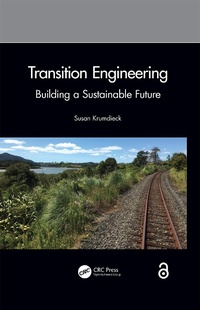
Transition Engineering
Building a Sustainable Future
1st Edition
Published on 19. September 2019
254 pages
978-1-000-69221-1 (ISBN)
Description

Transition Engineering: Building a Sustainable Future examines new strategies emerging in response to the mega-issues of global climate change, decline in world oil supply, scarcity of key industrial minerals, and local environmental constraints. These issues pose challenges for organizations, businesses, and communities, and engineers will need to begin developing ideas and projects to implement the transition of engineered systems. This work presents a methodology for shifting away from unsustainable activities. Teaching the Transition Engineering approach and methodology is the focus of the text, and the concept is presented in a way that engineers can begin applying it in their work.
The Open Access version of this book, available at http://www.taylorfrancis.com, has been made available under a Creative Commons [Attribution-Non Commercial-No Derivatives (CC-BY-NC-ND)] 4.0 license.
The Open Access version of this book, available at http://www.taylorfrancis.com, has been made available under a Creative Commons [Attribution-Non Commercial-No Derivatives (CC-BY-NC-ND)] 4.0 license.
Reviews / Votes
"Here is a book that captures the essential energy crisis of dependency on fossil fuels at a time when dramatic change is urgently needed to reduce emissions of greenhouse gases to avert the worst effects of climate instability. The book is accessible in style and uses imagery that illustrates the problems faced and the solutions available. Engineers need to increase their understanding of the huge challenges around energy that society faces, and this book helps with this understanding."Peter Guthrie, University of Cambridge, UK
"Usually, the societal transition from fossil fuels to renewable energy is discussed in terms of politics and investment. However, this historic shift also presents a huge and fascinating engineering challenge. Transition Engineering is a clear and useful guide to understanding technological issues in key aspects of energy production and usage, as they relate to a sustainable future. If you are interested in making a practical contribution to fighting climate change by redesigning industrial systems, you owe it to yourself to read this book."
Richard Heinberg, Post Carbon Institute, USA
"If you want to be challenged in the way that you think about the future role of energy in an economy that seriously tries to address the problems of finite resource depletion and climate change, then expose yourself to this book's provocative ideas on how engineering analysis can lead the way. It gets engineers to think as they are trained and inspires non-engineers to change their viewpoint and take action."
Carey King, University of Texas at Austin, USA "Here is a book that captures the essential energy crisis of dependency on fossil fuels at a time when dramatic change is urgently needed to reduce emissions of greenhouse gases to avert the worst effects of climate instability. The book is accessible in style and uses imagery that illustrates the problems faced and the solutions available. Engineers need to increase their understanding of the huge challenges around energy that society faces, and this book helps with this understanding."
Peter Guthrie, University of Cambridge, UK
"Usually, the societal transition from fossil fuels to renewable energy is discussed in terms of politics and investment. However, this historic shift also presents a huge and fascinating engineering challenge. Transition Engineering is a clear and useful guide to understanding technological issues in key aspects of energy production and usage, as they relate to a sustainable future. If you are interested in making a practical contribution to fighting climate change by redesigning industrial systems, you owe it to yourself to read this book."
Richard Heinberg, Post Carbon Institute, USA
"If you want to be challenged in the way that you think about the future role of energy in an economy that seriously tries to address the problems of finite resource depletion and climate change, then expose yourself to this book's provocative ideas on how engineering analysis can lead the way. It gets engineers to think as they are trained and inspires non-engineers to change their viewpoint and take action."
Carey King, University of Texas at Austin, USA
More details
Edition
1. Auflage
Language
English
Place of publication
London
United Kingdom
Publishing group
Taylor & Francis Ltd
Target group
Professional and scholarly
Illustrations
15 Tables, black and white; 67 Illustrations, black and white
File size
8,11 MB
ISBN-13
978-1-000-69221-1 (9781000692211)
Copyright in bibliographic data and cover images is held by Nielsen Book Services Limited or by the publishers or by their respective licensors: all rights reserved.
Schweitzer Classification
Other editions
Additional editions
Book
09/2019
1st Edition
CRC Press
€171.00
Shipment within 15-20 days
Book
09/2019
1st Edition
CRC Press
€79.60
Shipment within 15-20 days
Person
Susan Krumdieck is professor in the Department of Mechanical Engineering at the University of Canterbury in New Zealand where she has taught energy transition engineering for 17 years. She is the co-founder and a Trustee of the Global Association for Transition Engineering (GATE). Professor Krumdieck serves on the editorial board for six journals, including Energies, Energy Conservation & Management and Biophysical Economics, and she has edited special issues of Energy Policy, Energies, and Sustainability.
Content
1. The Mega-Problems of Unsustainability. 2. Problems of Unsustainability. 3. Complexity and Communication. 4. Transition Engineering. 5. InTIME Models and Methods. 6. Economic Decision Support. 7. Transition Economics: Balancing Costs and Benefits. 8. Conclusion and Discussion.
