

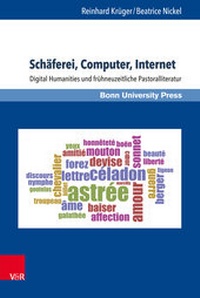
Schäferei, Computer, Internet
Digital Humanities und frühneuzeitliche Pastoralliteratur
1st Edition
Published on 10. October 2016
370 pages
978-3-8470-0626-8 (ISBN)
Description

Computergestützte Lektüren und philologisch-hermeneutische Textinterpretation miteinander zu vereinbaren oder sie füreinander nutzbar zu machen, ist Ziel dieses Bandes. In diesem Sinne kombinieren die hier vorgelegten Analysen zum frühneuzeitlichen Pastoralroman am Beispiel von Honoré d'Urfés fünfbändigem Werk L'Astrée (1607-1627) die Methoden des close und distant reading und wenden u. a. das Verfahren des sogenannten topic modeling an. Es geht den beiden Autoren dabei explizit nicht allein um quantitative Ergebnisse, sondern vor allem um inhaltsbezogene literaturwissenschaftliche Untersuchungen.
The aim of this book is to unite computer-aided lectures of literary texts with lectures that follow the philological-historical tradition: Both methods should be complementary. According to this aim, the analysis of the five-volume pastoral novel entitled L'Astrée (1607-1627) by Honoré d'Urfé will combine close and distant reading and employ the method of the so-called topic modeling. This book does not focus on quantitative results, but instead on researches in the field of literary interpretation.
The aim of this book is to unite computer-aided lectures of literary texts with lectures that follow the philological-historical tradition: Both methods should be complementary. According to this aim, the analysis of the five-volume pastoral novel entitled L'Astrée (1607-1627) by Honoré d'Urfé will combine close and distant reading and employ the method of the so-called topic modeling. This book does not focus on quantitative results, but instead on researches in the field of literary interpretation.
More details
Other editions
Additional editions
Reinhard Krüger | Beatrice Nickel
Schäferei, Computer, Internet
Digital Humanities und frühneuzeitliche Pastoralliteratur
Book
10/2016
1st Edition
Brill Deutschland
€69.00
Shipment within 7-9 days
Persons
Content
- Intro
- Title Page
- Copyright
- Table of Contents
- Body
- Vorwort
- 1. Einleitung
- 2. Überlegungen zu einer Archäologie der Digital Humanities
- 2.1 Maschinelle Simulation sprachlichen Verhaltens
- 2.2 Der Archetypus der Proteusverse
- 2.3 Kombination von Buchstaben
- 2.4 Kombination von Morphemen
- 2.5 Konrad Zuse: Die Z 3 als Kombinationsmaschine
- 2.6 Kombinatorische Texte im Computerzeitalter
- 2.7 Schreiben als Kombinatorik: Centodichtung, Edgar Allan Poe und Jorge Luis Borges
- 2.8 Globalisierung und polyglotte Wortkombinatorik von Thomas Morus bis zu James Joyce und weiter
- 2.9 James Joyce, Finnegans Wake (1939)
- 2.10 Hans G Helms: Fa:m' Ahniesgwow
- 2.11 Schach, Erzählen und Poesie
- 2.12 Alan Turing: Ein Computer spielt Schach, schreibt aber keine Sonette
- 2.13 OuLiPo: Kombinatorische contrainte und dichterische Freiheit
- 2.14 Der Cybernetic Poet von Ray Kurzweil
- 2.15 Die unkalkulierbare Innovation in poetischen Texten
- 2.16 Erzählung als Kombinatorik bei Italo Calvino
- 3. Vom gedruckten Text zum Digitalisat. Zur Editionsgeschichte eines fraktalen Romans
- 3.1 Der fraktale Text und seine Lektüre
- 3.2 Textwahrnehmung, Kognition und Interpretation. Zur computergestützten Lektüre von digitalisierten Texten
- 3.3 Digitalisierung nicht-normierter Typographie und Orthographie
- 4. Binnenformen in L'Astrée
- 4.1 Das implizite lyrische Gattungssystem in L'Astrée
- 4.2 Sonette als schriftliche Intarsien
- 4.2.1 Poetische Texte als graphische Konstrukte
- 4.2.2 Die Geschichte des Sonetts als Geschichte eines dynamischen Systems
- 4.2.3 Lektüregewohnheiten und Wahrnehmungsweisen des Sonetts
- 4.2.4 Das Sonett als Leitform der Poesie im 16. und 17. Jahrhundert
- 4.2.5 Das frühneuzeitliche Sonett und der Petrarkismus
- 4.2.6 Die Sonette in L'Astrée
- 4.2.7 Schlussbemerkung
- 4.2.8 Quantitative und qualitative Analyse des Sonettkorpus
- 4.3 Die Sprache der Bilder in L'Astrée oder: emblematisches Arkadien
- 4.3.1 Corneilles La suite du menteur oder die Lektüren einer Dienerin
- 4.3.2 Die Liebe als Motor der Kommunikation
- 4.3.3 Zur Theorie und Praxis des Emblems
- 4.3.4 Die Emblematisierung der Kommunikation
- 4.3.5 Ein Rebus als Devise
- 4.3.6 Ein Löwenamulett als Devise
- 4.3.7 Ritterliche Hirten und ihre erzählten Liebesdevisen
- 4.3.8 Königliche Embleme
- 4.3.9 >Imaginäre Embleme<
- 4.3.10 Naturwissenschaft und Kosmologie in emblematischer Ausdeutung
- 4.4 Binnenerzählungen: Inszenierte Mündlichkeit in L'Astrée
- 4.5 Inszenierung von Schriftlichkeit als Bestandteil des poetischen Textbewusstseins in der Frühen Neuzeit: Briefe in L'Astrée
- 5. 'Nonverbale' Kommunikation: Körpersprache und parasprachliche Zeichen
- 5.1 Die Körpersprache, Mimik und Gestik der Schäfer
- 5.1.1 Gekreuzte Arme
- 5.1.2 Körperliche Symptome: Erröten, Erblassen
- 5.1.3 Parasprachliche Zeichen in der Kommunikation der Schäfer
- 5.1.4 Lachen und Weinen zwischen Affektkontrolle und Pathos
- 6. Inszenierte Medialität
- 6.1 Poesie und Tanz
- 6.2 Die Erinnerung als Speichermedium von Texten
- 6.3 Inszenierte Materialität von Schrift
- 7. Der Forez als imaginäre Kulturlandschaft zwischen Stadt und Land
- 7.1 Vorbemerkungen
- 7.2 Geographische und kulturelle Bedingungen des arkadischen Traums
- 7.3 Der arkadische Forez in der Spätantike
- 7.4 Erzählte Landschaften und reale Geographie
- 7.5 Der erinnerte und der erzählte Ort
- 7.6 Zur Opposition zwischen Stadt und Land
- 8. Honnêteté als soziale Organisation des Lebens
- 8.1 Die Wechselbeziehung zwischen honnêteté und amour
- 8.2 Der Zusammenhang von honnêteté und Mäßigung
- 8.3 Honnêteté, retraite und repos auf dem Land
- 8.4 Die honnêteté als Stil des Handelns und Basis der Kommunikation
- 8.5 Herkunft der honnêteté aus dem höfischen Roman und der Ritterwelt
- 8.6 Soziale und geschlechtliche Indifferenz des honnêteté-Begriffs
- 9. Schlussbetrachtungen
- 10. Literaturverzeichnis
- 11. Abbildungsverzeichnis
- Anhang: Sonettkorpus
