

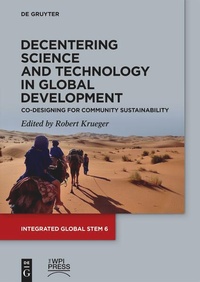
Decentering Science and Technology in Global Development
Description

Engineering and scientific interventions, especially Western interventions, in societies in the majority world, can no longer be left to the scientists and engineers coming from the west or channeling western ideals. In addressing these concerns, this volume brings new thinking, new concepts, and processes and procedures from a variety of disciplines and analytical lenses. It introduces a new development practice, from education to ideation and implementation to assessment. In the chapters, the authors, some of whom are scientists and engineers, but also anthropologists, geographers, and political scientists disentangle the socio-technical relations so that we can better understand the challenges that have befallen the global majority. The authors also integrate educational examples for how to train STEM forward professionals on how they can be agents of change, while maintaining a certain level of humility. The book offers critical and compelling insights into what is wrong with current hegemonic paradigms of development and the concepts and tools we can use to advance a different direction that promotes dignity, community self-sufficiency, and sustainability.
- Will appeal to engineers involved in technology for society projects.
- Will be of interest to social scientists and policy makers who seek to push the limits technology in the public interest.
More details
Other editions
Additional editions
Person
Robert Krueger is a human geographer whose scholarship and teaching focus on creating sustainable, socially just, improvements to development projects in the global north and south. His work has taken him around the world. He has worked in countries in North America, Europe, Asia, and Africa, on issues of economic development, technology, the circular economy to AI agents, poverty assessment, and policy and program evaluation. He is widely published in these areas with four books and dozens of peer-reviewed articles. In doing so, his work provides a clear and powerful entry point for reimagining social change.
In addition, to his books, Krueger is the author of dozens of publications on issues of urban sustainability, cities, development, and economy-environment relations. Krueger has guest edited several journal issues, including a recent one on diverse economies and the circular economy for the journal Local Environment. Krueger's research has been funded by US AID, The Templeton Foundation, the US Environmental Protection Agency, the Fonds National de la Researche, Luxembourg, the Regional Studies Association, and the Engineering Information Foundation. He has presented his research to the European Commission and the United Nations High-Level Political Forum on Sustainable Development.
Krueger has been at WPI for nearly 20 years. The first half of this career were spent working on community-based research projects in Worcester, Massachusetts and around the world. He was director of the Worcester Community Project Center and has advised award winning projects in Thailand and Namibia. Most recently, Krueger started the Development Design Lab (DDL) to support his work in Ghana and West Africa. The DDL has a wide-ranging remit that includes development, environmental, and education concerns sub-Saharan Africa, with work products in Ethiopia, Kenya, Mozambique, Namibia, Ghana, and Senegal.
