

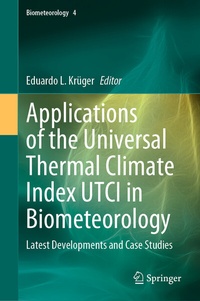
Applications of the Universal Thermal Climate Index UTCI in Biometeorology
Description

This book introduces the UTCI (Universal Thermal Climate Index) and summarizes progress in this area. The UTCI was developed as part of the European COST Action Program and first announced to the scientific community in 2009. Since then, a decade has followed of applicability tests and research results, as well as knowledge gained from applying the UTCI in human adaptation and thermal perception. These findings are of interest to researchers in the interdisciplinary areas of biometeorology, climatology and urban planning. The book summarizes this progress, discussing the limitations found and provides pointers to future developments. It also discusses UTCI applications in the areas of human biometeorology and urban planning including possibilities of using UTCI and similar indices in climate-responsive urban planning. The book's message is illustrated with many case studies from the real world.
Chapter 10 is available open access under a Creative Commons Attribution 4.0 International License via link.springer.com.
More details
Other editions
Additional editions
Person
Eduardo Krüger holds a bachelor's degree in Civil Engineering from the Catholic University of Petrópolis (1989), Brazil, a Master's Degree in Energy Planning from the Federal University of Rio de Janeiro (1993) and a Ph.D. in Architecture from Leibniz Universität Hannover, Germany (1998). Post-doctorate and sabbatical periods took place at Gurion University of the Negev, Israel (during 2005/2006) at Glasgow Caledonian University, UK (2010/2011) and at the Karslruher Institut für Technologie, KIT, Germany (2015/2016). Eduardo is currently an Associate Professor at the Federal Technological University of Paraná (UTFPR), lecturing both in the departments of Civil Construction and Architecture and Urbanism and conducting research at the Post-Graduate Program in Civil Engineering, UTFPR. Eduardo is an ad hoc consultant for several Funding Agencies in Brazil and a frequent reviewer for relevant journals from Elsevier such as Applied Energy, Building & Environment, Energy & Buildings, International Journal of Biometeorology, Science of the Total Environment, among others. He has published over 200 papers in scientific journals and conference proceedings. Research interests comprise indoor and outdoor thermal and luminous comfort, urban climatology, human biometeorology, climate-responsive building and urban design.
