

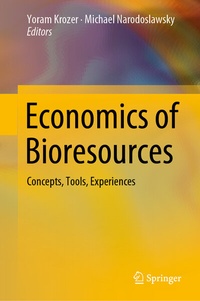
Economics of Bioresources
Description

This fundamental book provides a cross-sectoral, multi-disciplinary view on the biobased economy. It explains opportunities for the value-adding production and use of bioresources, while also discussing the main drivers and obstacles involved. The book is divided into three major parts, the first of which introduces readers to the basics of bioresource economics and engineering. In terms of economics, it discusses decision-making from the policy, producer, investor, and citizen perspectives; in terms of engineering, it addresses key technologies and the processing of bioresources, as well as the development of biorefineries for high-value products on large and small scales. In turn, the book's second part presents cases focused on different types of energy use, and written by practitioners. The cases illustrate the businesses and technologies involved, as well as the roles of citizens, social organisations and policies. The book's third and last part highlights opportunities in sustainable agriculture, valuable industrial products and innovative services, while also outlining key conditions for success.
Written by a team of scholars and practitioners from various engineering, natural-science and social-science disciplines, the book is primarily intended for undergraduate and graduate students, and for practitioners in business and policy who wish to explore the sustainable production and use of bioresources. All theoretical issues are explained with the aid of real-world examples, making the content highly accessible.
More details
Other editions
Additional editions
Persons
Michael Narodoslawsky completed his Ph.D. in Chemical Engineering at Graz University of Technology. Until retirement in 2016 he headed the research group Process Synthesis, Process Evaluation and Regional Development at the Technical University of Graz, as well as the European Commission's Working Group on Bioenergy. Currently, he co-chairs the European Sustainable Energy Innovation Alliance (eseia) Working Group on Bioresources. His chief research interests are in ecological assessment and lifecycle analysis, regional technology networks and biorefineries.
Content
1.Introduction: Yoram Krozer, Maarten Arentsen, Michael Narodoslawsky (10 pages).- Part I: Basics (20-25 pages each chapter).- 2.Bioresources basics: Michael Narodoslawsky.- 3.Bioresources for electricity: Andrej Gubina.- 4.Economic basics: Yoram Krozer.- 5.Regional capabilities: Frans Coenen.- 6.Market behavior: Boglarka Vajda and Yoram Krozer.- 7.Business development: Yoram Krozer and Petra Doelman.- 8.Policy development: Maarten Arentsen .- Part II Cases (5-10 pages each chapter).- 9.Willows for localized fuels: Sandor Bartha.- 10.Modern bio-refineries: Louis Duarte.- 11.Supplies for bioenergy markets: Devrim Yazan.- 12.Food chain waste processing: Ina Körner.- 13.Reuse of edible oils: Avinash Narayanswamy.- 14.Manure for energy: Willem van Laarhoven.
