

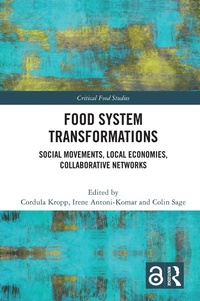
Food System Transformations
Social Movements, Local Economies, Collaborative Networks
1st Edition
Published on 28. December 2020
234 pages
978-1-000-33829-4 (ISBN)
Description

This book examines the role of local food movements, enterprises and networks in the transformation of the currently unsustainable global food system. It explores a series of innovations designed to re-integrate sustainable modes of food production and encourage food sovereignty.
It provides detailed insights into a specialised network of social actors collaborating in novel ways and creating new economic arrangements across different geographical locales. In working to devise 'local solutions to global problems', the initiatives explored in the book represent a 'second-generation' food social movement which is less preoccupied with distinctive local qualities than with building socially just food systems aimed at delivering healthy nutrition worldwide. Drawing on fieldwork undertaken in sites across Europe, the USA and Brazil, the book provides a rich collection of case studies that offer a fresh perspective on the role of grassroots action in the transition to more sustainable food production systems.
Addressing a substantive gap in the literature that falls between global analyses of the contemporary food system and highly localised case studies, the book will appeal to those teaching food studies and those conducting research on civic food initiatives or on environmental social movements more generally.
Chapters 1, 3, 7, and 8 of this book are freely available as downloadable Open Access PDFs at http://www.taylorfrancis.com under a Creative Commons Attribution-Non Commercial-No Derivatives (CC-BY-NC-ND) 4.0 license.
It provides detailed insights into a specialised network of social actors collaborating in novel ways and creating new economic arrangements across different geographical locales. In working to devise 'local solutions to global problems', the initiatives explored in the book represent a 'second-generation' food social movement which is less preoccupied with distinctive local qualities than with building socially just food systems aimed at delivering healthy nutrition worldwide. Drawing on fieldwork undertaken in sites across Europe, the USA and Brazil, the book provides a rich collection of case studies that offer a fresh perspective on the role of grassroots action in the transition to more sustainable food production systems.
Addressing a substantive gap in the literature that falls between global analyses of the contemporary food system and highly localised case studies, the book will appeal to those teaching food studies and those conducting research on civic food initiatives or on environmental social movements more generally.
Chapters 1, 3, 7, and 8 of this book are freely available as downloadable Open Access PDFs at http://www.taylorfrancis.com under a Creative Commons Attribution-Non Commercial-No Derivatives (CC-BY-NC-ND) 4.0 license.
More details
Series
Edition
1. Auflage
Language
English
Place of publication
London
United Kingdom
Publishing group
Taylor & Francis Ltd
Target group
College/higher education
Illustrations
2 Tables, black and white; 8 Line drawings, black and white; 8 Illustrations, black and white
File size
31,37 MB
ISBN-13
978-1-000-33829-4 (9781000338294)
Copyright in bibliographic data and cover images is held by Nielsen Book Services Limited or by the publishers or by their respective licensors: all rights reserved.
Schweitzer Classification
Other editions
Additional editions
Cordula Kropp | Irene Antoni-Komar | Colin Sage
Food System Transformations
Social Movements, Local Economies, Collaborative Networks
Book
01/2023
1st Edition
Routledge
€63.20
Shipment within 15-20 days
Cordula Kropp | Irene Antoni-Komar | Colin Sage
Food System Transformations
Social Movements, Local Economies, Collaborative Networks
Book
12/2020
1st Edition
Routledge
€206.30
Shipment within 15-20 days
Persons
Cordula Kropp is a sociologist and an expert for sustainability research, science technology studies, social innovation, technology and risk assessments. She is professor of sociology of environment and technology at the University of Stuttgart, Germany, and director of the Research Center for Interdisciplinary Risk and Innovation Studies (ZIRIUS).
Irene Antoni-Komar is a cultural scientist and a research associate at the Carl von Ossietzky University of Oldenburg, Germany. She works on sustainable food economy and transdisciplinary research and is co-editor of Transformative Unternehmen und die Wende in der Ernaehrungswirtschaft (2019).
Colin Sage is an independent scholar who works on the interconnections of food systems, environment and prospects for greater civic engagement around food. He is the author of Environment and Food (2012) and co-editor of Food Transgressions (2014) and Transdisciplinary Perspectives on Transitions to Sustainability (2017).
Irene Antoni-Komar is a cultural scientist and a research associate at the Carl von Ossietzky University of Oldenburg, Germany. She works on sustainable food economy and transdisciplinary research and is co-editor of Transformative Unternehmen und die Wende in der Ernaehrungswirtschaft (2019).
Colin Sage is an independent scholar who works on the interconnections of food systems, environment and prospects for greater civic engagement around food. He is the author of Environment and Food (2012) and co-editor of Food Transgressions (2014) and Transdisciplinary Perspectives on Transitions to Sustainability (2017).
Content
1. Grassroots initiatives in food system transformation: the role of food movements in the second 'Great Transformation' PART I Transformative food movements 2. Women, agroecology and "real food" in Brazil: from national movement to local practice 3. Alternative food politics: the production of urban food spaces in Leipzig (Germany) and Nantes (France) 4. Co-designing cities: urban gardening projects and the conflict between self-determination and administrative restrictions in German cities PART II Transformative food economies 5. Food cooperatives as diverse re-embedding forces: a multiple case study in Belgium 6. Innovating locally for global transformation: intermediating fluid, agroecological solutions - examples from France, the USA, Benin and South America 7. Cost effects of local food enterprises: supply chains, transaction costs and social diffusion PART III Transformative local networks 8. Transformative communities in Germany: working towards a sustainable food supply through creative doing and collaboration 9. Context-specific notions and practices of 'solidarity' in food procurement networks in Lombardy (Italy) and Massachusetts (USA) 10. Transformative governance and food practices for sustainability in and by ecovillages: a German case study 11. An anthropological reflection on urban gardening through the lens of citizenship
