

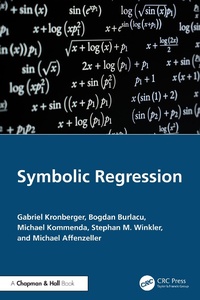
Symbolic Regression
1st Edition
Published on 16. August 2024
308 pages
978-0-429-67942-1 (ISBN)
Description

Symbolic regression (SR) is one of the most powerful machine learning techniques that produces transparent models, searching the space of mathematical expressions for a model that represents the relationship between the predictors and the dependent variable without the need of taking assumptions about the model structure. Currently, the most prevalent learning algorithms for SR are based on genetic programming (GP), an evolutionary algorithm inspired from the well-known principles of natural selection. This book is an in-depth guide to GP for SR, discussing its advanced techniques, as well as examples of applications in science and engineering.
The basic idea of GP is to evolve a population of solution candidates in an iterative, generational manner, by repeated application of selection, crossover, mutation, and replacement, thus allowing the model structure, coefficients, and input variables to be searched simultaneously. Given that explainability and interpretability are key elements for integrating humans into the loop of learning in AI, increasing the capacity for data scientists to understand internal algorithmic processes and their resultant models has beneficial implications for the learning process as a whole.
This book represents a practical guide for industry professionals and students across a range of disciplines, particularly data science, engineering, and applied mathematics. Focused on state-of-the-art SR methods and providing ready-to-use recipes, this book is especially appealing to those working with empirical or semi-analytical models in science and engineering.
The basic idea of GP is to evolve a population of solution candidates in an iterative, generational manner, by repeated application of selection, crossover, mutation, and replacement, thus allowing the model structure, coefficients, and input variables to be searched simultaneously. Given that explainability and interpretability are key elements for integrating humans into the loop of learning in AI, increasing the capacity for data scientists to understand internal algorithmic processes and their resultant models has beneficial implications for the learning process as a whole.
This book represents a practical guide for industry professionals and students across a range of disciplines, particularly data science, engineering, and applied mathematics. Focused on state-of-the-art SR methods and providing ready-to-use recipes, this book is especially appealing to those working with empirical or semi-analytical models in science and engineering.
More details
Edition
1. Auflage
Language
English
Place of publication
London
United Kingdom
Publishing group
Taylor & Francis Ltd
Target group
College/higher education
Professional and scholarly
Illustrations
33 Tables, black and white; 100 Line drawings, color; 36 Line drawings, black and white; 100 Illustrations, color; 36 Illustrations, black and white
ISBN-13
978-0-429-67942-1 (9780429679421)
Copyright in bibliographic data and cover images is held by Nielsen Book Services Limited or by the publishers or by their respective licensors: all rights reserved.
Schweitzer Classification
Other editions
Additional editions
Gabriel Kronberger | Bogdan Burlacu | Michael Kommenda
Symbolic Regression
Book
approx. 07/2026
1st Edition
Chapman & Hall/CRC
€65.00
Not yet published
Gabriel Kronberger | Bogdan Burlacu | Michael Kommenda
Symbolic Regression
Book
08/2024
1st Edition
Routledge
€145.20
Shipment within 10-20 days
Persons
The authors are all affiliated with the University of Applied Sciences (UAS) Upper Austria.
Gabriel Kronberger is professor for data engineering and business intelligence. His research interests are symbolic regression and machine learning as well as probabilistic graphical models.
Bogdan Burlacu is a research assistant. His main focus is the study of genetic programming evolutionary dynamics in symbolic regression scenarios.
Michael Kommenda is a research assistant. He has been applying symbolic regression methods in various industrial projects and application scenarios.
Stephan M. Winkler is professor for medical and bioinformatics and head of the bioinformatics research group. His research interests despite bioinformatics include genetic programming, nonlinear model identification and machine learning.
Michael Affenzeller is professor for heuristic optimization and machine learning and head of the Heuristic and Evolutionary Algorithms Laboratory. Furthermore, he is the vice dean for research and overall head of the COMET project for heuristic optimization in production and logistics (HOPL).
Gabriel Kronberger is professor for data engineering and business intelligence. His research interests are symbolic regression and machine learning as well as probabilistic graphical models.
Bogdan Burlacu is a research assistant. His main focus is the study of genetic programming evolutionary dynamics in symbolic regression scenarios.
Michael Kommenda is a research assistant. He has been applying symbolic regression methods in various industrial projects and application scenarios.
Stephan M. Winkler is professor for medical and bioinformatics and head of the bioinformatics research group. His research interests despite bioinformatics include genetic programming, nonlinear model identification and machine learning.
Michael Affenzeller is professor for heuristic optimization and machine learning and head of the Heuristic and Evolutionary Algorithms Laboratory. Furthermore, he is the vice dean for research and overall head of the COMET project for heuristic optimization in production and logistics (HOPL).
Content
Contents
Preface
Symbols and Notation
1. Introduction
2. Basics of Supervised Learning
3. Basics of Symbolic Regression
4. Evolutionary Computation and Genetic Programming
5. Model Validation, Inspection, Simplification and Selection
6. Advanced Techniques
7. Examples and Applications
8. Conclusion
Appendix
Bibliography
Preface
Symbols and Notation
1. Introduction
2. Basics of Supervised Learning
3. Basics of Symbolic Regression
4. Evolutionary Computation and Genetic Programming
5. Model Validation, Inspection, Simplification and Selection
6. Advanced Techniques
7. Examples and Applications
8. Conclusion
Appendix
Bibliography
