

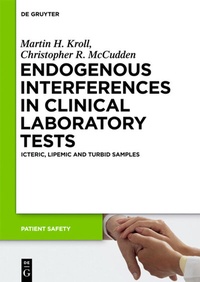
Endogenous Interferences in Clinical Laboratory Tests
Description

The goal of clinical laboratories is to produce accurate information for clinical decision making in medicine. More than half of the medical decisions made depend on clinical laboratory tests.
Patient safety represents an important and critical problem for laboratories. They need to assure that the information they deliver to physicians is accurate, and therefore safe for clinicians to use. Endogenous compounds can interfere with laboratory tests, decreasing accuracy and threatening patient safety. Elevated bilirubin (bilirubinemia) and elevated lipids (lipemia) are common conditions that cause significant interferences with laboratory results. Clinicians depend on laboratories to detect these endogenous interferences. Laboratories must have a means to detect these endogenous interferences, make decisions about reporting results, and evaluate their impact.
Most clinical pathology books provide only an abbreviated introduction to the subject, or provide a long list of references, without the necessary foundation for evaluating their significance. Package inserts typically provide scant information. This book provides the empirical and theoretical foundation for these interferences, describes the clinical settings where they occur, and explains their evaluation and detection, allowing the laboratory to interpret the available data on interferences and make the appropriate decision to effectively report test results while protecting patient safety.
More details
Other editions
Additional editions
Persons
Content
2 - 1 Accuracy Goals for Laboratory Tests [Seite 13]
2.1 - 1.1 Accuracy and Precision [Seite 13]
2.1.1 - 1.1.1 Definition [Seite 13]
2.1.2 - 1.1.2 Imprecision as a Form of Error [Seite 14]
2.2 - 1.2 Types of Error [Seite 14]
2.2.1 - 1.2.1 Bias [Seite 14]
2.2.2 - 1.2.2 Impact of Bias [Seite 16]
2.3 - 1.3 Interference as a Type of Bias [Seite 18]
2.4 - 1.4 References [Seite 20]
3 - 2 Nature of Interferences [Seite 23]
3.1 - 2.1 Definition [Seite 23]
3.2 - 2.2 Nature of Interferences [Seite 23]
3.3 - 2.3 Instrumentation [Seite 24]
3.4 - 2.4 The Chemistry of the Absorbance of Light [Seite 27]
3.5 - 2.5 References [Seite 32]
4 - 3 The Nature of Icteric Interference [Seite 33]
4.1 - 3.1 Source Information on Bilirubin Interference [Seite 33]
4.2 - 3.2 Allen Correction as a Source of Bilirubin Interference [Seite 33]
4.3 - 3.3 Bilirubin Interference with Oximetry [Seite 34]
4.3.1 - 3.3.1 Co-oximetry Interference [Seite 36]
4.3.2 - 3.3.2 Pulse Oximetry [Seite 37]
4.3.3 - 3.3.3 Cerebral Oximetry [Seite 38]
4.3.4 - 3.3.4 Interference with Methemoglobin [Seite 39]
4.4 - 3.4 Chemical Reactions as a Cause of Bilirubin Interference [Seite 40]
4.4.1 - 3.4.1 Bilirubin Reaction with Creatinine Methods [Seite 41]
4.4.2 - 3.4.2 Bilirubin Reactions with Peroxidase Methods [Seite 43]
4.5 - 3.5 References [Seite 44]
5 - 4 The Nature of Lipemic and Turbidity Interferences [Seite 47]
5.1 - 4.1 Types of Interferences [Seite 47]
5.2 - 4.2 Lipemia Causes Turbidity [Seite 48]
5.3 - 4.3 Lipemia Interference Mechanisms [Seite 49]
5.3.1 - 4.3.1 Light Scattering [Seite 49]
5.3.2 - 4.3.2 Lipoprotein Particles [Seite 52]
5.3.3 - 4.3.3 Intralipid® and Lipemia Simulation [Seite 54]
5.3.4 - 4.3.4 Empirical Studies in Lipemia Turbidity [Seite 55]
5.4 - 4.4 Lipoprotein Particles and Lipemia [Seite 56]
5.5 - 4.5 References [Seite 57]
6 - 5 Measurement of Interference [Seite 59]
6.1 - 5.1 A Typical Commercial Study [Seite 59]
6.2 - 5.2 Guidelines for Interference Studies [Seite 60]
6.3 - 5.3 Bilirubin [Seite 61]
6.4 - 5.4 Intralipid® [Seite 62]
6.5 - 5.5 Procedure to Make Five Concentrations [Seite 64]
6.6 - 5.6 Interference Criteria [Seite 64]
6.7 - 5.7 Data Analysis [Seite 66]
6.8 - 5.8 References [Seite 72]
7 - 6 Origin of Icteric Samples [Seite 75]
7.1 - 6.1 The Origin of Bilirubin [Seite 75]
7.2 - 6.2 Bilirubin Toxicity [Seite 77]
7.3 - 6.3 Transport of Bilirubin in the Blood [Seite 77]
7.4 - 6.4 Uptake of Bilirubin by the Liver [Seite 78]
7.5 - 6.5 Clinical Aspects of Bilirubin [Seite 78]
7.6 - 6.6 Neonatal Jaundice [Seite 79]
7.7 - 6.7 Cholestasis [Seite 81]
7.8 - 6.8 Hepatitis [Seite 82]
7.9 - 6.9 Alcoholic Liver Disease [Seite 82]
7.10 - 6.10 Hemolysis [Seite 83]
7.11 - 6.11 Drug Induced Hyperbilirubinemia [Seite 83]
7.12 - 6.12 Summary [Seite 84]
7.13 - 6.13 References [Seite 84]
8 - 7 Impact of Icterus [Seite 87]
8.1 - 7.1 Introduction [Seite 87]
8.2 - 7.2 Estimated Impacts Based on Interference Studies [Seite 87]
8.3 - 7.3 Differential Interference with Different Bilirubin Isoforms [Seite 89]
8.4 - 7.4 Non-spectrophotometric Icterus Interference [Seite 91]
8.5 - 7.5 Resolving Icterus Interference [Seite 92]
8.6 - 7.6 Summary [Seite 93]
8.7 - 7.7 References [Seite 93]
9 - 8 Origin of Lipemia and Turbidity [Seite 95]
9.1 - 8.1 Lipoprotein Pathways [Seite 95]
9.2 - 8.2 Classification of Hypertriglyceridemia [Seite 97]
9.2.1 - 8.2.1 Frederickson Classification of Dyslipidemias [Seite 97]
9.2.2 - 8.2.2 Obesity, Metabolic Syndrome and Diabetes [Seite 99]
9.2.3 - 8.2.3 Alcohol [Seite 100]
9.2.4 - 8.2.4 Nonalcoholic Fatty-liver Disorder [Seite 101]
9.2.5 - 8.2.5 Medications [Seite 101]
9.2.6 - 8.2.6 HIV Infection [Seite 101]
9.2.7 - 8.2.7 Renal Disease [Seite 102]
9.3 - 8.3 References [Seite 103]
10 - 9 Impact of Lipemia/Turbidity [Seite 105]
10.1 - 9.1 Introduction [Seite 105]
10.2 - 9.2 Estimated Impacts Based on Interference Studies [Seite 107]
10.2.1 - 9.2.1 Interference by Light Scattering [Seite 107]
10.2.2 - 9.2.2 Interference by Volume Displacement [Seite 108]
10.2.3 - 9.2.3 Interference by Lipid Partitioning [Seite 111]
10.3 - 9.3 Summary [Seite 111]
10.4 - 9.4 References [Seite 111]
11 - 10 Endogenous Interferences in Clinical Laboratory Tests: Icteric, Lipemic and Turbid Samples [Seite 113]
11.1 - 10.1 Interference Indices [Seite 113]
11.2 - 10.2 Generating Interference Indices [Seite 113]
11.2.1 - 10.2.1 Preparation of Standards [Seite 114]
11.2.2 - 10.2.2 Data Collection and Deconvolution of Non-Target Interferences [Seite 115]
11.2.2.1 - 10.2.2.1 Subtraction Using Selected Wavelengths [Seite 116]
11.2.2.2 - 10.2.2.2 Index Calculation Using Derivative Spectrometry [Seite 117]
11.2.3 - 10.2.3 Establishing Indices and Defining Ranges [Seite 119]
11.3 - 10.3 Limitations [Seite 122]
11.4 - 10.4 Summary [Seite 122]
11.5 - 10.5 References [Seite 123]
12 - 11 Reporting of Results [Seite 125]
12.1 - 11.1 Introduction [Seite 125]
12.2 - 11.2 Procedures for Handling Samples with Interference Within the Laboratory [Seite 125]
12.3 - 11.3 Reporting of Results in Icteric and Turbid Samples [Seite 127]
12.4 - 11.4 Autoverification and Reporting Algorithms [Seite 128]
12.5 - 11.5 Practical Issues: Education and Implementation [Seite 129]
12.6 - 11.6 References [Seite 130]
13 - 12 Analyte-dependent Interference [Seite 131]
13.1 - 12.1 Complex Interferences [Seite 131]
13.1.1 - 12.1.1 Model for Analyte-dependent Interference [Seite 132]
13.1.2 - 12.1.2 Examples of Analyte-Dependent Interference [Seite 133]
13.2 - 12.2 Statistical Testing for Significance [Seite 141]
13.3 - 12.3 Failure to Design the Interference Study [Seite 145]
13.4 - 12.4 Advantages of Using Multiple Regression Analysis [Seite 145]
13.5 - 12.5 Concluding Remarks [Seite 147]
13.6 - 12.6 References [Seite 149]
14 - Index [Seite 151]
