

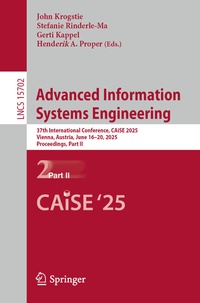
Advanced Information Systems Engineering
37th International Conference, CAiSE 2025, Vienna, Austria, June 16-20, 2025, Proceedings, Part II
Published on 14. June 2025
XXIII, 343 pages
978-3-031-94571-7 (ISBN)
Description

The two-volume set LNCS 15701 + 15702 constitutes the proceedings of the 37th International Conference on Advanced Information Systems Engineering, CAiSE 2025, which was held in Vienna, Austria, during June 16-17, 2025.
The 35 papers included in the proceedings were carefully reviewed and selected from 229 submissions. They were organized in topical sections as follows:
Part I: Modelling with LLM; Security; Sustainability; Chatbots and social networks; process monitoring; IS-development and usage; pre-processing and forecasting;
Part II: Comprehension, explanation and recommendation; process discovery; system architecture and privacy; conformance-checking; cloud systems; extending process modelling; ontologies and knowledge graphs.
More details
Series
Language
English
Place of publication
Cham
Switzerland
Publishing group
Springer International Publishing
Target group
Professional and scholarly
Product notice
Reflowable
Illustrations
XXIII, 343 p. 101 illus., 71 illus. in color.
File size
29,83 MB
ISBN-13
978-3-031-94571-7 (9783031945717)
DOI
10.1007/978-3-031-94571-7
Schweitzer Classification
Other editions
Additional editions
John Krogstie | Stefanie Rinderle-Ma | Gerti Kappel
Advanced Information Systems Engineering
37th International Conference, CAiSE 2025, Vienna, Austria, June 16-20, 2025, Proceedings, Part II
Book
06/2025
Springer
€80.24
Shipment within 15-20 days
