

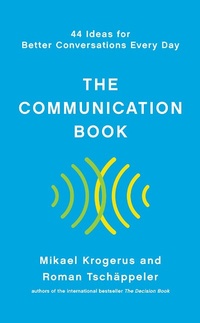
The Communication Book
44 Ideas for Better Conversations Every Day
Published on 4. February 2020
208 pages
978-1-324-00199-7 (ISBN)
Description

Mikael Krogerus and Roman Tschäppeler have tested the 44 most important communication theories and distilled them in book form, alongside clear and entertaining illustrations.
- Want better conversations? Ask open-ended questions that have no right or wrong answers—make your partner feel brilliant.
- Want better meetings? Ban smartphones, use a timer, and make everyone stand up.
- Want better business deals? Focus on the thing, rather than the person; on similarities, rather than differences; and on good outcomes, rather than perfect ones.
Whether you want to present ideas more clearly, improve your small talk, or master the art of introspection, The Communication Book delivers, fusing theoretical knowledge and practical advice in a small but mighty package. With sections on work, the self, relationships and language, this book is indispensable for anyone who wants to improve what they say, and how they say it.
More details
Other editions
Additional editions
Mikael Krogerus | Roman Tschappeler
The Communication Book
44 Ideas for Better Conversations Every Day
Book
03/2020
WW Norton & Co
€18.50
Shipment within 15-20 days
Persons
Mikael Krogerus is a freelance journalist and an editor with Das Magazin, the weekly supplement to Switzerland's biggest newspaper.
Content
- Intro
- Title
- Contents
- Introduction: We Need to Talk
- Job and Career
- 1. Six Principles of Persuasion
- 2. Rules of Meetings
- 3. Boss Talk
- 4. The Salami Tactic
- 5. Theory of Rhetoric
- 6. Storytelling
- 7. Principled Negotiation
- 8. The Feedback Method
- 9. Groupthink
- 10. The Power Method
- 11. Intercultural Communication
- Self and Knowledge
- 12. Self-Talk
- 13. Active Listening
- 14. Small Talk
- 15. The Iceberg Model
- 16. The Spiral of Silence
- 17. The Speech Act Theory
- 18. The Social Judgment Theory
- 19. The Sorry Matrix
- 20. White Lies
- 21. The Six-Word Rule
- Love and Friendship
- 22. Watzlawick's Axiom Theory
- 23. Proust's Questionnaire
- 24. Nonviolent Communication
- 25. The Cooperative Principle
- 26. The Expectancy Violations Theory
- 27. Schulz von Thun's Communication Model
- 28. Game Theory
- 29. Second-Order Observation
- 30. Transactional Analysis
- 31. Parenting Tips
- 32. L'Esprit de l'escalier
- Words and Meanings
- 33. The Framing Effect
- 34. McLuhan's Media Theory
- 35. The FoMO Phenomenon
- 36. Lasswell's Communication Model
- 37. The Uses and Gratifications Theory
- 38. The Encoding/Decoding Model
- 39. Visual Communication
- 40. Euphemisms
- 41. Sophism
- 42. The Cultivation Theory
- 43. The Standpoint Theory
- Conclusion
- 44. The Peak-End Rule
- Sources
- Thanks
- The Authors
- Copyright
