

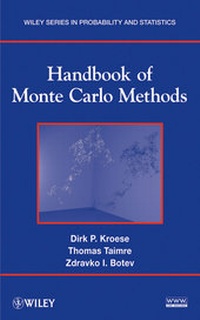
Handbook of Monte Carlo Methods
Description

More details
Other editions
Additional editions
Persons
Thomas Taimre, PhD, is a Postdoctoral Research Fellow at The University of Queensland. He currently focuses his research on Monte Carlo methods and simulation, from the theoretical foundations to performing computer implementations.
Zdravko I. Botev, PhD, is a Postdoctoral Research Fellow at the University of Montreal (Canada). His research interests include the splitting method for rare-event simulation and kernel density estimation. He is the author of one of the most widely used free MATLAB® statistical software programs for nonparametric kernel density estimation.
Content
Acknowledgments.
1 Uniform Random Number Generation.
1.1 Random Numbers.
1.2 Generators Based on Linear Recurrences.
1.3 Combined Generators.
1.4 Other Gnerators.
1.5 Tests for Random Number Generators.
References.
2 Quasirandom Number Generation.
2.1 Multidimensional Integration.
2.2 Van der Corput and Digital Sequences.
2.3 Halton Sequences.
2.4 Faure Sequences.
2.5 Sobol' Sequences.
2.6 Lattice Methods.
2.7 Randomization and Scrambling.
References.
3 Random Variable Generation.
3.1 Generic Algorithms Based on Common Transformations.
3.2 Copulas.
3.3 Generation Methods for Various Random Objects.
References.
4 Probability Distributions.
4.1 Discrete Distributions.
4.2 Continuous Distributions.
4.3 Multivariate Distributions.
References.
5 Random Process Generation.
5.1 Gaussian Processes.
5.2 Markov Chains.
5.3 Markov Jump Processes.
5.4 Poisson Processes.
5.5 Wiener Process and Brownian Motion.
5.6 Stochastic Differential Equations and Diffusion Processes.
5.7 Brownian Bridge.
5.8 Geometric Brownian Motion.
5.9 Ornstein-Uhlenbeck Process.
5.10 Reflected Brownian Motion.
5.11 Fractional Brownian Motion.
5.12 Random Fields.
5.13 Lévy Processes.
5.14 Time Series.
References.
6 Markov Chain Monte Carlo.
6.1 Metropolis-Hastings Algorithm.
6.2 Gibbs Sampler.
6.3 Specialized Samplers.
6.4 Implementation Issues.
6.5 Perfect Sampling.
References.
7 Discrete Event Simulation.
7.1 Simulation Models.
7.2 Discrete Event Systems.
7.3 Event-Oriented Approach.
7.4 More Examples of Discrete Event Simulation.
References.
8 Statistical Analysis of Simulation Data.
8.1 Simulation Data.
8.2 Estimation of Performance Measures for Independent Data.
8.3 Estimation of Steady-State Performance Measures.
8.4 Emprical Cdf.
8.5 Kernal Density Estimation.
8.6 Resampling and the Bootstrap Method.
8.7 Goodness of Fit.
References.
9 Variance Reduction.
9.1 Variance Reduction Example.
9.2 Antithetic Random Variables.
9.3 Control Variables.
9.4 Conditional Monte Carlo.
9.5 Stratified Sampling.
9.6 Latin Hypercube Sampling.
9.7 Importance Scaling.
9.8 Quasi Monte Carlo
References.
10 Rare-Event Simulation.
10.1 Efficiency of Estimators.
10.2 Importance Sampling Methods for Light Tails.
10.3 Conditioning Methods for Heavy Tails.
10.4 State-Dependent Importance Sampling.
10.5 Cross-Entropy Method for Rare-Event Simulation.
10.6 Splitting Method.
References.
11 Estimation of Derivatives.
11.1 Gradient Estimation.
11.2 Finite Difference Method.
11.3 Infinitesimal Perturbation Analysis.
11.4 Score Function Method.
11.5 Weak Deriatives.
11.6 Sensitivity Analysis for Regenerative Processes.
References.
12 Randomized Optimization.
12.1 Stochastic Approximation.
12.2 Stochastic Counterpart Method.
12.3 Simulated Annealing.
12.4 Evolutionary Algorithms.
12.5 Cross-Entropy Method for Optimization.
12. 6 Other Randomized Optimization Techniques.
References.
13 Cross-Entropy Method.
13.1 Cross-Entropy Method.
13.2 Cross-Entropy Method for Estimation.
13.3 Cross-Entropy Method for Optimization.
References.
14 Particle Methods.
14.1 Sequential Monte Carlo.
14.2 Particle Splitting.
14.3 Splitting for Static Rare-Event Probability Estimaton.
14.4 Adaptive Splitting Algorithm.
14.5 Estimation of Multidimensional Integrals.
14.6 Combinatorial Optimization via Splitting.
14.7 Markov Chain Monte Carlo With Splitting.
References.
15 Applications to Finance.
15.1 Standard Model.
15.2 Pricing via Monte Carlo Simulation.
15.3 Sensitivities.
References.
16 Applications to Network Reliability.
16.1 Network Reliability.
16.2 Evolution Model for a Static Network.
16.3 Conditional Monte Carlo.
16.4 Importance Sampling for Network Reliability.
16.5 Splitting Method.
References.
17 Applications to Differential Equations.
17. 1 Connections Between Stochastic and Partial Di_erential Equations.
17.2 Transport Processes and Equations.
17.3 Connections to ODEs Through Scaling.
References.
Appendix A: Probability and Stochastic Processes.
Appendix B: Elements of Mathematical Statistics.
Appendix C: Optimization.
Appendix D: Miscellany.
References.
Acronyms and Abbreviations.
List of Symbols.
List of Distributions.
Index.
