

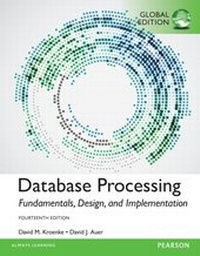
Database Processing: Fundamentals, Design, and Implementation, Global Edition
Description

For undergraduate database management courses.
Get Students Straight to the Point of Database Processing
Database Processing: Fundamentals, Design, and Implementation reflects a new teaching and professional workplace environment and method that gets students straight to the point with its thorough and modern presentation of database processing fundamentals.
The full text downloaded to your computer
With eBooks you can:
- search for key concepts, words and phrases
- make highlights and notes as you study
- share your notes with friends
eBooks are downloaded to your computer and accessible either offline through the Bookshelf (available as a free download), available online and also via the iPad and Android apps.
Upon purchase, you'll gain instant access to this eBook.
Time limit
The eBooks products do not have an expiry date. You will continue to access your digital ebook products whilst you have your Bookshelf installed.
All prices
More details
Other editions
Additional editions
Persons
David worked for the US Air Force and Boeing Computer Services. He was a principal in the startup of three companies, serving as the vice president of product marketing and development for the Microrim Corporation and as chief of database technologies for Wall Data, Inc. He is the father of the semantic object data model. David's consulting clients have included IBM, Microsoft, and Computer Sciences Corporations, as well as numerous smaller companies. Recently, David has focused on using information systems for teaching collaboration and teamwork.
David J. Auer is a senior instructor emeritus at the College of Business (CBE) of Western Washington University in Bellingham, WA. He served as Director of Information Systems and Technology Services at CBE from 1994 to 2014 and taught in CBE's Department of Decision Sciences from 1981 to 2015. Auer has taught CBE courses in quantitative methods, production and operations management, statistics, finance, and management information systems. Besides managing CBE's computer, network, and other technology resources, he also teaches management information systems courses. He has taught the principles of management information systems and business database development courses, and he was responsible for developing CBE's network infrastructure courses, including Computer Hardware and Operating Systems, Telecommunications, and Network Administration.
He holds a bachelor's degree in English literature from the University of Washington, and three degrees from Western Washington University¿-¿a bachelor's degree in mathematics and economics, a master's degree in economics, and a master's degree in counselling psychology. He served as a commissioned officer in the US Air Force, and he has also worked as an organisational development specialist and therapist for an employee assistance program (EAP).
Content
- Part I: Getting Started
- 1. Introduction
- 2. Introduction to Structured Query Language
- Part II: Database Design
- 3.The Relational Model and Normalization
- 4. Database Design Using Normalization
- 5. Data Modeling and the Entity-Relationship Model
- 6. Transforming Data Models in Database Designs
- Part III: Database Implementation
- 7.SQL for Database Construction and Application Processing
- 8. Database Redesign
- Part IV: Multiuser Database Processing
- 9. Managing Multiuser Databases
- 10.Managing Databases with SQL Server 2014, Oracle Database 12c, and MySQL 5.7
- Part V: Database Access Standards
- 11. The Web Server Environment
- 12. Big Data, Data Warehouses, and Business Intelligence Systems
