

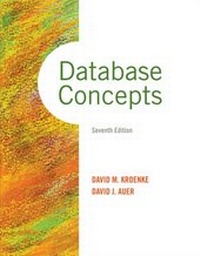
Database Concepts, Global Edition
1st Edition
Published on 26. January 2015
528 pages
978-1-292-07624-9 (ISBN)
Description

For undergraduate database management students or business professionals Heres practical help for understanding, creating, and managing small databasesfrom two of the worlds leading database authorities. Database Concepts by David Kroenke and David Auer gives undergraduate database management students and business professionals alike a firm understanding of the concepts behind the software, using Access 2013 to illustrate the concepts and techniques. Three projects run throughout the text, to show students how to apply the concepts to real-life business situations. The text provides flexibility for choosing the software instructors want to use in class, allows students to work with new, complete databases, including Wedgewood Pacific Corporation, Heather Sweeney Designs, and Wallingford Motors, and includes coverage for some of the latest information on databases available.Teaching and Learning Experience This text will provide a better teaching and learning experiencefor you and your students. Here's how: Provides a firm understanding of the concepts behind the software Uses Access 2013 to illustrate the concepts and techniques while also providing flexibility to choose the software used in class Allows students to work with new, complete databases Includes coverage of some of the latest information available
More details
Other editions
Additional editions
David Kroenke | David M. Kroenke | David J. Auer
Database Concepts, Global Edition
Book
01/2015
7th Edition
Pearson Education Limited
€96.99
Shipment within 10-20 days
Content
- Cover
- Brief Contents
- Contents
- Part I: Database Fundamentals
- Chapter 1: Getting Started: An Overview of Databases
- Why Use a Database?
- Problems with Lists
- Using Relational Database Tables
- Processing Relational Tables
- What Is a Database System?
- The Database
- The DBMS
- Personal Versus Enterprise-Class Database Systems
- What Is a NoSQL Database?
- The Access Workbench Section 1-Getting Started with Microsoft Access
- Summary
- Key Terms
- Review Questions
- Exercises
- Access Workbench Key Terms
- Access Workbench Exercises
- San Juan Sailboat Charters Case Questions
- Garden Glory Project Questions
- James River Jewelry Project Questions (See Online Appendix D)
- The Queen Anne Curiosity Shop Project Questions
- Chapter 2: The Relational Model and Database Normalization
- Relations
- A Sample Relation and Two Nonrelations
- A Note on Presenting Relation Structures
- A Note on Terminology
- Types of Keys
- Composite Keys
- Candidate and Primary Keys
- Surrogate Keys
- Foreign Keys and Referential Integrity
- The Problem of Null Values
- Functional Dependencies and Normalization
- Functional Dependencies
- Primary and Candidate Keys Revisited
- Normalization
- Relational Design Principles
- The Normalization Process
- Normalization Examples
- Eliminating Anomalies from Multivalued Dependencies
- Normal Forms: One Step at a Time
- The Access Workbench Section 2-Working with Multiple Tables in Microsoft Access
- Summary
- Key Terms
- Review Questions
- Exercises
- Access Workbench Key Terms
- Access Workbench Exercises
- Regional Labs Case Questions
- Garden Glory Project Questions
- James River Jewelry Project Questions (See Online Appendix D)
- The Queen Anne Curiosity Shop Project Questions
- Chapter 3: Structured Query Language
- An Example Database
- Does Not Work with Microsoft Access ANSI-89 SQL
- SQL for Data Definition (DDL)-Creating Tables and Relationships
- Defining Primary Keys with Table Constraints
- Defining Foreign Keys with the Table Constraints
- Submitting SQL to the DBMS
- SQL for Data Manipulation (DML)-Inserting Data
- Inserting Data
- SQL for Data Manipulation (DML)-Single Table Queries
- The SQL SELECT/FROM/WHERE Framework
- Reading Specified Columns from a Single Table
- Reading Specified Rows from a Single Table
- Reading Specified Columns and Specified Rows from a Single Table
- Ranges, Wildcards, and Nulls in WHERE Clauses
- Sorting the Results of a Query
- SQL Built-in Functions and Calculations
- Built-in Functions and Grouping
- SQL for Data Manipulation (DML)- Multiple Table Queries
- Querying Multiple Tables with Subqueries
- Querying Multiple Tables with Joins
- The SQL JOIN ON Syntax
- Inner Joins and Outer Joins
- SQL for Data Manipulation (DML)-Data Modification and Deletion
- Modifying Data
- Deleting Data
- SQL for Data Definition (DDL)-Table and Constraint Modification and Deletion
- The SQL DROP TABLE Statement
- The SQL ALTER TABLE Statement
- The SQL TRUNCATE TABLE Statement
- The CHECK Constraint
- SQL Views
- The Access Workbench Section 3-Working with Queries in Microsoft Access
- Summary
- Key Terms
- Review Questions
- Exercises
- Access Workbench Key Terms
- Access Workbench Exercises
- Heather Sweeney Designs Case Questions
- Garden Glory Project Questions
- James River Jewelry Project Questions (See Online Appendix D
- The Queen Anne Curiosity Shop Project Questions
- Part 2: Database Design
- Chapter 4: Data Modeling and the Entity-Relationship Model
- Requirements Analysis
- The Entity-Relationship Data Model
- Entities
- Attributes
- Identifiers
- Relationships
- Entity-Relationship Diagrams
- Variations of the E-R Model
- The IE Crow's Foot E-R Model
- Weak Entities
- ID-Dependent Entities
- Non-ID-Dependent Weak Entities
- Associative Entities
- Subtype Entities
- Recursive Relationships
- Developing an Example E-R Diagram
- Heather Sweeney Designs
- The Seminar Customer List
- The Customer Form Letter
- The Sales Invoice
- Attribute Specifications
- Business Rules
- Validating the Data Model
- The Access Workbench Section 4-Prototyping Using Microsoft Access
- Summary
- Key Terms
- Review Questions
- Exercises
- Access Workbench Key Terms
- Access Workbench Exercises
- Highline University Mentor Program Case Questions
- Washington State Patrol Case Questions
- Garden Glory Project Questions
- James River Jewelry Project Questions (See Online Appendix D)
- The Queen Anne Curiosity Shop Project Questions
- Chapter 5: Database Design
- The Purpose of a Database Design
- Transforming a Data Model into a Database Design
- Representing Entities with the Relational Model
- Representing the ITEM Entity
- Representing the CUSTOMER Entity
- Denormalization
- A Relational Design for the SALES_COMMISSION Entity
- Representing Weak Entities
- Representing Relationships
- Relationships Between Strong Entities
- Relationships Using Weak Entities
- Relationships with Subtypes
- Representing Recursive Relationships
- Database Design at Heather Sweeney Designs
- Weak Entities
- Verifying Normalization
- Specifying Column Properties
- Relationships
- Enforcing Referential Integrity
- The Access Workbench Section 5-Relationships in Microsoft Access
- Summary
- Key Terms
- Review Questions
- Exercises
- Access Workbench Key Terms
- Access Workbench Exercises
- San Juan Sailboat Charters Case Questions
- Washington State Patrol Case Questions
- Garden Glory Project Questions
- James River Jewelry Project Questions (See Online Appendix D)
- The Queen Anne Curiosity Shop Project Questions
- Part 3: Database Management
- Chapter 6: Database Administration and Management
- The Heather Sweeney Designs Database
- The Need for Control, Security, and Reliability
- Concurrency Control
- The Need for Atomic Transactions
- Concurrent Transaction Processing
- The Lost Update Problem
- Resource Locking
- Serializable Transactions
- Deadlock
- Optimistic Versus Pessimistic Locking
- SQL Transaction Control Language and Declaring Lock Characteristics
- Consistent Transactions
- Transaction Isolation Level
- Cursor Types
- Database Security
- User Accounts
- User Processing Rights and Responsibilities
- DBMS-Level Security
- Application-Level Security
- Database Backup and Recovery
- Recovery via Reprocessing
- Recovery via Rollback and Rollforward
- Additional DBA Responsibilities
- The Access Workbench Section 6-Database Administration in Microsoft Access
- Summary
- Key Terms
- Review Questions
- Exercises
- Access Workbench Key Terms
- Access Workbench Exercises
- Marcia's Dry Cleaning Case Questions
- Garden Glory Project Questions
- James River Jewelry Project Questions (See Online Appendix D)
- The Queen Anne Curiosity Shop Project Questions
- Chapter 7: Database Processing in Applications
- The Database Processing Environment
- Queries, Forms, and Reports
- Client/Server and Traditional Application Processing
- SQL/PSM: User-Defined Functions, Stored Procedures, and Triggers
- Web Application Database Processing
- ODBC
- Web Processing with the Microsoft IIS
- Getting Started with HTML Web Pages
- The index.html Web Page
- Creating the index.html Web Page
- Web Database Processing Using PHP
- Updating a Table with PHP
- Challenges for Web Database Processing
- SQL Injection Attacks
- Database Processing and XML
- The Importance of XML
- XML as a Markup Language
- XML and Database Processing
- XML Web Services
- The Access Workbench Section 7-Web Database Processing Using Microsoft Access
- Summary
- Key Terms
- Review Questions
- Exercises
- Access Workbench Exercises
- Marcia's Dry Cleaning Case Questions
- Garden Glory Project Questions
- James River Jewelry Project Questions (See Online Appendix D)
- The Queen Anne Curiosity Shop Project Questions
- Chapter 8: Big Data, Data Warehouses, and Business Intelligence Systems
- Business Intelligence Systems
- The Relationship Between Operational and BI Systems
- Reporting Systems and Data Mining Applications
- Reporting Systems
- Data Mining Applications
- Data Warehouses and Data Marts
- The Components of a Data Warehouse
- Data Warehouses Versus Data Marts
- Dimensional Databases
- OLAP
- Distributed Database Processing
- Types of Distributed Databases
- Challenges of Distributed Databases
- Object-Relational Databases
- Big Data and the Not Only SQL Movement
- Column Family Databases
- MapReduce
- Hadoop
- The Access Workbench Section 8-Business Intelligence Systems Using Microsoft Access
- Summary
- Key Terms
- Review Questions
- Exercises
- Access Workbench Exercises
- Marcia's Dry Cleaning Case Questions
- Garden Glory Project Questions
- James River Jewelry Project Questions
- The Queen Anne Curiosity Shop Project Questions
- Online Appendices
- Glossary
- Index
