

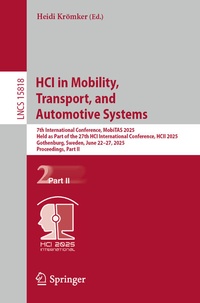
HCI in Mobility, Transport, and Automotive Systems
Description

This book constitutes the refereed proceedings of the 7th International Conference on HCI in Mobility, Transport, and Automotive Systems, MobiTAS 2025, held as part of the 27th HCI International Conference, HCII 2025, which took place in Gothenburg, Sweden, during June 22-27, 2025.
The total of 1430 papers and 355 posters included in the HCII 2025 proceedings was carefully reviewed and selected from 7972 submissions.
The MobiTAS 2025 proceedings were organized in the following topical sections- Human-Autonomous Vehicle Interaction and User Experience; User Interfaces and Interaction Methods for Mobility; Trust, Transparency, and Comfort in Automated Driving; Pedestrian Interaction and Road Safety in Automated Mobility.
More details
Other editions
Additional editions
Person
Content
Trust, Transparency, and Comfort in Automated Driving
A Predictive Model of User Experience in Driving Simulators: Examining the Impact of Individual Differences.- Human-Centric Design for Next-Generation Infotainment Systems.- Determinants of Autonomous Vehicle Adoption Among Croatian Residents.- Influence of Automobile Brand on the Structure of Initial Trust in Driving Automation.- Research on the Interaction Design of Sense of Control in Intelligent Driving Scenarios.- Generated User Interfaces for Human-AI Interaction in Cars: Evaluation of AI-generated motion sickness notifications in automated cars.- Investigating the Mitigation of Stress in Autonomous and Non-autonomous Vehicles using LLM Feedback.- Factors Influencing Perceived Comfort during Driver Take-overs in Automated Driving.- Impacts of Transparency Direction and Level on Trust and Intention to Use in Autonomous Driving.-
Pedestrian Interaction and Road Safety in Automated Mobility
Evaluating Pedestrian Behavior in Virtual Reality for Traffic Education Using Eye Tracking.- I'm Going to Stop, Will You Cross?: The Impact of Vehicle's eHMI on Pedestrian's Decision-Making.- Safety Effects of Yellow Alert on Changeable Message Signs: The Driving Simulator Experiment.- Influence of Modulation Frequency and Feedback Diameter on Gesture Control with Mid-air Haptics in a Driving Simulator.- Modelling Driver Intervention Tendencies in Connected and Automated Vehicles: A Survey-Based Investigation.- Bifocal Effect of Gaze on Crossing Behavior.- Effectiveness of Information Presentation by Gaze Timing Consistent with Roles in Collision Avoidance.-
Advances in Transport and Mobility
Safety Effects of Yellow Alert on Changeable Message Sign: A Survey Study.- Introducing Diversity Personas in Gender-Responsive Mobility Planning.- A Novel System for Predicting the Arrival Times of Public Buses in Developing Countries.- Sensitization to Appropriate Use of Electric Scooters to Avoid their Banning.- Satisfaction, Acceptance and Use Patterns of a New E-Cargo Bike Sharing System - First Results from A German Living Lab Study.
