

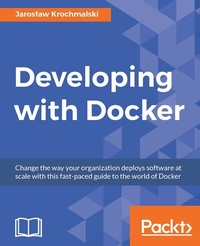
Developing with Docker
Learn to automate your deployments with Docker
Published on 13. January 2025
262 pages
978-1-78646-633-4 (ISBN)
Description

Change the way your organization deploys software at scale with this fast-paced guide to the world of Docker
Key Features
[*] Cut through the noise and in simple terms learn to package your applications and test, ship, and scale your containers
[*] Find and build images and successfully run your programs within containers
[*] Build, deploy, and test your Docker containers and put them to work in production
Book DescriptionThis fast-paced practical guide will get you up and running with Docker. Using Docker, you will be able to build, ship, and run many distributed applications in real time. You will start with quickly installing Docker and start working with images and containers. We will present different types of containers and their applications, and show you how to find and build images. You will learn how you can contribute to the image repository by publishing different images. This will familiarize you with the image building process and you will be able to successfully run your programs within containers. By finishing this book, you will be well equipped in deploying your applications using Docker and will have a clear understanding of concepts, techniques, and practical methods to get it running in production systems. What you will learn
[*] Understand Docker's architecture
[*] Build, ship, and run distributed applications
[*] Deploy, automate, and manage the execution of applications within Docker
[*] Scale and virtualize images and containers
[*] Utilize the networking features that Docker offers
[*] Use repositories to store and retrieve images
Who this book is forThis book is for IT professionals, system administrators, and DevOps professionals or anyone looking to quickly develop and deploy software to production at scale. If you are interested in Docker, DevOps, or containers in general, don't look any further.
Key Features
[*] Cut through the noise and in simple terms learn to package your applications and test, ship, and scale your containers
[*] Find and build images and successfully run your programs within containers
[*] Build, deploy, and test your Docker containers and put them to work in production
Book DescriptionThis fast-paced practical guide will get you up and running with Docker. Using Docker, you will be able to build, ship, and run many distributed applications in real time. You will start with quickly installing Docker and start working with images and containers. We will present different types of containers and their applications, and show you how to find and build images. You will learn how you can contribute to the image repository by publishing different images. This will familiarize you with the image building process and you will be able to successfully run your programs within containers. By finishing this book, you will be well equipped in deploying your applications using Docker and will have a clear understanding of concepts, techniques, and practical methods to get it running in production systems. What you will learn
[*] Understand Docker's architecture
[*] Build, ship, and run distributed applications
[*] Deploy, automate, and manage the execution of applications within Docker
[*] Scale and virtualize images and containers
[*] Utilize the networking features that Docker offers
[*] Use repositories to store and retrieve images
Who this book is forThis book is for IT professionals, system administrators, and DevOps professionals or anyone looking to quickly develop and deploy software to production at scale. If you are interested in Docker, DevOps, or containers in general, don't look any further.
All prices
More details
Edition
Digital original
Language
English
Place of publication
Birmingham
United Kingdom
Target group
Professional and scholarly
US School Grade: College Graduate Student
Edition type
Digital original
File size
20,30 MB
ISBN-13
978-1-78646-633-4 (9781786466334)
Copyright in bibliographic data and cover images is held by Nielsen Book Services Limited or by the publishers or by their respective licensors: all rights reserved.
Schweitzer Classification
Other editions
Additional editions
Jaros¿aw Krochmalski
Developing with Docker
Book
11/2016
Packt Publishing
€55.60
Shipment within 3-4 weeks
Person
Krochmalski Jaroslaw :
Jaroslaw Krochmalski is a passionate software designer and developer who specializes in the financial business domain. He has over 12 years of experience in software development. He is a clean-code and software craftsmanship enthusiast. He is a Certified Scrum Master and a fan of Agile. His professional interests include new technologies in web application development, design patterns, enterprise architecture, and integration patterns. He has been designing and developing software professionally since 2000 and has been using Java as his primary programming language since 2002. In the past, he worked for companies such as Kredyt Bank (KBC) and Bank BPS on many large-scale projects such as international money orders, express payments and collection systems. He currently works as a consultant in Danish company 7N as an IT architect for the Nykredit bank. You can reach him via Twitter at @jkroch or by e-mail at jarek@finsys.pl. I would like to say hello to my friends at 7N and Nykredit, keep up the great job! Krochmalski Jaroslaw :
Jaros?aw Krochmalski is a passionate software designer and developer who specializes in the financial business domain. He has over 12 years of experience in software development. He is a clean-code and software craftsmanship enthusiast. He is a Certified Scrum Master and a fan of Agile. His professional interests include new technologies in web application development, design patterns, enterprise architecture, and integration patterns. He has been designing and developing software professionally since 2000 and has been using Java as his primary programming language since 2002. In the past, he worked for companies such as Kredyt Bank (KBC) and Bank BPS on many large-scale projects such as international money orders, express payments, and collection systems. He currently works as a consultant at Danish company 7N as an infrastructure architect for the Nykredit bank. You can reach him via Twitter at @jkroch or by e-mail at jarek@finsys.pl.
Jaroslaw Krochmalski is a passionate software designer and developer who specializes in the financial business domain. He has over 12 years of experience in software development. He is a clean-code and software craftsmanship enthusiast. He is a Certified Scrum Master and a fan of Agile. His professional interests include new technologies in web application development, design patterns, enterprise architecture, and integration patterns. He has been designing and developing software professionally since 2000 and has been using Java as his primary programming language since 2002. In the past, he worked for companies such as Kredyt Bank (KBC) and Bank BPS on many large-scale projects such as international money orders, express payments and collection systems. He currently works as a consultant in Danish company 7N as an IT architect for the Nykredit bank. You can reach him via Twitter at @jkroch or by e-mail at jarek@finsys.pl. I would like to say hello to my friends at 7N and Nykredit, keep up the great job! Krochmalski Jaroslaw :
Jaros?aw Krochmalski is a passionate software designer and developer who specializes in the financial business domain. He has over 12 years of experience in software development. He is a clean-code and software craftsmanship enthusiast. He is a Certified Scrum Master and a fan of Agile. His professional interests include new technologies in web application development, design patterns, enterprise architecture, and integration patterns. He has been designing and developing software professionally since 2000 and has been using Java as his primary programming language since 2002. In the past, he worked for companies such as Kredyt Bank (KBC) and Bank BPS on many large-scale projects such as international money orders, express payments, and collection systems. He currently works as a consultant at Danish company 7N as an infrastructure architect for the Nykredit bank. You can reach him via Twitter at @jkroch or by e-mail at jarek@finsys.pl.
Content
Table of Contents
Introduction to Docker
Installing Docker
Understand images and containers
Networking and persistent storage
Finding Images
Building images
Running Containers
Publishing images
Using Docker in Development
Appendix (More resources)
Introduction to Docker
Installing Docker
Understand images and containers
Networking and persistent storage
Finding Images
Building images
Running Containers
Publishing images
Using Docker in Development
Appendix (More resources)

