

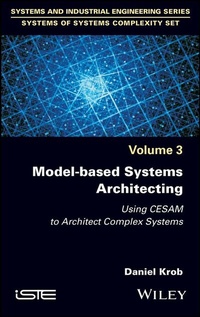
Model-based Systems Architecting
Description

It presents the CESAMES Systems Architecting Method (CESAM), a systems architecting and modeling framework which has been developed since 2003 in close interaction with many leading industrial companies, providing rigorous and unambiguous semantics for all classical systems architecture concepts. This approach is practically robust and easy-to-use: during the last decade, it was deployed in more than 2,000 real system development projects within the industry, and distributed to around 10,000 engineers around the globe.
Daniel Krob is one of the leading world experts in systems architecting and engineering. He was Institute Professor at Ecole Polytechnique, Palaiseau, France, and founder and Director of its Industrial Chair dedicated to complex systems engineering for more than 15 years. He is currently President of the Center of Excellence on Systems Architecture, Management, Economy & Strategy (CESAMES) and has been an INCOSE Fellow since 2014.
More details
Other editions
Additional editions
Person
Content
Preface ix
Acknowledgments xv
Introduction xvii
Chapter 1 Introduction to CESAM 1
1.1 CESAM: a mathematically sound system modeling framework 1
1.2 CESAM: a framework focused on complex integrated systems 8
1.3 CESAM: a collaboration-oriented architecting framework 12
1.4 CESAM: a business-oriented framework 16
Chapter 2 Why Architecting Systems? 19
2.1 Product and project systems 19
2.2 The complexity threshold 22
2.3 Addressing systems architecting becomes key 25
2.4 The value of systems architecting 31
2.5 The key role of systems architects 34
2.6 How to analyze a systems architect profile? 36
Chapter 3 CESAM Framework 39
3.1 Elements of systemics 39
3.1.1 Interface 39
3.1.2 Environment of a system 41
3.2 The three architectural visions 42
3.2.1 Architectural visions definition 42
3.2.2 Architectural visions overview 46
3.2.3 Relationships between the three architectural visions 52
3.2.4 Organization of a system model 55
3.3 CESAM systems architecture pyramid 57
3.3.1 The three key questions to ask 57
3.3.2 The last question that shall not be forgotten 59
3.4 More systems architecture dimensions 60
3.4.1 Descriptions versus expected properties 60
3.4.2 Descriptions 62
3.4.3 Expected properties 73
3.5 CESAM systems architecture matrix 78
Chapter 4 Identifying Stakeholders: Environment Architecture 83
4.1 Why identify stakeholders? 83
4.2 The key deliverables of environment architecture 85
4.2.1 Stakeholder hierarchy diagram 85
4.2.2 Environment diagram 87
Chapter 5 Understanding Interactions with Stakeholders: Operational Architecture 91
5.1 Why understand interactions with stakeholders? 91
5.2 The key deliverables of operational architecture 94
5.2.1 Need architecture diagram 94
5.2.2 Lifecycle diagram 95
5.2.3 Use case diagrams 97
5.2.4 Operational scenario diagrams 99
5.2.5 Operational flow diagram 101
Chapter 6 Defining What the System Shall Do: Functional Architecture 103
6.1 Why understand what the system does? 103
6.2 The key deliverables of functional architecture 105
6.2.1 Functional requirement architecture diagram 106
6.2.2 Functional mode diagram 108
6.2.3 Functional breakdown and interaction diagrams 109
6.2.4 Functional scenario diagrams 111
6.2.5 Functional flow diagram 112
Chapter 7 Deciding How the System Shall be Formed: Constructional Architecture 115
7.1 Understanding how the system is formed? 115
7.2 The key deliverables of constructional architecture 117
7.2.1 Constructional requirement architecture diagram 118
7.2.2 Configuration diagram 120
7.2.3 Constructional breakdown and interaction diagram 121
7.2.4 Constructional scenario diagram 123
7.2.5 Constructional flow diagram 124
Chapter 8 Taking into Account Failures: Dysfunctional Analysis 127
8.1 Systems do not always behave as they should 127
8.2 The key deliverables of dysfunctional analysis 134
8.2.1 Dysfunctional analysis from an operational perspective 135
8.2.2 Dysfunctional analysis from a functional perspective 136
8.2.3 Dysfunctional analysis from a constructional perspective 138
Chapter 9 Choosing the Best Architecture: Trade-off Techniques 141
9.1 Systems architecting does not usually lead to a unique solution 141
9.2 Trade-off techniques 143
9.2.1 General structure of a trade-off process 143
9.2.2 Managing trade-offs in practice 145
Conclusion 149
Appendices 157
Appendix 1 System Temporal Logic 159
Appendix 2 Classical Engineering Issues 163
Appendix 3 Example of System Model Managed with CESAM 177
Appendix 4 Implementing CESAM through a SysML Modeling Tool 199
Appendix 5 Some Good Practices in Systems Modeling 209
References 211
Index 219
Preface
CESAMES and the CESAM Community
The CESAM Community, which disseminates the CESAM method and is the origin of this book, is managed by CESAMES, a non-profit organization created under the French law of July 1, 1901.
CESAMES emerged in 2009, as a spin-off of the "Engineering of Complex Systems" industrial chair of Ecole Polytechnique, the leading engineering university in France, with the objective of promoting systems architecting in academia and industry. To do so, CESAMES organizes awareness events all year long that allow scientists and industrialists to meet and to share about complex industrial systems. As an example, since 2010 CESAMES has organized on a yearly basis the "Complex Systems Design & Management" (CSD&M) international conference series. This event - that now alternates between France and Asia - gathers each year more than 300 academic and professional participants, coming from all parts of the world. CESAMES also manages working groups and professional workshops, always with the same goal: increasing awareness about systems architecting methods and tools.
Thanks to these events, CESAMES has federated a significant international community of systems architects and engineers who all share the same vision: systems architecting and engineering represent a key factor of competitiveness for companies that has to be developed.
In order to reinforce its visibility and to get more influence at a worldwide level, CESAMES decided in 2017 to manage its activities through the "CESAM Community" banner. However, the mission of the CESAM Community remained of course the same: sharing good practices in enterprise and systems architecture among the community and attesting the competences of the community members in these domains through the CESAM certification.
More precisely, the CESAM Community works to achieve the following:
- - Make architecture a key tool for business competitiveness by disseminating its use within companies and by communicating the results of its implementation through the visibility and communication actions managed by the CESAM Community.
- - Propose and develop the best practices of systems architecture in industry and services, through the creation of dedicated publications and the sharing of returns on experience between systems architects and engineers during the events of the community.
- - Propose reference systems architectures, based on the generic CESAM systems architecting methodology, that are specific to some industrial sectors in order to facilitate the work of systems architects and engineers within these sectors.
- - Facilitate access to the CESAM method and develop its use in France and worldwide.
CESAMES Systems Architecting Method (CESAM)
The CESAM Community and its members act as the initial developers and contributors of the CESAMES Systems Architecting Method (CESAM), which is presented in more detail in this book.
The CESAM is a systems architecting and modeling framework, developed since 2003 in close interaction with many industrial leading companies. It is dedicated to the working systems architects, engineers or modelers in order to help them to better master the complex integrated systems they are dealing with in their day-to-day professional life.
The CESAM framework indeed has a number of unique features:
- 1) First of all, CESAM has sound mathematical fundamentals, which are providing a rigorous and unambiguous semantics to all introduced architectural concepts. This first property is clearly key for ensuring an efficient and real understanding1 between the stakeholders of a system development project (which is often key for ensuring the success of such projects).
- 2) These bases ensure that CESAM is a logically complete lean systems modeling framework: in other terms, the architectural views proposed by CESAM are just necessary and sufficient to model any integrated system. This second property guarantees both the completeness of a CESAM system model and that no useless modeling work will be done when using CESAM.
- 3) Finally, CESAM is practically robust and easy to use both by systems architects and systems modelers. This was indeed pragmatically observed among the very large number of concrete systems within many industrial areas (aeronautics, automotive, civil engineering, defense and security, energy, railway, space, etc.) that were modeled and architected using CESAM.
Note also that the CESAM framework - due to the right level of abstraction - can be implemented and used with both all existing systems modeling frameworks and systems modeling software tools2 available on the market.
Last but not least, one shall finally point out, as already stated, that CESAM intends both to propose a generic architecting framework, as introduced in this book, and to progressively offer specific concrete reference systems architectures for a number of industrial application domains in order to facilitate the work of the systems architects and engineers within these areas.
How to read this book?
This book on model-based systems architecting with CESAM is organized in order to be read in many different ways. Typical reading modes are presented below depending on the reader's objectives.
- - Discovering what a system is from a pragmatic perspective: the Introduction is an introductory section that introduces systems from a purely practical point of view.
- - Understanding systems architecting fundamentals: Chapter 1 is dedicated to the reader who wants to discover the sound logical basis the CESAM framework relies upon.
- - Being aware of systems architecting benefits: you may only read Chapter 2 where the main motivations of systems architecting are described.
- - Getting an overview of the CESAM framework: you shall then focus on Chapter 3 where all the core CESAM systems architecture concepts are presented.
- - Practicing systems architecting: a systems architect shall know how to model a system, as well as, much more deeply, what are the needs that the system shall satisfy since they will be the compass to be used in order to regularly make the right design decisions. We thus recommend systems architects to read first Chapter 2 to be aware of the main motivations of systems architecting. You may then pass to Chapter 3 up to Chapter 9 in order to get a good overview of the CESAM framework, then learn the main systemic views and their connection with dysfunctional/safety analyses, and how to use them within an architectural decision process (which is discussed in Chapter 9). Conclusion will finally provide you some indications on how to progress in systems architecting.
- - Analyzing systems safety: a safety expert shall know how to feed the dysfunctional/safety analyses with relevant systems architecture information. The connections between systems architecture and dysfunctional/safety analyses are explained in Chapter 8.
- - Modeling systems: read first Chapter 3 to get an overview of CESAM systems architecture views and follow then from Chapter 4 up to Chapter 7 in order to learn one by one what are the views requested to model completely an integrated system. A last step may be to end by Appendix 3 where you can find a rather complete CESAM model on a realistic case study.
The proposed agenda
This model-based systems architecting which uses CESAM to architect complex systems is organized into 10 chapters, with the addition of some appendices specifically dedicated to more specialized material, as described below.
- - Introduction - Systems, which is intended for readers with only a little system background knowledge.
- - Chapter 1 - Introduction to CESAM that may be skipped for the first approach.
- - Chapter 2 - Why Architecting Systems? Which presents the main motivations of the systems architecting approach and of the CESAM framework.
- - Chapter 3 - CESAM Framework that provides an overview of all CESAM concepts.
- - Chapters 4 to 7 that present in detail, one after the other, each architectural vision of the CESAM systems modeling framework:
- - Chapter 4 - Identifying Stakeholders: Environment Architecture.
- - Chapter 5 - Understanding Interactions with Stakeholders: Operational Architecture.
- - Chapter 6 - Defining What the System Shall Do: Functional Architecture.
- - Chapter 7 - Deciding How the System Shall be Formed: Constructional Architecture.
- - Chapter 8 - Taking into Account Failures: Dysfunctional Analysis which discusses the nature of the connection existing between systems architecture and dysfunctional/safety analyses.
- - Chapter 9 - Choosing the Best Architecture: Trade-off Techniques that introduces systems architecture prioritization, a key tool for the systems architect.
- - Conclusion, which gives some hints to the reader on how to continue the systems architecting...
