

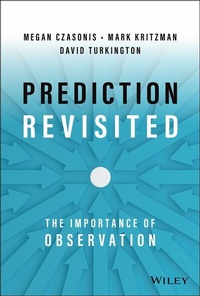
Prediction Revisited
Description

In Prediction Revisited: The Importance of Observation, a team of renowned experts in the field of data-driven investing delivers a ground-breaking reassessment of the delicate science of prediction for anyone who relies on data to contemplate the future. The book reveals why standard approaches to prediction based on classical statistics fail to address the complexities of social dynamics, and it provides an alternative method based on the intuitive notion of relevance.
The authors describe, both conceptually and with mathematical precision, how relevance plays a central role in forming predictions from observed experience. Moreover, they propose a new and more nuanced measure of a prediction's reliability. Prediction Revisited also offers:
* Clarifications of commonly accepted but less commonly understood notions of statistics
* Insight into the efficacy of traditional prediction models in a variety of fields
* Colorful biographical sketches of some of the key prediction scientists throughout history
* Mutually supporting conceptual and mathematical descriptions of the key insights and methods discussed within
With its strikingly fresh perspective grounded in scientific rigor, Prediction Revisited is sure to earn its place as an indispensable resource for data scientists, researchers, investors, and anyone else who aspires to predict the future from the data-driven lessons of the past.
More details
Other editions
Additional editions
Persons
MARK KRITZMAN is a Founding Partner and CEO of Windham Capital Management. He is also a Founding Partner of State Street Associates and teaches a graduate course at the Massachusetts Institute of Technology.
DAVID TURKINGTON is Senior Managing Director and Head of State Street Associates.
Content
Essential Concepts xi
Preface xv
1 Introduction 1
Relevance 2
Informativeness 3
Similarity 4
Roadmap 4
2 Observing Information 7
Observing Information Conceptually 7
Central Tendency 8
Spread 9
Information Theory 10
The Strong Pull of Normality 14
A Constant of Convenience 17
Key Takeaways 18
Observing Information Mathematically 20
Average 20
Spread 21
Information Distance 24
Observing Information Applied 26
Appendix 2.1: On the Inflection Point of the Normal Distribution 32
References 39
3 Co-occurrence 41
Co-occurrence Conceptually 41
Correlation as an Information-Weighted Average of Co-occurrence 46
Pairs of Pairs 49
Across Many Attributes 50
Key Takeaways 52
Co-occurrence Mathematically 54
The Covariance Matrix 58
Co-occurrence Applied 59
References 66
4 Relevance 67
Relevance Conceptually 67
Informativeness 68
Similarity 72
Relevance and Prediction 73
How Much Have You Regressed? 74
Partial Sample Regression 76
Asymmetry 80
Sensitivity 86
Memory and Bias 87
Key Takeaways 88
Relevance Mathematically 90
Prediction 95
Equivalence to Linear Regression 97
Partial Sample Regression 100
Asymmetry 102
Relevance Applied 107
Appendix 4.1: Predicting Binary Outcomes 114
Predicting Binary Outcomes Conceptually 114
Predicting Binary Outcomes Mathematically 116
References 121
5 Fit 123
Fit Conceptually 123
Failing Gracefully 125
Why Fit Varies 126
Avoiding Bias 129
Precision 130
Focus 133
Key Takeaways 134
Fit Mathematically 136
Components of Fit 138
Precision 139
Fit Applied 143
6 Reliability 149
Reliability Conceptually 149
Key Takeaways 153
Reliability Mathematically 155
Reliability Applied 163
References 168
7 Toward Complexity 169
Toward Complexity Conceptually 169
Learning by Example 170
Expanding on Relevance 171
Key Takeaways 175
Toward Complexity Mathematically 177
Complexity Applied 183
References 183
8 Foundations of Relevance 185
Observations and Relevance: A Brief Review of the Main Insights 186
Spread 187
Co-occurrence 187
Relevance 188
Asymmetry 188
Fit and Reliability 189
Partial Sample Regression and Machine Learning Algorithms 189
Abraham de Moivre (1667-1754) 190
Pierre-Simon Laplace (1749-1827) 192
Carl Friedrich Gauss (1777-1853) 193
Francis Galton (1822-1911) 195
Karl Pearson (1857-1936) 197
Ronald Fisher (1890-1962) 199
Prasanta Chandra Mahalanobis (1893-1972) 200
Claude Shannon (1916-2001) 202
References 206
Concluding Thoughts 209
Perspective 209
Insights 210
Prescriptions 210
Index 211
1
Introduction
We rely on experience to shape our view of the unknown, with the notable exception of religion. But for most practical purposes we lean on experience to guide us through an uncertain world. We process experiences both naturally and statistically; however, the way we naturally process experiences often diverges from the methods that classical statistics prescribes. Our purpose in writing this book is to reorient common statistical thinking to accord with our natural instincts.
Let us first consider how we naturally process experience. We record experiences as narratives, and we store these narratives in our memory or in written form. Then when we are called upon to decide under uncertainty, we recall past experiences that resemble present circumstances, and we predict that what will happen now will be like what happened following similar past experiences. Moreover, we instinctively focus more on past experiences that were exceptional rather than ordinary because they reside more prominently in our memory.
Now, consider how classical statistics advises us to process experience. It tells us to record experiences not as narratives, but as data. It suggests that we form decisions from as many observations as we can assemble or from a subset of recent observations, rather than focus on observations that are like current circumstances. And it advises us to view unusual observations with skepticism. To summarize:
Natural Process
- Records experiences as narratives.
- Focuses on experiences that are like current circumstances.
- Focuses on experiences that are unusual.
Classical Statistics
- Record experiences as data.
- Include observations irrespective of their similarity to current circumstances.
- Treat unusual observations with skepticism.
The advantage of the natural process is that it is intuitive and sensible. The advantage of classical statistics is that by recording experiences as data we can analyze experiences more rigorously and efficiently than would be allowed by narratives. Our purpose is to reconcile classical statistics with our natural process in a way that secures the advantages of both approaches.
We accomplish this reconciliation by shifting the focus of prediction away from the selection of variables to the selection of observations. As part of this shift in focus from variables to observations, we discard the term variable. Instead, we use the word attribute to refer to an independent variable (something we use to predict) and the word outcome to refer to a dependent variable (something we want to predict). Our purpose is to induce you to think foremost of experiences, which we refer to as observations, and less so of the attributes and outcomes we use to measure those experiences. This shift in focus from variables to observations does not mean we undervalue the importance of choosing the right variables. We accept its importance. We contend, however, that the choice of variables has commanded disproportionately more attention than the choice of observations. We hope to show that by choosing observations as carefully as we choose variables, we can use data to greater effect.
Relevance
The underlying premise of this book is that some observations are relevant, and some are not-a distinction that we argue receives far less attention than it deserves. Moreover, of those that are relevant, some observations are more relevant than others. By separating relevant observations from those that are not, and by measuring the comparative relevance of observations, we can use data more effectively to guide our decisions. As suggested by our discussion thus far, relevance has two components: similarity and unusualness. We formally refer to the latter as informativeness. This component of relevance is less intuitive than similarity but is perhaps more foundational to our notion of relevance; therefore, we tackle it first.
Informativeness
Informativeness is related to information theory, the creation of Claude Shannon, arguably the greatest genius of the twentieth century.1 As we discuss in Chapter 2, information theory posits that information is inversely related to probability. In other words, observations that are unusual contain more information than those that are common. We could stop here and rest on Shannon's formidable reputation to validate our inclusion of informativeness as one of the two components of relevance. But it never hurts to appeal to intuition. Therefore, let us consider the following example.
Suppose we would like to measure the relationship between the performance of the stock market and a collection of economic attributes (think variables) such as inflation, interest rates, energy prices, and economic growth. Our initial thought might be to examine how stock returns covary with changes in these attributes. If these economic attributes behaved in an ordinary way, it would be difficult to tell which of the attributes were driving stock returns or even if the performance of the stock market was instead responding to hidden forces. However, if one of the attributes behaved in an unusual way, and the stock market return we observed was also notable, we might suspect that these two occurrences are linked by more than mere coincidence. It could be evidence of a fundamental relationship. We provide a more formal explanation of informativeness in Chapter 2, but for now let us move on to similarity.
Similarity
Imagine you are a health care professional charged with treating a patient who has contracted a life-threatening disease. It is your job to decide which treatment to apply among a variety of available treatments. You might consider examining the outcomes of alternative treatments from as large a sample of patients with the same disease as you can find, reasoning that a large sample should produce more reliable guidance than a small sample. Alternatively, you might focus on a subset of the large sample comprising only patients of a similar age, with similar health conditions, and with similar behavior regarding exercise and smoking. The first approach of using as large a sample as possible to evaluate treatments would undoubtedly yield the more robust treatment; that is, the treatment that would help, at least to some extent, the largest number of patients irrespective of each person's specific features. But the second approach of focusing on a targeted subset of similar patients is more likely to identify the most effective treatment for the specific patient under your care.
We contrived these examples to lend intuition to the notions of informativeness and similarity. In most cases, though, informativeness and similarity depend on nuances that we would fail to detect by casual inspection. Moreover, it is important that we combine an observation's informativeness and similarity in proper proportion to determine its relevance. This would be difficult, if not impossible, to do informally.
Fortunately, we have discovered how to measure informativeness, similarity, and therefore relevance, in a mathematically precise way. The recipe for doing so is one of the key insights of this book. However, before we reveal it, we need to establish a new conceptual and mathematical foundation for observing data. By viewing common statistical measures through a new lens, we hope to bring clarity to certain statistical concepts that, although they are commonly accepted, are not always commonly understood. But our purpose is not to present these new statistical concepts merely to enlighten you; rather, we hope to equip you with tools that will enable you to make better predictions.
Roadmap
Here is what awaits you. In Chapter 2, we lay out the foundations of our approach to observing information from data. In Chapter 3, we characterize patterns between multiple attributes. In Chapter 4, we introduce relevance and show how to use it to form predictions. In Chapter 5, we discuss how to measure confidence in predictions by considering the tradeoff between relevance and noise. In Chapter 6, we apply this new perspective to evaluate the efficacy of prediction models. In Chapter 7, we compare our relevance-based approach to prediction to machine learning algorithms. And lastly, in Chapter 8, we provide biographical sketches of some of the key scientists throughout history who established the theoretical foundation that underpins our notion of relevance.
In each chapter, we first present the material conceptually, leaning heavily on intuition. And we highlight the key takeaways from our conceptual exposition. Then, we present the material again, but this time mathematically. We conclude each chapter with an empirical application of the concepts, which builds upon itself as we progress through the chapters.
If you are strongly disinclined toward mathematics, you can pass by the math and concentrate only on the prose, which is sufficient to convey the key concepts of this book. In fact, you can think of this book as two books: one written in the language of poets and one written in the language of mathematics, although you may conclude we are not very good at poetry.
We expect some readers will view our key insight about relevance skeptically, because it calls into question notions about statistical analysis that are deeply entrenched in beliefs from earlier training. To get the most out of this book, we ask you to suspend these beliefs and give us a chance to...
