

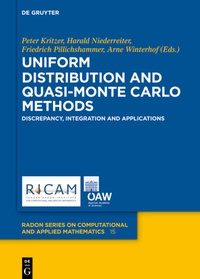
Uniform Distribution and Quasi-Monte Carlo Methods
Description

This book is summarizing the results of the workshop "Uniform Distribution and Quasi-Monte Carlo Methods" of the RICAM Special Semester on "Applications of Algebra and Number Theory" in October 2013.
The survey articles in this book focus on number theoretic point constructions, uniform distribution theory, and quasi-Monte Carlo methods. As deterministic versions of the Monte Carlo method, quasi-Monte Carlo rules enjoy increasing popularity, with many fruitful applications in mathematical practice, as for example in finance, computer graphics, and biology.
The goal of this book is to give an overview of recent developments in uniform distribution theory, quasi-Monte Carlo methods, and their applications, presented by leading experts in these vivid fields of research.
More details
Other editions
Additional editions
Persons
Content
2 - Contents [Seite 7]
3 - Metric number theory, lacunary series and systems of dilated functions [Seite 11]
3.1 - 1 Uniform distribution modulo 1 [Seite 12]
3.2 - 2 Metric number theory [Seite 14]
3.3 - 3 Discrepancy [Seite 16]
3.4 - 4 Lacunary series [Seite 17]
3.5 - 5 Almost everywhere convergence [Seite 20]
3.6 - 6 Sums involving greatest common divisors [Seite 22]
4 - Strong uniformity [Seite 27]
4.1 - 1 Introduction [Seite 27]
4.2 - 2 Superuniformity and super-duper uniformity [Seite 36]
4.2.1 - 2.1 Superuniformity of the typical billiard paths [Seite 36]
4.2.2 - 2.2 Super-duper uniformity of the 2-dimensional ray [Seite 47]
4.3 - 3 Superuniformmotions [Seite 51]
4.3.1 - 3.1 Billiards in other shapes [Seite 51]
4.3.2 - 3.2 Superuniformity of the geodesics on an equifacial tetrahedron surface [Seite 52]
5 - Discrepancy theory and harmonic analysis [Seite 55]
5.1 - 1 Introduction [Seite 55]
5.2 - 2 Exponential sums [Seite 56]
5.3 - 3 Fourier analysis methods [Seite 59]
5.3.1 - 3.1 Rotated rectangles [Seite 59]
5.3.2 - 3.2 The lower bound for circles [Seite 61]
5.3.3 - 3.3 Further remarks [Seite 63]
5.4 - 4 Dyadic harmonic analysis: discrepancy function estimates [Seite 64]
5.4.1 - 4.1 Lp -discrepancy, 1 < p < [Seite 4.1 Lp -discrepancy, 1 < p < ]
8 - 65 [Seite 65]
5.4.2 - 4.2 The L8 [Seite 4.2 The L8]
discrepancy estimates - 66 [Seite 66]
5.4.3 - 4.3 The other endpoint, L1 [Seite 4.3 The other endpoint, L1]
- 68 [Seite 68]
6 - Explicit constructions of point sets and sequences with low discrepancy [Seite 73]
6.1 - 1 Introduction [Seite 73]
6.2 - 2 Lower bounds [Seite 75]
6.3 - 3 Upper bounds [Seite 77]
6.4 - 4 Digital nets and sequences [Seite 79]
6.5 - 5 Walsh series expansion of the discrepancy function [Seite 81]
6.6 - 6 The construction of finite point sets according to Chen and Skriganov [Seite 87]
6.7 - 7 The construction of infinite sequences according to Dick and Pillichshammer [Seite 89]
6.8 - 8 Extensions to the Lq [Seite 8 Extensions to the Lq]
discrepancy - 92 [Seite 92]
6.9 - 9 Extensions to Orlicz norms of the discrepancy function [Seite 93]
7 - Subsequences of automatic sequences and uniform distribution [Seite 97]
7.1 - 1 Introduction [Seite 97]
7.2 - 2 Automatic sequences [Seite 100]
7.3 - 3 Subsequences along the sequence nc [Seite 3 Subsequences along the sequence nc]
- 103 [Seite 103]
7.4 - 4 Polynomial subsequences [Seite 105]
7.5 - 5 Subsequences along the primes [Seite 108]
8 - On Atanassov's methods for discrepancy bounds of low-discrepancy sequences [Seite 115]
8.1 - 1 Introduction [Seite 115]
8.2 - 2 Atanassov's methods for Halton sequences [Seite 117]
8.2.1 - 2.1 Review of Halton sequences [Seite 117]
8.2.2 - 2.2 Review of previous bounds for the discrepancy of Halton sequences [Seite 118]
8.2.3 - 2.3 Atanassov's methods applied to Halton sequences [Seite 118]
8.2.4 - 2.4 Scrambling Halton sequences with matrices [Seite 123]
8.3 - 3 Atanassov's method for [Seite 3 Atanassov's method for]
(t,s)-sequences - 128 [Seite 128]
8.3.1 - 3.1 Review of (t,s)-sequences [Seite 3.1 Review of (t,s)-sequences]
- 128 [Seite 128]
8.3.2 - 3.2 Review of bounds for the discrepancy of (t,s)-sequences [Seite 3.2 Review of bounds for the discrepancy of (t,s)-sequences]
- 129 [Seite 129]
8.3.3 - 3.3 Atanassov'smethod applied to (t,s)- [Seite 3.3 Atanassov'smethod applied to (t,s)-]
sequences - 129 [Seite 129]
8.3.4 - 3.4 The special case of even bases for (t,s)-sequences [Seite 131]
8.4 - 4 Atanassov's methods for generalized Niederreiter sequences and (??, e, ??)- sequences [Seite 134]
9 - The hybrid spectral test: a unifying concept [Seite 137]
9.1 - 1 Introduction [Seite 137]
9.2 - 2 Adding digit vectors [Seite 139]
9.3 - 3 Notation [Seite 142]
9.4 - 4 The hybrid spectral test [Seite 144]
9.5 - 5 Examples [Seite 147]
9.5.1 - 5.1 Example I: Integration lattices [Seite 147]
9.5.2 - 5.2 Example II: Extreme and star discrepancy [Seite 150]
10 - Tractability of multivariate analytic problems [Seite 157]
10.1 - 1 Introduction [Seite 157]
10.2 - 2 Tractability [Seite 159]
10.3 - 3 A weighted Korobov space of analytic functions [Seite 164]
10.4 - 4 Integration in H(Ks,a,b) [Seite 166]
10.5 - 5 L2-approximation in [Seite 5 L2-approximation in]
H(Ks,a,b) - 172 [Seite 172]
10.6 - 6 Conclusion and outlook [Seite 179]
11 - Discrepancy estimates for sequences: new results and open problems [Seite 181]
11.1 - 1 Introduction [Seite 181]
11.2 - 2 Metrical and average type discrepancy estimates for digital point sets and sequences and for good lattice point sets [Seite 184]
11.3 - 3 Discrepancy estimates for and applications of hybrid sequences [Seite 191]
11.4 - 4 Miscellaneous problems [Seite 195]
12 - A short introduction to quasi-Monte Carlo option pricing [Seite 201]
12.1 - 1 Overview [Seite 201]
12.2 - 2 Foundations of financial mathematics [Seite 202]
12.2.1 - 2.1 Bonds, stocks and derivatives [Seite 202]
12.2.2 - 2.2 Arbitrage and the no-arbitrage principle [Seite 204]
12.2.3 - 2.3 The Black-Scholesmodel [Seite 206]
12.2.4 - 2.4 SDE models [Seite 207]
12.2.5 - 2.5 Lévy models [Seite 209]
12.2.6 - 2.6 Examples [Seite 210]
12.3 - 3 MC and QMC simulation [Seite 211]
12.3.1 - 3.1 Nonuniform random number generation [Seite 211]
12.3.2 - 3.2 Generation of Brownian paths [Seite 218]
12.3.3 - 3.3 Generation of Lévy paths [Seite 224]
12.3.4 - 3.4 Multilevel (quasi-)Monte Carlo [Seite 226]
12.3.5 - 3.5 Examples [Seite 228]
13 - The construction of good lattice rules and polynomial lattice rules [Seite 233]
13.1 - 1 Lattice rules and polynomial lattice rules [Seite 233]
13.1.1 - 1.1 Lattice rules [Seite 234]
13.1.2 - 1.2 Polynomial lattice rules [Seite 235]
13.2 - 2 The worst-case error [Seite 237]
13.2.1 - 2.1 Koksma-Hlawka error bound [Seite 237]
13.2.2 - 2.2 Lattice rules [Seite 239]
13.2.3 - 2.3 Polynomial lattice rules [Seite 242]
13.3 - 3 Weighted worst-case errors [Seite 246]
13.4 - 4 Some standard spaces [Seite 248]
13.4.1 - 4.1 Lattice rules and Fourier spaces [Seite 248]
13.4.2 - 4.2 Randomly-shifted lattice rules and the unanchored Sobolev space [Seite 249]
13.4.3 - 4.3 Tent-transformed lattice rules and the cosine space [Seite 251]
13.4.4 - 4.4 Polynomial lattice rules and Walsh spaces [Seite 253]
13.5 - 5 Component-by-component constructions [Seite 255]
13.5.1 - 5.1 Component-by-component construction [Seite 255]
13.5.2 - 5.2 Fast component-by-component construction [Seite 259]
13.6 - 6 Conclusion [Seite 262]
14 - Index [Seite 267]
