

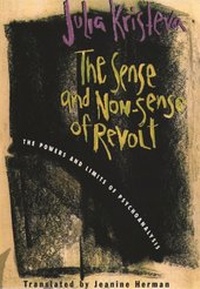
The Sense and Non-Sense of Revolt
The Powers and Limits of Psychoanalysis
1st Edition
Published on 26. December 2001
288 pages
978-0-231-51843-7 (ISBN)
Description

Linguist, psychoanalyst, and cultural theorist, Julia Kristeva is one of the most influential and prolific thinkers of our time. Her writings have broken new ground in the study of the self, the mind, and the ways in which we communicate through language. Her work is unique in that it skillfully brings together psychoanalytic theory and clinical practice, literature, linguistics, and philosophy.
In her latest book on the powers and limits of psychoanalysis, Kristeva focuses on an intriguing new dilemma. Freud and psychoanalysis taught us that rebellion is what guarantees our independence and our creative abilities. But in our contemporary "entertainment" culture, is rebellion still a viable option? Is it still possible to build and embrace a counterculture? For whom--and against what--and under what forms?
Kristeva illustrates the advances and impasses of rebel culture through the experiences of three twentieth-century writers: the existentialist John Paul Sartre, the surrealist Louis Aragon, and the theorist Roland Barthes. For Kristeva the rebellions championed by these figures--especially the political and seemingly dogmatic political commitments of Aragon and Sartre--strike the post-Cold War reader with a mixture of fascination and rejection. These theorists, according to Kristeva, are involved in a revolution against accepted notions of identity--of one's relation to others. Kristeva places their accomplishments in the context of other revolutionary movements in art, literature, and politics. The book also offers an illuminating discussion of Freud's groundbreaking work on rebellion, focusing on the symbolic function of patricide in his Totem and Taboo and discussing his often neglected vision of language, and underscoring its complex connection to the revolutionary drive.
In her latest book on the powers and limits of psychoanalysis, Kristeva focuses on an intriguing new dilemma. Freud and psychoanalysis taught us that rebellion is what guarantees our independence and our creative abilities. But in our contemporary "entertainment" culture, is rebellion still a viable option? Is it still possible to build and embrace a counterculture? For whom--and against what--and under what forms?
Kristeva illustrates the advances and impasses of rebel culture through the experiences of three twentieth-century writers: the existentialist John Paul Sartre, the surrealist Louis Aragon, and the theorist Roland Barthes. For Kristeva the rebellions championed by these figures--especially the political and seemingly dogmatic political commitments of Aragon and Sartre--strike the post-Cold War reader with a mixture of fascination and rejection. These theorists, according to Kristeva, are involved in a revolution against accepted notions of identity--of one's relation to others. Kristeva places their accomplishments in the context of other revolutionary movements in art, literature, and politics. The book also offers an illuminating discussion of Freud's groundbreaking work on rebellion, focusing on the symbolic function of patricide in his Totem and Taboo and discussing his often neglected vision of language, and underscoring its complex connection to the revolutionary drive.
All prices
More details
Other editions
Additional editions
Book
12/2001
Columbia University Press
€34.72
Article not available at the moment
Book
03/2000
Columbia University Press
€109.12
Shipment within 10-20 days
Persons
Julia Kristeva is a practicing psychoanalyst and professor of linguistics at the University of Paris. She is the author of many acclaimed books, including Time and Sense; Strangers to Ourselves, and New Maladies of the Soul, all published by Columbia.
Content
Introduction
1. What Revolt Today?
2. The Sacred and Revolt: Various Logics
3. The Metamorphoses of "Language'' in the Freudian Discovery (Freudian Models of Language)
4. Oedipus Again; or, Phallic Monism
5. On the Extraneousness of the Phallus; or, the Feminine Between Illusion and Disillusion
6. Aragon, Defiance, and Deception: A Precursor?
7. Sartre; or, "We Are Right to Revolt''
8. Roland Barthes and Writing as Demystification
1. What Revolt Today?
2. The Sacred and Revolt: Various Logics
3. The Metamorphoses of "Language'' in the Freudian Discovery (Freudian Models of Language)
4. Oedipus Again; or, Phallic Monism
5. On the Extraneousness of the Phallus; or, the Feminine Between Illusion and Disillusion
6. Aragon, Defiance, and Deception: A Precursor?
7. Sartre; or, "We Are Right to Revolt''
8. Roland Barthes and Writing as Demystification
