

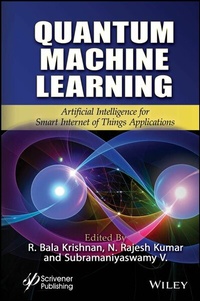
Quantum Machine Learning
Description

Revolutionize your IoT infrastructure with this guide to mastering quantum-enhanced machine learning algorithms and theoretical frameworks that are shattering the boundaries of classical computing to deliver unprecedented network performance and security.
In a world increasingly reliant on interconnected devices and data-driven insights, the limitations of classical computing become ever more apparent. The convergence of quantum computing, machine learning, and the Internet of Things (IoT) heralds a new era of technological advancement, one where the boundaries of computational possibility are continually redefined. This book offers an in-depth examination of how quantum algorithms are utilized to improve the performance, security, and efficiency of IoT devices and networks. It connects theoretical concepts with practical applications, providing a comprehensive look at fundamental principles and advanced techniques in this rapidly growing field. Using case studies and real-world insights, this book gives readers the latest developments in quantum machine learning, artificial intelligence, and the smart Internet of Things, and their potential to create an accessible pathway to the future.
Readers will find the volume:
- Demonstrates how to seamlessly integrate quantum computing and machine learning for next-gen IoT solutions;
- Explores the emerging field of quantum machine learning and its various applications for the AI-driven Internet of Things;
- Provides real-world examples and case studies demonstrating the power of quantum machine learning in smart IoT environments;
- Comprehensively covers a wide range of topics.
Audience
Researchers and engineers in machine learning, quantum computing, data science, the Internet of Things.
More details
Other editions
Additional editions
Persons
R. Bala Krishnan, PhD is an Assistant Professor in the Department of Computer Science and Engineering at the Srinivasa Ramanujan Centre at SASTRA University, Kumbakonam, India, with more than 15 years of experience. He has published more than 50 research papers in international journals and his interests include quantum computing, machine learning, artificial intelligence, intrusion detection and prevention systems.
N. Rajesh Kumar, PhD is an Assistant Professor in the Department of Computer Science and Engineering at the Srinivasa Ramanujan Centre at SASTRA University, Kumbakonam, India. He has published more than 30 research articles in journals and conferences of repute. His research interests include information hiding, image processing, and visual cryptography.
Subramaniyaswamy V., PhD is a Professor in the School of Computer Science and Engineering at the Vellore Institute of Technology. Vellore. Tamil Nadu, India. He has internationally published more than 200 articles and book chapters. His technical competencies lie in recommender systems, blockchain networks, artificial intelligence, machine learning, and big data analytics.
