

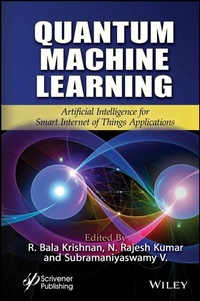
Quantum Machine Learning
Description

Revolutionize your IoT infrastructure with this guide to mastering quantum-enhanced machine learning algorithms and theoretical frameworks that are shattering the boundaries of classical computing to deliver unprecedented network performance and security.
In a world increasingly reliant on interconnected devices and data-driven insights, the limitations of classical computing become ever more apparent. The convergence of quantum computing, machine learning, and the Internet of Things (IoT) heralds a new era of technological advancement, one where the boundaries of computational possibility are continually redefined. This book offers an in-depth examination of how quantum algorithms are utilized to improve the performance, security, and efficiency of IoT devices and networks. It connects theoretical concepts with practical applications, providing a comprehensive look at fundamental principles and advanced techniques in this rapidly growing field. Using case studies and real-world insights, this book gives readers the latest developments in quantum machine learning, artificial intelligence, and the smart Internet of Things, and their potential to create an accessible pathway to the future.
Readers will find the volume:
- Demonstrates how to seamlessly integrate quantum computing and machine learning for next-gen IoT solutions;
- Explores the emerging field of quantum machine learning and its various applications for the AI-driven Internet of Things;
- Provides real-world examples and case studies demonstrating the power of quantum machine learning in smart IoT environments;
- Comprehensively covers a wide range of topics.
Audience
Researchers and engineers in machine learning, quantum computing, data science, the Internet of Things.
More details
Other editions
Additional editions
Persons
R. Bala Krishnan, PhD is an Assistant Professor in the Department of Computer Science and Engineering at the Srinivasa Ramanujan Centre at SASTRA University, Kumbakonam, India, with more than 15 years of experience. He has published more than 50 research papers in international journals and his interests include quantum computing, machine learning, artificial intelligence, intrusion detection and prevention systems.
N. Rajesh Kumar, PhD is an Assistant Professor in the Department of Computer Science and Engineering at the Srinivasa Ramanujan Centre at SASTRA University, Kumbakonam, India. He has published more than 30 research articles in journals and conferences of repute. His research interests include information hiding, image processing, and visual cryptography.
Subramaniyaswamy V., PhD is a Professor in the School of Computer Science and Engineering at the Vellore Institute of Technology. Vellore. Tamil Nadu, India. He has internationally published more than 200 articles and book chapters. His technical competencies lie in recommender systems, blockchain networks, artificial intelligence, machine learning, and big data analytics.
Content
1
Essentials of Data Analytics for Smart IoT
J.E. Judith1*, C.R. Jothy1, C. Dhayananth Jegan2 and A.J. Anju3
1Department of Computer Science and Engineering, Noorul Islam Centre for Higher Education, Kumaracoil, Tamil Nadu, India
2Department of Mechanical Engineering, Stella Mary's College of Engineering, Nagercoil, Tamil Nadu, India
3Department of Computer Science and Engineering, Vimal Jyothi Engineering College, Kannur, Tamil Nadu, India
Abstract
The Internet of Things (IoT) has brought a new paradigm in how devices can communicate and interact, leading to the emergence of intelligent infrastructures for data production, processing, and analysis. This chapter examines the principles of data analytics in the context of Smart IoT, emphasizing its vital role in transforming raw data into valuable insights. The chapter begins with a conceptual explanation of IoT and Smart IoT, their relevance, and the data-oriented paradigm of these technologies. Then, it examines various data analytics approaches that are applicable to the extraction of features from IoT-derived data, as well as data storage and management methods. Tooling and technology of data collection and storage/reproduction/processing and analysis, including cloud computing, edge computing, and big data platform, are also in the discussion. The main aspects of the data analytics of Smart IoT are described in different fields. In the chapter discussion, case studies and practical examples are used to describe how data analytics can make operations, processes, and decisions more efficient and effective in various fields. In that chapter, the challenges of data analytics in Smart IoT are presented, where data protection, security, and scalability are discussed. Specifically, it studies possible solutions and suggested practices to address these challenges, keeping the data management of IoT systems strong and secure. This chapter finishes with a detailed guide on establishing efficient data analytics tactics in Smart IoT systems. Hence, grasping the basics of data analytics in Smart IoT, the smart applications can be best utilized and thus push the smart technology applications to another level.
Keywords: IoT, machine learning, edge computing, cloud computing, data analytics, smart technology
1.1 Introduction
The Internet of Things has grown as a result of technological advancements and the quick integration of wireless communication, digital electronics, and micro-electro-mechanical systems (MEMS). A network of physical items, including vehicles, home appliances, and other gadgets, that have sensors, software, and connections to allow data sharing and communication with other systems and devices via the Internet is identified as the Internet of Things [1]. IoT is growing more and more important in a number of fields, such as agriculture, industry, transportation, and healthcare. As shown in Figure 1.1, a Statista analysis [26] projects that there will be 39.6 billion connected devices globally by 2033, up from 18 billion in 2024. In this environment, data analytics-the process of analyzing through enormous and varied databases to find hidden patterns, correlations, and insights-is essential for directing corporate choices. Since it allows companies to understand the huge quantities of data they produce, it is an essential component of the IoT world. Businesses able to process this information and extract useful information may enhance customer satisfaction, reduce operational costs, and increase operational efficiency [2].
Data is being created at a phenomenal rate owing to the ubiquitous existence of Internet of Things (IoT) devices across various sectors. The real potential of IoT lies in the knowledge that can be derived from that data. It may be possible for businesses to monetize this value by applying data analytics [1] and taking data-driven, impactful decisions about operating the business.
Figure 1.1 Number of connected devices worldwide.
- Smart IoT data analytics
Smart IoT data analytics is the activity of collecting, analyzing, and interpreting IoT device generated data. Things such as wearables, smart appliances, sensors, and other networked devices that acquire and send data to and from the Internet are all examples of such devices. The Smart IoTs employ specific software and tools to analyze and interpret large amounts of data collected from such a device, with the aim of gaining knowledge and taking actions. By means of machine learning algorithms, data mining approaches and predictive analytics, Smart IoTs identify patterns, relationships, and trends in data [1]. Smart IoT data analytics insights can also be applied to enhance customer experiences, optimize business processes, optimize operations, and discover new revenue opportunities. For example, a business may use IoT data analytics to monitor equipment performance, identify inefficiencies, and improve manufacturing processes in real time to boost productivity and reduce downtime. Similarly, an individual store may employ IoT data analytics to monitor customer choices, preferences, and behavior, adapt marketing promotions, and enhance the shopping experience.
The primary data source in the Internet of Things environment is sensor-equipped devices that employ certain protocols. Two key protocols that are commonly used in the Internet of Things are Message Queue Telemetry Transport and Data Distribution Service. Since sensors are utilized in practically every business, it is anticipated that the Internet of Things will generate massive volumes of data. Data from IoT devices can be utilized to identify emerging research trends and analyze the effects of specific choices or activities [27].
Figure 1.2 shows how the Smart IoT data platform does data analytics. Even while the Internet of Things has opened up incredible possibilities to increase income, cut expenses, and enhance productivity, simply gathering vast volumes of data is insufficient. To truly profit from the Internet of Things, businesses need to develop a platform that can collect, handle, and analyze large amounts of data in a scalable and cost-effective manner. In this regard, having an effective data integration process and a big data platform to manage several data sources are essential.
Analytics and data integration can help businesses transform their operations. Specifically, companies can utilize data analytics tools to transform massive amounts of sensor-generated data into insightful information. Figure 1.2 shows the framework for IoT-based data analytics. Both IoT and Smart IoT are transformative technologies that are fundamentally reshaping how we interact with the world around us. Both are deeply data-centric, relying on the collection, transmission, and investigation of data to deliver their value.
Figure 1.2 Data analytics in smart IoT data platform.
- Importance of IoT data analytics
Data analytics can make IoT smarter, which is essential for efficient operation since it allows businesses to glean valuable insights from the vast volumes of data produced by IoT devices.
Making informed decisions increasingly requires processing, evaluating, and understanding the data generated by linked devices. Because it makes real-time monitoring, optimization, and automation possible, the IoT has the potential to revolutionize a number of industries. However, if businesses want to fully benefit from IoT, they must manage and analyze the enormous amounts of data generated by IoT devices. The Internet of Things requires data analytics for the following reasons:
- Big data insights extraction: IoT devices stores and handles enormous volumes of data that may be too much for conventional data processing techniques to handle [10]. Organizations can use data analytics to glean insights and make well-informed decisions.
- Real-time monitoring and alerts: Monitoring and storing real-time data from IoT devices and sending alerts in the event of anomalies or potential issues are made possible by data analytics. This capacity aids organizations in promptly identifying and resolving issues.
- Predictive maintenance: By using data analytics, maintenance may be proactively scheduled and equipment failure can be anticipated, reducing downtime and maintenance expenses.
- Process optimization: Data analytics can benefit businesses to enhance their operations, cut expenses, and boost efficiency by locating bottlenecks, inefficiencies, and other areas for optimization.
- Personalization: By using consumer data to tailor experiences, goods, and services, data analytics can improve customer loyalty and engagement.
- Innovation: New revenue streams and commercial prospects can be found using data analytics. By analyzing the data generated by IoT devices, companies can develop new, creative goods and services that meet customer needs.
1.2 Analytics Techniques for IoT Data
As shown in Figure 1.3, analytics can be characterized into four categories: descriptive, diagnostic, predictive, and prescriptive. Finding new business possibilities and problems is aided by descriptive analytics, which provides answers to "what has happened or what is happening". Diagnostic analytics concentrates deeper into the data to answer, "Why did it happen?". It goes beyond descriptive analytics by identifying the causes or factors behind certain outcomes. This often involves looking at correlations...
