

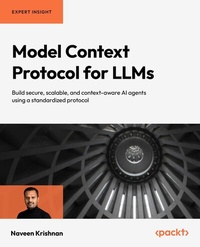
Model Context Protocol for LLMs
Build secure, scalable, and context-aware AI agents using a standardized protocol
Published on 28. February 2026
436 pages
978-1-80666-226-5 (ISBN)
Description

Build scalable, secure LLM applications with the Model Context Protocol and design modular, context-aware multi-agent systems for real-world deployment Free with your book: DRM-free PDF version + access to Packt's next-gen Reader*
Key Features
Build modular, production-ready AI agents using the Model Context Protocol (MCP)
Integrate MCP with LangChain, AutoGen, and RAG for multi-agent collaboration
Apply security, performance optimization, and evaluation patterns for real-world deployment
Book DescriptionModern LLM applications often fail due to weak context management, fragile tool integration, and poorly coordinated agents. To address these challenges, this book provides a practical blueprint for building reliable, scalable AI systems using the Model Context Protocol (MCP), an open standard for interoperable AI architectures. You'll explore why context is the missing layer in many AI deployments and how MCP formalizes it. Through clear explanations and practical examples, you'll design modular components such as resource providers, tool providers, gateways, and standardized interfaces. You'll also integrate MCP with LangChain, AutoGen, and RAG pipelines to build collaborative, context-aware multi-agent systems. You'll learn how to apply MCP to multimodal applications, personalization engines, and enterprise knowledge management solutions, while evaluating and benchmarking implementations for production readiness and implementing authentication, authorization, and scaling strategies for secure cloud deployments. Written by a data and AI solutions engineer with over 17 years of experience at Microsoft and Fortune 500 organizations, this guide combines architectural depth with hands-on implementation. By the end, you'll be able to design, build, and deploy secure, reusable MCP-based LLM systems that scale confidently in production. *Email sign-up and proof of purchase required What you will learn
Understand the MCP architecture and standardized primitives
Implement resource and tool providers in Python
Connect LangChain and AutoGen to MCP pipelines
Secure agent interactions using authentication and access control
Add RAG pipelines with shared contextual memory
Apply authentication, TLS, and access control models
Optimize performance with caching and async patterns
Evaluate and benchmark MCP systems for production readiness
Who this book is forAI/ML engineers, software engineers, and solution architects building LLM-powered applications in production will benefit the most from this book. Cloud architects and platform engineers designing AI infrastructure will also find it valuable. If you're looking for a standardized, modular, and secure approach to managing context across agents and tools, this guide is for you. Intermediate Python skills, a working knowledge of LLM concepts and REST APIs, and familiarity with system design patterns are expected.
Key Features
Build modular, production-ready AI agents using the Model Context Protocol (MCP)
Integrate MCP with LangChain, AutoGen, and RAG for multi-agent collaboration
Apply security, performance optimization, and evaluation patterns for real-world deployment
Book DescriptionModern LLM applications often fail due to weak context management, fragile tool integration, and poorly coordinated agents. To address these challenges, this book provides a practical blueprint for building reliable, scalable AI systems using the Model Context Protocol (MCP), an open standard for interoperable AI architectures. You'll explore why context is the missing layer in many AI deployments and how MCP formalizes it. Through clear explanations and practical examples, you'll design modular components such as resource providers, tool providers, gateways, and standardized interfaces. You'll also integrate MCP with LangChain, AutoGen, and RAG pipelines to build collaborative, context-aware multi-agent systems. You'll learn how to apply MCP to multimodal applications, personalization engines, and enterprise knowledge management solutions, while evaluating and benchmarking implementations for production readiness and implementing authentication, authorization, and scaling strategies for secure cloud deployments. Written by a data and AI solutions engineer with over 17 years of experience at Microsoft and Fortune 500 organizations, this guide combines architectural depth with hands-on implementation. By the end, you'll be able to design, build, and deploy secure, reusable MCP-based LLM systems that scale confidently in production. *Email sign-up and proof of purchase required What you will learn
Understand the MCP architecture and standardized primitives
Implement resource and tool providers in Python
Connect LangChain and AutoGen to MCP pipelines
Secure agent interactions using authentication and access control
Add RAG pipelines with shared contextual memory
Apply authentication, TLS, and access control models
Optimize performance with caching and async patterns
Evaluate and benchmark MCP systems for production readiness
Who this book is forAI/ML engineers, software engineers, and solution architects building LLM-powered applications in production will benefit the most from this book. Cloud architects and platform engineers designing AI infrastructure will also find it valuable. If you're looking for a standardized, modular, and secure approach to managing context across agents and tools, this guide is for you. Intermediate Python skills, a working knowledge of LLM concepts and REST APIs, and familiarity with system design patterns are expected.
All prices
More details
Edition
Digital original
Language
English
Place of publication
Birmingham
United Kingdom
Target group
Professional and scholarly
US School Grade: College Graduate Student
Edition type
Digital original
Product notice
Reflowable
File size
14,33 MB
ISBN-13
978-1-80666-226-5 (9781806662265)
Copyright in bibliographic data and cover images is held by Nielsen Book Services Limited or by the publishers or by their respective licensors: all rights reserved.
Schweitzer Classification
Other editions
Additional editions
Naveen Krishnan
Model Context Protocol for LLMs
Build secure, scalable, and context-aware AI agents using a standardized protocol
Book
02/2026
Packt Publishing
€61.60
Shipment within 3-4 weeks
Person
Naveen Krishnan is a Data and AI Solutions Engineer with over 17 years of experience delivering enterprise-grade systems across retail, banking, healthcare, and manufacturing. As an AI Lead at Microsoft, a Fellow of BCS, and a Senior Member of IEEE, he has designed and deployed large-scale RAG and multi-agent systems using LangChain, AutoGen, and MCP. A judge at global NASA Space Apps and Microsoft hackathons and the author of 35+ technical publications, he specializes in secure, scalable AI architectures and responsible AI practices for real-world deployment.
Content
Table of Contents
Introduction to the Model Context Protocol
Theoretical Foundations of Multi-Agent Systems
The MCP for Non-Technical Readers
MCP Components and Interfaces
MCP Architecture Overview
Server-Side Implementation
Client-Side Integration
MCP Security Model
MCP Performance Optimization
MCP and Multi-Agent Systems
MCP for Retrieval-Augmented Generation
Integrating MCP with LangChain
Integrating MCP with AutoGen
MCP for Enterprise Knowledge Management
MCP for Personalization and Recommendation Systems
MCP for Multimodal Applications
MCP Evaluation Methodologies
Performance Benchmarks and Testing
Optimization Strategies and Performance Tuning
Future Directions and Emerging Trends
Preface Free benefits with your book Part 1: Foundations and Concepts Chapter 1: Introduction to the Model Context Protocol Technical requirements The evolution of AI systems The disconnected model problem What is the Model Context Protocol (MCP)? Historical development and timeline Code example: Setting up a development environment Setting up the environment Creating your first MCP server Testing the server Summary Chapter 2: Theoretical Foundations of Multi-Agent Systems Historical development of multi-agent systems Understanding agency in AI Autonomy: the foundation of independent operation Social ability: the art of AI communication Reactivity: responding to a dynamic world Proactivity: anticipating and acting From single agents to multi-agent systems Challenges in multi-agent coordination Summary Chapter 3: The MCP for Non-Technical Readers Understanding MCP without the technical jargon Why MCP matters for everyone MCP in everyday scenarios The future with MCP Common questions about MCP Preparing for an MCP-enabled future Summary Part 2: Architecture and Core Implementation Chapter 4: MCP Components and Interfaces Overview of MCP architecture components Resource provider interface Tool provider interface Prompt providers interfaces Security interfaces Discovery interfaces Client features Sampling Roots Elicitation Summary Chapter 5: MCP Architecture Overview Client-server architecture Core components and their relationships Standardized primitives Communication mechanisms Message formats and protocols Security and authentication framework Code example Summary Chapter 6: Server-Side Implementation Design principles for MCP servers Be discoverable, not just documented Understand context, don't just process requests Be resilient, not just robust Optimize for intelligence, not just performance Security: user consent and context Implementing resource providers Metadata is as important as data Progressive disclosure of complexity Implementing tool providers Design for composability Provide multiple levels of abstraction Handle uncertainty gracefully Implementing prompt providers Provide context, not just templates Make prompts adaptive Handling authentication and authorization Context-aware authorization Risk-based security Scalability and performance considerations AI operations are computationally intensive Request patterns are unpredictable Context matters for performance Code example: Building an MCP server Summary Chapter 7: Client-Side Integration The role of the MCP client Discovery and capability management Context management and state coordination Intelligent orchestration Integrating with AI models and frameworks LangChain integration patterns AutoGen integration strategies Direct model integration Managing context retrieval Intelligent context selection Progressive context loading Context caching and optimization Orchestrating tool execution Dependency management Adaptive workflow management Error handling and recovery Handling security on the client side Credential management Permission delegation Data protection Session and state management Distributed session management Long-running task management State synchronization Code example: Building MCP client integrations Summary Part 3: Security and Performance Chapter 8: MCP Security Model Importance of security in MCP The autonomous decision problem The collaboration complexity The context sensitivity challenge The emergent behavior risk Authentication mechanisms Multi-party authentication Agent identity and attestation Dynamic trust assessment Authorization and access control Capability-based authorization Contextual policy evaluation Intent-based authorization Transport layer security (TLS) End-to-end encryption Certificate management for AI systems Performance considerations Data security and privacy Data minimization and purpose limitation Differential privacy and anonymization Data lineage and provenance Auditing and logging Comprehensive activity logging Behavioral analysis and anomaly detection Privacy-preserving audit techniques Security considerations for clients ...
Introduction to the Model Context Protocol
Theoretical Foundations of Multi-Agent Systems
The MCP for Non-Technical Readers
MCP Components and Interfaces
MCP Architecture Overview
Server-Side Implementation
Client-Side Integration
MCP Security Model
MCP Performance Optimization
MCP and Multi-Agent Systems
MCP for Retrieval-Augmented Generation
Integrating MCP with LangChain
Integrating MCP with AutoGen
MCP for Enterprise Knowledge Management
MCP for Personalization and Recommendation Systems
MCP for Multimodal Applications
MCP Evaluation Methodologies
Performance Benchmarks and Testing
Optimization Strategies and Performance Tuning
Future Directions and Emerging Trends
Table of Contents
Preface Free benefits with your book Part 1: Foundations and Concepts Chapter 1: Introduction to the Model Context Protocol Technical requirements The evolution of AI systems The disconnected model problem What is the Model Context Protocol (MCP)? Historical development and timeline Code example: Setting up a development environment Setting up the environment Creating your first MCP server Testing the server Summary Chapter 2: Theoretical Foundations of Multi-Agent Systems Historical development of multi-agent systems Understanding agency in AI Autonomy: the foundation of independent operation Social ability: the art of AI communication Reactivity: responding to a dynamic world Proactivity: anticipating and acting From single agents to multi-agent systems Challenges in multi-agent coordination Summary Chapter 3: The MCP for Non-Technical Readers Understanding MCP without the technical jargon Why MCP matters for everyone MCP in everyday scenarios The future with MCP Common questions about MCP Preparing for an MCP-enabled future Summary Part 2: Architecture and Core Implementation Chapter 4: MCP Components and Interfaces Overview of MCP architecture components Resource provider interface Tool provider interface Prompt providers interfaces Security interfaces Discovery interfaces Client features Sampling Roots Elicitation Summary Chapter 5: MCP Architecture Overview Client-server architecture Core components and their relationships Standardized primitives Communication mechanisms Message formats and protocols Security and authentication framework Code example Summary Chapter 6: Server-Side Implementation Design principles for MCP servers Be discoverable, not just documented Understand context, don't just process requests Be resilient, not just robust Optimize for intelligence, not just performance Security: user consent and context Implementing resource providers Metadata is as important as data Progressive disclosure of complexity Implementing tool providers Design for composability Provide multiple levels of abstraction Handle uncertainty gracefully Implementing prompt providers Provide context, not just templates Make prompts adaptive Handling authentication and authorization Context-aware authorization Risk-based security Scalability and performance considerations AI operations are computationally intensive Request patterns are unpredictable Context matters for performance Code example: Building an MCP server Summary Chapter 7: Client-Side Integration The role of the MCP client Discovery and capability management Context management and state coordination Intelligent orchestration Integrating with AI models and frameworks LangChain integration patterns AutoGen integration strategies Direct model integration Managing context retrieval Intelligent context selection Progressive context loading Context caching and optimization Orchestrating tool execution Dependency management Adaptive workflow management Error handling and recovery Handling security on the client side Credential management Permission delegation Data protection Session and state management Distributed session management Long-running task management State synchronization Code example: Building MCP client integrations Summary Part 3: Security and Performance Chapter 8: MCP Security Model Importance of security in MCP The autonomous decision problem The collaboration complexity The context sensitivity challenge The emergent behavior risk Authentication mechanisms Multi-party authentication Agent identity and attestation Dynamic trust assessment Authorization and access control Capability-based authorization Contextual policy evaluation Intent-based authorization Transport layer security (TLS) End-to-end encryption Certificate management for AI systems Performance considerations Data security and privacy Data minimization and purpose limitation Differential privacy and anonymization Data lineage and provenance Auditing and logging Comprehensive activity logging Behavioral analysis and anomaly detection Privacy-preserving audit techniques Security considerations for clients ...
