

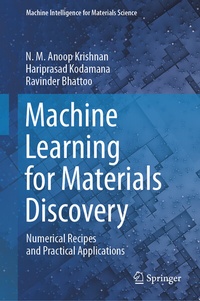
Machine Learning for Materials Discovery
Description

Focusing on the fundamentals of machine learning, this book covers broad areas of data-driven modeling, ranging from simple regression to advanced machine learning and optimization methods for applications in materials modeling and discovery. The book explains complex mathematical concepts in a lucid manner to ensure that readers from different materials domains are able to use these techniques successfully. A unique feature of this book is its hands-on aspect-each method presented herein is accompanied by a code that implements the method in open-source platforms such as Python. This book is thus aimed at graduate students, researchers, and engineers to enable the use of data-driven methods for understanding and accelerating the discovery of novel materials.
More details
Other editions
Additional editions
Persons
N. M. Anoop Krishnan is an Associate Professor in the Department of Civil Engineering, IIT Delhi, with a joint affiliation in the Yardi School of Artificial Intelligence, IIT Delhi. Prior to this, he worked as Lecturer and Postdoctoral Researcher at the University of California, Los Angeles. His primary area of research includes data- and physics-based modeling of materials. He has published more than 100 peer-reviewed publications and won several prestigious awards including the Google research scholar award (2023), W. A. Weyl international glass science award, Young Associate 2022 (Indian Academy of Sciences), Young Engineer Award 2020 (Indian National Academy of Engineering).
Hariprasad Kodamana is an Associate Professor in the Department of Chemical Engineering, IIT Delhi withaffiliation in the Yardi School of Artificial Intelligence, IIT Delhi. Prior to this, he worked as Assistant Professor at IIT Kharagpur, Postdoctoral Researcher and Sessional Instructor at the University of Alberta, Canada, and Process Engineer at GE Energy. His primary area of research includes data-driven modeling and optimization. He serves as Reviewer for various scientific journals and has won several awards including the Young Faculty Incentive Fellowship (IIT Delhi) and the IIT Bombay Institute Award for best Ph.D. thesis.
Ravinder Bhattoo is currently a postdoctoral researcher in the University of Wisconsin-Madison. Prior to this, he completed his Ph.D. in the Department of Civil Engineering, IIT Delhi and undergraduate degree in civil engineering from IIT Roorkee. He works in the area of machine learning applied to glass science to predict the composition-property relationships in glasses. He has won several awards including the prestigious prime minister's research fellowship (PMRF).
Content
Part I: Introduction.- Part II: Basics of Machine Learning Methods.- Introduction to Data-Based Modeling.- Model Development.- Introduction to Machine Learning.- Quick Dive into Probabilistic Methods.- Optimization.- Part III: Application in Glass Science.- Property Prediction.- Glass Discovery.- Understanding Glass Physics.- Atomistic Modeling.- Future Directions.
