

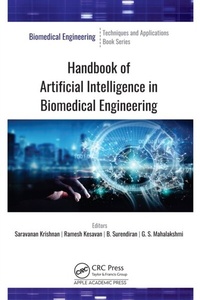
Handbook of Artificial Intelligence in Biomedical Engineering
1st Edition
Published on 29. March 2021
564 pages
978-1-000-06763-7 (ISBN)
Description

Handbook of Artificial Intelligence in Biomedical Engineering focuses on recent AI technologies and applications that provide some very promising solutions and enhanced technology in the biomedical field. Recent advancements in computational techniques, such as machine learning, Internet of Things (IoT), and big data, accelerate the deployment of biomedical devices in various healthcare applications.
This volume explores how artificial intelligence (AI) can be applied to these expert systems by mimicking the human expert's knowledge in order to predict and monitor the health status in real time. The accuracy of the AI systems is drastically increasing by using machine learning, digitized medical data acquisition, wireless medical data communication, and computing infrastructure AI approaches, helping to solve complex issues in the biomedical industry and playing a vital role in future healthcare applications.
The volume takes a multidisciplinary perspective of employing these new applications in biomedical engineering, exploring the combination of engineering principles with biological knowledge that contributes to the development of revolutionary and life-saving concepts.
This volume explores how artificial intelligence (AI) can be applied to these expert systems by mimicking the human expert's knowledge in order to predict and monitor the health status in real time. The accuracy of the AI systems is drastically increasing by using machine learning, digitized medical data acquisition, wireless medical data communication, and computing infrastructure AI approaches, helping to solve complex issues in the biomedical industry and playing a vital role in future healthcare applications.
The volume takes a multidisciplinary perspective of employing these new applications in biomedical engineering, exploring the combination of engineering principles with biological knowledge that contributes to the development of revolutionary and life-saving concepts.
More details
Edition
1. Auflage
Language
English
Place of publication
London
United Kingdom
Publishing group
Taylor & Francis Ltd
Target group
College/higher education
Professional and scholarly
Illustrations
41 Tables, black and white; 6 Illustrations, color; 163 Illustrations, black and white
ISBN-13
978-1-000-06763-7 (9781000067637)
Copyright in bibliographic data and cover images is held by Nielsen Book Services Limited or by the publishers or by their respective licensors: all rights reserved.
Schweitzer Classification
Other editions
Additional editions
Saravanan Krishnan | Ramesh Kesavan | B. Surendiran
Handbook of Artificial Intelligence in Biomedical Engineering
Book
10/2022
1st Edition
Apple Academic Press Inc.
€123.29
Shipment within 3-4 weeks
Saravanan Krishnan | Ramesh Kesavan | B. Surendiran
Handbook of Artificial Intelligence in Biomedical Engineering
Book
03/2021
1st Edition
Apple Academic Press Inc.
€311.30
Shipment within 3-4 weeks
Persons
Saravanan Krishnan, PhD, is a Senior Assistant Professor in the Department of Computer Science & Engineering at Anna University, Regional Campus, Tirunelveli, Tamilnadu, India. He has 14 years of experience in academics and the IT industry and has published papers in 14 international conferences and 24 international journals. He has also written six book chapters and has edited three books with international publishers. He has done four research projects and two consultancy projects with the total worth of Rs.70 Lakhs. He is an active researcher and academician. Also, he is reviewer for many reputed journals published by Elsevier, Springer, IEEE, etc. He also received an outstanding reviewer certificate from Elsevier, Inc. He is a Mentor of Change for Atal Tinkering Lab of NITI Aayog. He has professional membership with several professional organizations. He has previously worked at Cognizant Technology Solutions, Pvt Ltd. as software associate. He earned his PhD in 2015 and completed his ME (Software Engineering) in 2007.
Ramesh Kesavan, PhD, is currently an Assistant Professor in the Department of Computer Applications, Anna University Regional Campus, Tirunelveli, India. His area of research includes cloud computing, big data analytics, data mining, and machine learning. He earned his PhD degree in Computer Science from Anna University, Chennai, India.
B. Surendiran, PhD, is an Associate Dean (Academic) and Assistant Professor in the Department of Computer Science and Engineering at the National Institute of Technology, Puducherry, Karaikal, India. His research interests include medical imaging, machine learning, dimensionality reduction, and intrusion detection. He has published over 20 papers in international journals and has several conference publications to his credit. He is an active reviewer for various SCI and Scopus journals. He earned his PhD at the National Institute of Technology, Tiruchirappalli, India.
G. S. Mahalakshmi, PhD, is currently working as Associate Professor in the Computer Science and Engineering Department at College of Engineering, Anna University, Guindy, Chennai, India. She has vast research experience and has published 180 papers in reputed journals and international conferences. She is also deputy director for the Centre for Entrepreneurship Development, Anna University. She is an active reviewer for various SCI, Scopus journals. Her research interest includes machine learning, artificial intelligence, text mining, and natural language processing.
Ramesh Kesavan, PhD, is currently an Assistant Professor in the Department of Computer Applications, Anna University Regional Campus, Tirunelveli, India. His area of research includes cloud computing, big data analytics, data mining, and machine learning. He earned his PhD degree in Computer Science from Anna University, Chennai, India.
B. Surendiran, PhD, is an Associate Dean (Academic) and Assistant Professor in the Department of Computer Science and Engineering at the National Institute of Technology, Puducherry, Karaikal, India. His research interests include medical imaging, machine learning, dimensionality reduction, and intrusion detection. He has published over 20 papers in international journals and has several conference publications to his credit. He is an active reviewer for various SCI and Scopus journals. He earned his PhD at the National Institute of Technology, Tiruchirappalli, India.
G. S. Mahalakshmi, PhD, is currently working as Associate Professor in the Computer Science and Engineering Department at College of Engineering, Anna University, Guindy, Chennai, India. She has vast research experience and has published 180 papers in reputed journals and international conferences. She is also deputy director for the Centre for Entrepreneurship Development, Anna University. She is an active reviewer for various SCI, Scopus journals. Her research interest includes machine learning, artificial intelligence, text mining, and natural language processing.
Content
Preface
1. Design of Medical Expert Systems Using Machine Learning Techniques
S. Anto, S. Siamala Devi, K. R. Jothi, and R. Lokeshkumar
2. FFrom Design Issues to Validation: Machine Learning in Biomedical Engineering
Christa I L Sharon and V. Suma
3. Biomedical Engineering and Informatics Using Artificial Intelligence
K. Padmavathi and A. S. Saranya
4. Hybrid Genetic Algorithms for Biomedical Applications
Srividya P. and Rajendran Sindhu
5. Healthcare Applications of the Biomedical AI System
S. Shyni Carmel Mary and S. Sasikala
6. Applications of Artificial Intelligence in Biomedical Engineering
Puja Sahay Prasad, Vinit Kumar Gunjan, Rashmi Pathak, and Saurabh Mukherjee
7. Biomedical Imaging Techniques Using AI Systems
A. Aafreen Nawresh and S. Sasikala
8. Analysis of Heart Disease Prediction Using Machine Learning Techniques
N. Hema Priya, N. Gopikarani, and S. Shymala Gowri
9. A Review on Patient Monitoring and Diagnosis Assistance by Artificial Intelligence Tools
Sindhu Rajendran, Meghamadhuri Vakil, Rhutu Kallur, Vidhya Shree, Praveen Kumar Gupta, and Lingaiya Hiremat
10. Semantic Annotation of Healthcare Data
M. Manonmani and Sarojini Balakrishanan
11. Drug Side Effect Frequency Mining over a Large Twitter Dataset using Apache Spark
Dennis Hsu, Melody Moh, Teng-Sheng Moh, and Diane Moh
12. Deep Learning in Brain Segmentation
Hao-Yu Yang
13. Security and Privacy Issues in Biomedical AI Systems and Potential Solutions
G. Niranjana and Deya Chatterjee
14. LiMoS-Live Patient Monitoring System
T. Ananth Kumar, S. Arunmozhi Selvi, R.S. Rajesh, P. Sivananaintha Perumal, and J. Stalin
15. Real-Time Detection of Facial Expressions Using k-NN, SVM, Ensemble classifier and Convolution Neural Networks
A. Sharmila, B. Bhavya, and K. V. N. Kavitha, and P. Mahalakshmi
16. Analysis and Interpretation of Uterine Contraction Signals Using Artificial Intelligence
P. Mahalakshmi and S. Suja Priyadharsini
17. Enhanced Classification Performance of Cardiotocogram Data for Fetal State Anticipation Using Evolutionary Feature Reduction Techniques
Subha Velappan, Manivanna Boopathi Arumugam, and Zafer Comert
18. Deployment of Supervised Machine Learning and Deep Learning Algorithms in Biomedical Text Classification
G. Kumaravelan and Bichitrananda Behera
19. Energy Efficient Optimum Cluster Head Estimation for Body Area Networks
P. Sundareswaran and R.S. Rajesh
20. Segmentation and Classification of Tumour Regions from Brain Magnetic Resonance Images by Neural Network-Based Technique
J. V. Bibal Benifa and G. Venifa Mini
21. A Hypothetical Study in Biomedical Based Artificial Intelligence Systems using Machine Language (ML) Rudiments
D. Renuka Devi and S. Sasikala
22. Neural Source Connectivity Estimation using particle filter and Granger causality methods
Santhosh Kumar Veeramalla and T. V. K. Hanumantha Rao
23. Exploration of Lymph Node-Negative Breast Cancers by Support Vector Machines, Naive Bayes, and Decision Trees: A Comparative Study
J. Satya Eswari and Pradeep Singh
Index
1. Design of Medical Expert Systems Using Machine Learning Techniques
S. Anto, S. Siamala Devi, K. R. Jothi, and R. Lokeshkumar
2. FFrom Design Issues to Validation: Machine Learning in Biomedical Engineering
Christa I L Sharon and V. Suma
3. Biomedical Engineering and Informatics Using Artificial Intelligence
K. Padmavathi and A. S. Saranya
4. Hybrid Genetic Algorithms for Biomedical Applications
Srividya P. and Rajendran Sindhu
5. Healthcare Applications of the Biomedical AI System
S. Shyni Carmel Mary and S. Sasikala
6. Applications of Artificial Intelligence in Biomedical Engineering
Puja Sahay Prasad, Vinit Kumar Gunjan, Rashmi Pathak, and Saurabh Mukherjee
7. Biomedical Imaging Techniques Using AI Systems
A. Aafreen Nawresh and S. Sasikala
8. Analysis of Heart Disease Prediction Using Machine Learning Techniques
N. Hema Priya, N. Gopikarani, and S. Shymala Gowri
9. A Review on Patient Monitoring and Diagnosis Assistance by Artificial Intelligence Tools
Sindhu Rajendran, Meghamadhuri Vakil, Rhutu Kallur, Vidhya Shree, Praveen Kumar Gupta, and Lingaiya Hiremat
10. Semantic Annotation of Healthcare Data
M. Manonmani and Sarojini Balakrishanan
11. Drug Side Effect Frequency Mining over a Large Twitter Dataset using Apache Spark
Dennis Hsu, Melody Moh, Teng-Sheng Moh, and Diane Moh
12. Deep Learning in Brain Segmentation
Hao-Yu Yang
13. Security and Privacy Issues in Biomedical AI Systems and Potential Solutions
G. Niranjana and Deya Chatterjee
14. LiMoS-Live Patient Monitoring System
T. Ananth Kumar, S. Arunmozhi Selvi, R.S. Rajesh, P. Sivananaintha Perumal, and J. Stalin
15. Real-Time Detection of Facial Expressions Using k-NN, SVM, Ensemble classifier and Convolution Neural Networks
A. Sharmila, B. Bhavya, and K. V. N. Kavitha, and P. Mahalakshmi
16. Analysis and Interpretation of Uterine Contraction Signals Using Artificial Intelligence
P. Mahalakshmi and S. Suja Priyadharsini
17. Enhanced Classification Performance of Cardiotocogram Data for Fetal State Anticipation Using Evolutionary Feature Reduction Techniques
Subha Velappan, Manivanna Boopathi Arumugam, and Zafer Comert
18. Deployment of Supervised Machine Learning and Deep Learning Algorithms in Biomedical Text Classification
G. Kumaravelan and Bichitrananda Behera
19. Energy Efficient Optimum Cluster Head Estimation for Body Area Networks
P. Sundareswaran and R.S. Rajesh
20. Segmentation and Classification of Tumour Regions from Brain Magnetic Resonance Images by Neural Network-Based Technique
J. V. Bibal Benifa and G. Venifa Mini
21. A Hypothetical Study in Biomedical Based Artificial Intelligence Systems using Machine Language (ML) Rudiments
D. Renuka Devi and S. Sasikala
22. Neural Source Connectivity Estimation using particle filter and Granger causality methods
Santhosh Kumar Veeramalla and T. V. K. Hanumantha Rao
23. Exploration of Lymph Node-Negative Breast Cancers by Support Vector Machines, Naive Bayes, and Decision Trees: A Comparative Study
J. Satya Eswari and Pradeep Singh
Index
