
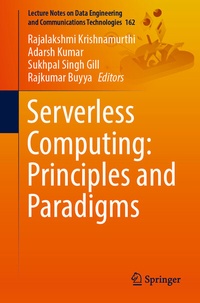
Serverless Computing: Principles and Paradigms
Description
Alles über E-Books | Antworten auf Fragen rund um E-Books, Kopierschutz und Dateiformate finden Sie in unserem Info- & Hilfebereich.
This book explores how advances in graphic processing units (GPUs), programmable logic devices (TPUs), and field-programmable gate arrays have altered the serverless computing landscape (FPGAs). Distributed system architectures and implementations have undergone significant changes due to the popularity of serverless computing. Making and releasing product applications, doing market research, and maintaining customer interactions might all benefit from the reduced infrastructure expenses made possible by serverless computing. This book is a great resource for teachers and students interested in learning more about serverless computing. Some of the main questions surrounding serverless technology, such as scalability and performance distribution, are answered. Concepts and fundamentals of computing performance such as cost-free operation, good time and resource management, fairness, and interoperability are discussed. Serverless is at the forefront of this shift, which has made data-intensive, distributed applications, and open-source platforms essential for any modern computer to function. Data-centric queuing, real-time logging and monitoring, querying, and alarms are all examples of serverless services.
More details
Other editions
Additional editions

Content
System requirements
File format: PDF
Copy protection: Watermark-DRM (Digital Rights Management)
System requirements:
- Computer (Windows; MacOS X; Linux): Use the free software Adobe Reader, Adobe Digital Editions, or any other PDF viewer of your choice (see eBook Help).
- Tablet/Smartphone (Android; iOS): Install the free app Adobe Digital Editions or another reading app for eBooks, e.g., PocketBook (see eBook Help).
- E-reader: Bookeen, Kobo, Pocketbook, Sony, Tolino and many more (only limited: Kindle).
The file format PDF always displays a book page identically on any hardware. This makes PDF suitable for complex layouts such as those used in textbooks and reference books (images, tables, columns, footnotes). Unfortunately, on the small screens of e-readers or smartphones, PDFs are rather annoying, requiring too much scrolling.
This eBook uses Watermark-DRM, a „soft” copy protection. This means that there are no technical restrictions to prevent illegal distribution. However, there is a personalised watermark embedded in the eBook that can be used to identify the purchaser of the eBook in the event of misuse and to provide evidence for legal purposes.
For more information, see our eBook Help page.