

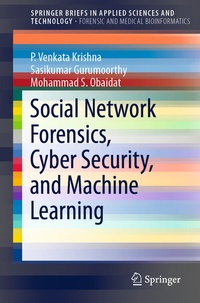
Social Network Forensics, Cyber Security, and Machine Learning
Description

This book discusses the issues and challenges in Online Social Networks (OSNs). It highlights various aspects of OSNs consisting of novel social network strategies and the development of services using different computing models. Moreover, the book investigates how OSNs are impacted by cutting-edge innovations.
More details
Other editions
Additional editions
Persons
Dr. Sasikumar Gurumoorthy received his Ph.D. in Computer Science and Engineering from VIT University (VIT), Vellore, Tamil Nadu, India. He is currently a Professor at the Department of Computer Science and Systems engineering at Sree Vidyanikethan Engineering College, Tirupati, India. He has published more than 80 technical papers in various international journals, conferences, as well as three books and five book chapters. His current interests include soft computing and artificial intelligence in biomedical engineering, human and machine interaction and applications of intelligent system techniques, new user interfaces, brain-based interactions, human-centric computing, fuzzy sets and systems, image processing, cloud computing, content-based learning and social network analysis.
Dr. Mohammad S. Obaidat (Fellow of IEEE and Fellow of SCS) is an internationally respected academic and researcher. He received his Ph.D. and M.S. degrees in Computer Engineering with a minor in Computer Science from The Ohio State University, Columbus, Ohio, USA. Among his previous positions are Advisor to the President of Philadelphia University for Research, Development and Information Technology, President of the Society for Molding and Simulation International, SCS, Senior Vice President of SCS, Dean of the College of Engineering at Prince Sultan University, Chair and Professor at the Department of Computer and Information Science and Director of the MS Graduate Program in Data Analytics at Fordham University, Chair and Professor of the Department of Computer Science and Director of the Graduate Program at Monmouth University. Dr. Obaidat is currently a Full Professor at the King Abdullah II School of Information Technology, the University of Jordan. He is the founding Editor-in-Chief of the Wiley Security and Privacy Journal and is also the Editor-in-Chief of the Wiley International Journal of Communication Systems, and the FTRA Journalof Convergence. He served as the Editor-in-Chief of the KSIP Journal of Information Processing. He is also an Editor of IEEE Wireless Communications, IEEE Systems Journal, Simulation: Transactions of the Society for Modeling and Simulations (SCS) International, Elsevier Computer Communications Journal, Springer Journal of Supercomputing, IET Wireless Sensor Systems, SCS Journal of Defense Modeling and Simulation, International Journal of Communication Networks and Distributed Systems, The Academy Journal of Communications, International Journal of BioSciences and Technology, International Journal of Information Technology and ICST Transactions on Industrial Networks and Intelligent Systems, among others.
