

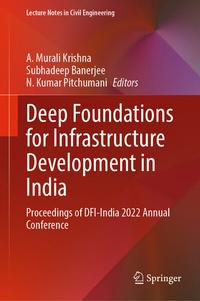
Deep Foundations for Infrastructure Development in India
Description

This book comprises select proceedings of the 11th annual conference of Deep Foundations Institute of India, DFI India 2022, held during 15-17 September 2022 in Tirupati. The conference showcased advancements in deep foundation technologies through articles on research and case histories. The book presents papers on deep foundation and deep excavation technologies for metro and high-speed rail; innovative techniques and testing for geotechnical investigations; monitoring, performance, and the QA-QC of deep foundations; challenges to working and the impact of existing codes with respect to technical innovations in deep foundations; ground improvement techniques for mass stabilization; geotechnics for marine, near-shore, and coastal constructions; research, experimental and numerical methods in deep foundations and deep excavation technologies; mono-piles and other advanced deep foundation systems; deep foundations in coralline and carbonate rocks and other unique and interesting papers related to deep foundation themes.
More details
Other editions
Additional editions
Persons
Prof. A. Murali Krishna is a faculty member of Civil & Environmental Engineering Department at Indian Institute of Technology (IIT), Tirupati, since May 2019. Before this, he was a faculty member in the Department of Civil Engineering at IIT Guwahati for about 11 years. Dr. Krishna obtained his Ph.D. from the Indian Institute of Science, Bangalore, M.Tech. from IIT Kanpur and B.Tech. from Sri Venkateswara University College of Engineering, Tirupati. His research interests include earthquake geotechnics, geosynthetics and ground improvement, site characterization and numerical and physical modelling of geotechnical structures. He is an executive member of Deep Foundations Institute (DFI) India, Indian Geotechnical Society. He co-authored nearly 200 publications of technical papers in international and national journals, conferences and seminar proceedings, including book chapters.
Dr. N. Kumar Pitchumani holds 30 years of experience in the field of Geotechnical Engineering, including experience in teaching and working as a practitioner. He has been responsible for various projects involving ground improvement of soft clays, reclamation fills and design of underground structures for metro projects. He is presently involved with the Chennai Metro, Kolkata Metro, and Patna Metro. Dr. Pitchumani obtained his Bachelor's in Civil Engineering in the year 1987 from Bombay University and later obtained his Master's and Ph.D. from IIT Kanpur in 1989 and 1992, respectively. He is a chartered engineer with Institution of Engineers, London, and level D-certified project management associate. He was an assistant professor at IIT Madras and worked in prestigious organizations, such as the National Institute of Rock Mechanics, L&T Ramboll, L&T ECC and COWI, Dubai, before joining AECOM.
Content
- Intro
- Foreword
- Preface
- Contents
- Deep Foundation and Deep Excavation Technologies for Metro and High Speed Rail
- A Case Study of Deep Shaft Excavation in River Channel Soil Deposit in Kolkata
- 1 Introduction
- 2 Brief Summary of the Case Study
- 3 Geological and Geotechnical Discussion
- 4 Finite Element Analysis and Results
- 5 Field Results
- 6 Discussion
- References
- Water Powered Percussive Downhole Hammers-Energy Savings and Productivity
- 1 Short Introduction to Different Drilling Technologies
- 2 Water DTH Versus Air DTH
- 3 The Venturi Effect
- 4 Water Hammers in Ground Treatment-Application Jet-Grouting
- 5 Jet-Grouting Hammer
- 6 Reference Case Brenner Base Tunnel
- 7 Reference Case Rio De Janeiro Metro-Jet-Grouted Columns for Station Box Construction
- 8 Summary
- References
- Excavation Techniques for Underground Drinking Water Pipeline with Micropiles as a Special Application
- 1 Micropiles
- 2 Stratigraphy and Subsurface Units
- 3 Geotechnical Design Parameters and Their Basis
- 4 Design of Micropile Wall (Shoring System)
- 5 Micropile Wall Stability Analysis
- 6 Strut and Waler Beam Design
- 7 Components of Micropile System
- 8 Grout Specification and Grout Quality Control
- 9 Sequence of Construction
- 10 Construction Issues and Challenges
- 11 Conclusion
- References
- Special Geotechnical Works for Metro Cairo (Egypt)
- 1 Introduction
- 2 Geotechnical Works for Metro Line 3
- 3 Main Equipment
- 3.1 Jet Grouting
- 4 Trench Stabilisation
- 5 Permeation Grouting
- 6 Jet Grouting
- 7 Soil Freezing
- 8 Outlook or Concluding Remarks
- Reference
- Deep Excavation by Controlled Rock Blasting Considering Ground Condition and Nearby Structures in UG Metro Station-A Case Study
- 1 Introduction
- 2 Human Response to Ground Vibration
- 3 Vibration Standards and Criteria to Prevent Structural Damage
- 3.1 Geology of the Area
- 4 Estimation of Peak Particle Velocity
- 5 Methodology
- 6 Discussion on FEM Modelling
- 7 Concluding Remarks
- References
- Safety Evaluation of Adjoining Structures in Urban Areas During Deep Excavation: A Case Study of Nagpur Metro
- 1 Introduction
- 2 Literature Review
- 2.1 General
- 3 Deep Excavations Hazards
- 3.1 Influence on Adjacent Buildings
- 3.2 Events of Structural Failures Due to Deep Excavation of Adjoining Structures
- 4 Protective Support Systems for Deep Excavation
- 5 Scope of Study
- 6 Numerical Modelling by MIDAS GTS NX 3D
- 6.1 Problem Definition
- 6.2 Model Development in MIDAS GTS NX 3D
- 6.3 Assigning Properties
- 6.4 Mesh Generation
- 6.5 Application of Load
- 6.6 Defining Non-linear Analysis
- 7 Analysis, Post-processing and Result Evaluation
- 8 Analysis, Post-processing and Result Evaluation
- 9 Results and Interpretation
- 10 Conclusions
- References
- Innovative Techniques and Testing for Geotechnical Investigations Monitoring, Performance, and QA-QC of Deep Foundations
- Forensic Evaluation of Bored Piles for a Factory Project at Jhajjar
- 1 Introduction
- 2 Tests Performed
- 3 Site Stratigraphy
- 4 Pile Load Tests
- 5 Low-Strain Pile Integrity Tests
- 6 Pile Coring
- 7 Probe Holes Around Piles
- 8 Condition of Some Exposed Piles
- 9 Conclusions
- References
- "Digital Specialist Foundations"-Using the Digital Twin During Project Execution
- 1 Using BIM Planning During Work Preparation
- 2 Using a Production Data and Process Management System for Specialist Foundations to Generate a Digital Twin
- 3 Web-Based Access to Aggregated Measuring and Production Data
- 4 Further Usage of Information from Construction Process in BIM and GIS Process
- 5 Summary and Conclusion
- Geotechnical Monitoring of Deep Shoring Adjacent to Train Infrastructure
- 1 Project Background
- 2 Instrumentation and Monitoring Plan
- 3 Baseline Monitoring
- 4 Construction Monitoring
- 5 Brace Removal
- 6 Conclusions
- A Review Low Strain Integrity Testing Practices in India and Complexities Involved in Evaluation of Test Results
- 1 Introduction
- 2 Testing Equipment
- 3 Data Acquisition and Evaluation
- 4 Low Strain Testing Software Features and Interpretation
- 4.1 Use of Magnification (MA) and Magnification Delay (MD)
- 4.2 Use of High Pass Filter (HI)
- 4.3 Testing of Micropiles or Piles with Reinforcement Closely Spaced
- 4.4 Incorrect Data Collection/Interpretation or Abuse of Data
- 5 Conclusion
- References
- Challenges to Working and the Impact of Existing Codes with Respect to Technical Innovations in Deep Foundations
- State-of-Art Working Platform for Heavy Equipments Used for Deep Foundation Construction
- 1 Introduction
- 2 Need for Temporary Working Platform
- 3 Existing Design Methods
- 3.1 Temporary Working Forum-TWf 2019:02
- 3.2 Br470
- 4 Upgradation with Technical Advancements
- 5 Case Study on Geosynthetic Reinforced Working Platform
- 6 Conclusion and Recommendation
- References
- Ground Improvement Techniques for Mass Stabilization
- Vibro Stone Columns with Preloading-An Effective Foundation Solution for Large Storage Structures
- 1 Introduction
- 2 Structure Details and Performance Criteria
- 3 Subsoil Conditions
- 4 Foundation Solution
- 5 Requirement for Preloading
- 6 Settlement Monitoring and Its Inferences
- 7 Conclusion
- References
- Application of Deep Mixing and Stone Column Techniques for Stabilization of Large Earth Cum Rock Fill (ECRF) Dam for an Irrigation Project
- 1 Introduction
- 2 Need for the Installation of the DSM Column Below the ECRF Dam
- 3 Designing the DSM Columns for Protection Works
- 4 Summary of the Geotechnical Data at the Job Site
- 4.1 Methodology for Trial Works for Deep Soil Mixing
- 4.2 Trial Columns
- 4.3 Deep Soil Mixing Technology and Work Sequence at Field Trial Works and Main Works
- 4.4 Methodology of Collection of Samples at Various Depths
- 4.5 Assessment of Improvement
- 4.6 Main Works
- 4.7 Post-performance Criteria for DSM Works
- 5 Details on the Design and Execution Works
- 5.1 Transition Zone
- 5.2 Introduction to Soil Stabilization Analysis
- 5.3 Soil Settlement
- 6 Conclusion
- References
- Ground Improvement By Controlled Modulus Columns-A West Africa Case Study
- 1 Introduction
- 2 Geotechnical Background
- 3 Ground Improvement Technique Proposals
- 4 Controlled Modulus Columns (CMC)
- 4.1 Displacement CMC (Fig. 4)
- 4.2 Drilled CMC Using Continuous Flight Auger (CFA) Drilling Equipment (Fig. 5)
- 5 Design and Modelling Philosophy of CMC
- 6 CMC Working Mechanism
- 7 Construction Stages of CMC Based on Geotechnical Investigations
- 8 Vertical Settlement Results
- 9 Load Test on CMC
- 10 Load Test Results
- 11 Summary, Concluding Remarks and Lessons Learnt
- References
- Stability Analysis of Micropile Reinforced Idukki Soil Slopes
- 1 Introduction
- 2 Stability Analysis of Idukki Soil Slopes
- 2.1 Properties of Soil Slopes
- 2.2 Numerical Modelling and Analysis of Soil Slopes
- 3 Stability Analysis of Micropile Reinforced Soil Slopes
- 3.1 Material Properties of Micropile
- 3.2 Geometrical Parameters of Micropile
- 3.3 Cap Beam
- 3.4 Modelling of Reinforced Soil Slopes
- 4 Results and Discussion
- 5 Conclusions
- References
- Performance of Stone Columns in Multi-Layered Soils Under the Action of Seismic Loads
- 1 Introduction
- 2 Soil Profile and Input Motion Characteristics
- 3 Numerical Modelling
- 3.1 Validation Study
- 3.2 Numerical Modelling for the Present Study
- 4 Results and Discussions
- 4.1 Excess Pore Water Pressure
- 4.2 Acceleration Time History
- 4.3 Vertical Deformation
- 4.4 Cyclic Stress Ratio
- 5 Conclusion
- References
- Geotechnics for Marine, Near-Shore, and Coastal Construction
- Geotechnical Assessment of Highly Saline Soil Stabilized with Fly Ash-Cement Admixtures
- 1 Introduction
- 2 Material Properties
- 2.1 Soil
- 2.2 Fly Ash (FA)
- 2.3 Cement
- 3 Experimental Programme
- 3.1 Unconfined Compressive Strength (UCS)
- 3.2 California Bearing Ratio
- 3.3 Electrical Conductivity
- 3.4 Durability
- 4 Results and Discussion
- 4.1 Influence of FA + Cement Treatment on CBR of Bhavnagar Saline Soil
- 4.2 Influence of FA + Cement Treatment on UCS Tests of Bhavnagar Saline Soil
- 4.3 Effect of FA-Cement Mix Treatment on Durability Characteristics of Bhavnagar Saline Soil
- 4.4 Effect of FA-Cement Mix Treatment on Salinity Characteristics of Bhavnagar Saline Soil
- 5 Conclusions
- References
- Recycled Polymer Application During Pile Boring Operations: A Review
- 1 Introduction
- 2 Background
- 3 Methodology-Boring Operation During Pile Foundation
- 4 Factors Considered While Selecting Suitable Supporting Fluid
- 5 Activities of Supporting Fluid Application During Pile Boring
- 5.1 Selection of Supporting Fluid Based on Soil Strata
- 5.2 Methodology Adopted During Fluid Preparation
- 5.3 Installation of Mixing Tank
- 5.4 Storage and Sedimentation Tanks
- 5.5 Stabilization of the Borehole
- 5.6 Slurry Regeneration
- 5.7 Test on Supporting Fluid
- 5.8 Disposal
- 5.9 The Performance of Supporting Fluid in Problematic Soils
- 6 Conclusions
- References
- Research, Experimental and Numerical Methods in Deep Foundations and Deep Excavation Technologies
- Reliability Analysis of Load Bearing Capacity of Single Pile Placed Adjacent to Existing Buried Conduit or Utility Tunnel
- 1 Introduction
- 2 Issue of Uncertainty in Geotechnical Parameters
- 3 Literature Background
- 4 Objective of the Present Study
- 5 Quantification of Uncertainty
- 6 Reliability Analysis
- 7 Response Surface Method (RSM)
- 8 Problem Statement
- 9 Numerical Modeling Procedure
- 10 Results and Discussion
- 11 Conclusions
- 12 Annexure I
- References
- Mono-piles and Other Advanced Deep Foundation Systems
- A Review on Pedestal Piles
- 1 Introduction
- 2 Bearing Capacity
- 2.1 Uplift Behavior of Piles
- 2.2 Lateral Behavior of Piles
- 2.3 Vertical Bearing Behavior
- 3 Summary and Conclusions
- References
- Trench Cutter Technology-The Multi-purpose Solution
- 1 Introduction
- 1.1 Retaining Walls
- 2 The Working Principle
- 2.1 Construction Sequence
- 2.2 Multi-purpose Solution
- 2.3 Cut-Off Walls
- 2.4 Foundation (Barrettes)
- 2.5 Mining Application
- 3 Site References
- 3.1 Execution of a Cut-Off Wall at the Dead Sea-Unique Conditions Require Unique Solutions (Gerressen et al. 2017)
- 3.2 Foundation/Barrettes: Residential Tower Bullfinch Crossing, Boston USA (Fraley 2018)
- 3.3 Mining Application: FalCon Project, Sasketchewan Canada (Gerressen et al. 2020)
- 4 Conclusion
- References
- Monopile Construction Technique for Mumbai Coastal Road Package 1-Mumbai
- 1 Introduction
- 2 Environmental Brief
- 3 Geological Brief
- 4 Advantages in Adopting Monopile
- 5 Monopile Construction Technique
- 5.1 Phase 1-Liner Pitching
- 5.2 Phase II-Positioning of PBA
- 5.3 Phase III-Positioning of BHA
- 5.4 Phase IV-Reverse Circulation Drilling
- 5.5 Phase V-Flushing and Reinforcement Cage Lowering
- 5.6 Phase VI-Concreting and Chipping
- 5.7 Phase VII-Testing of the Monopile
- 6 Test Requirements for the Monopile
- 6.1 Types of Tests for Monopile
- 7 Vertical Pile Load Test (Bi-Directional Pile Load Test)-Load Testing Procedure
- 8 Lateral Pile Load Test
- 9 Dynamic Pile Load Test
- 10 Conclusions
- References
- Deep Foundations in Coralline and Carbonate Rocks, and Any Other Unique and Interesting Papers Related to Deep Foundation Themes
- Installation of Three Up to 120 m Deep Diaphragm Wall Shafts, with Diameters Between 8 m and 35 m at Woodsmith Mine in North Yorkshire (England)
- 1 Introduction
- 2 Project Description
- 2.1 Diaphragm Wall
- 2.2 Design
- 3 Main Equipment
- 4 Tolerances
- 5 Spacers
- 6 Polymer
- 6.1 B-tronic Activity
- 7 Health and Safety
- 7.1 Summary and Conclusions
- References
- Replacing Top Layer of Soft Clay with Compacted Engineering Fill to Improve the Lateral Capacity of Piles
- 1 Introduction
- 2 Project Scope and Stratigraphy
- 3 Foundation Details for LNG Tank
- 4 Design Lateral Load and Pile Deflection from L-Pile Analysis for Actual Existing Soil Data
- 5 Improved Soil Parameters and Initial Load Test
- 6 Conclusion
- References
