

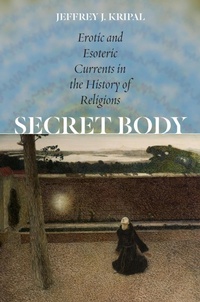
Secret Body
Erotic and Esoteric Currents in the History of Religions
Published on 22. December 2022
448 pages
978-0-226-49148-6 (ISBN)
Description

"An academic memoir... addresses topics as diverse as Hindu Tantra, Christian mysticism, American counterculture, and the history of the paranormal." -Los Angeles Review of Books
Over the course of his twenty-five-year career, Jeffrey J. Kripal's study of religion has had two major areas of focus: the erotic expression of mystical experience and the rise of the paranormal in American culture. This book brings these two halves together in surprising ways through a blend of memoir, manifesto, and anthology, drawing new connections between these two realms of human experience and revealing Kripal's body of work to be a dynamic whole that has the potential to renew and reshape the study of religion.
Kripal tells his story, biographically, historically and politically contextualizing each of the six books of his Chicago corpus, from Kali's Child to Mutants and Mystics, all the while answering his censors and critics and exploring new implications of his thought. In the process, he begins to sketch out a speculative "new comparativism" in twenty theses. The result is a new vision for the study of religion, one that takes in the best of the past, engages with outside critiques from the sciences and the humanities, and begins to blaze a new positive path forward. A major work decades in the making, Secret Body will become a landmark in the study of religion.
"Kripal presents us with a compilation of theories, cultural references and anecdotes making up an impassioned thesis about the future of religious studies and 'what human beings may become'... For all its eccentricities, Kripal's work is playful, engaging and original." - Times Higher Education
Over the course of his twenty-five-year career, Jeffrey J. Kripal's study of religion has had two major areas of focus: the erotic expression of mystical experience and the rise of the paranormal in American culture. This book brings these two halves together in surprising ways through a blend of memoir, manifesto, and anthology, drawing new connections between these two realms of human experience and revealing Kripal's body of work to be a dynamic whole that has the potential to renew and reshape the study of religion.
Kripal tells his story, biographically, historically and politically contextualizing each of the six books of his Chicago corpus, from Kali's Child to Mutants and Mystics, all the while answering his censors and critics and exploring new implications of his thought. In the process, he begins to sketch out a speculative "new comparativism" in twenty theses. The result is a new vision for the study of religion, one that takes in the best of the past, engages with outside critiques from the sciences and the humanities, and begins to blaze a new positive path forward. A major work decades in the making, Secret Body will become a landmark in the study of religion.
"Kripal presents us with a compilation of theories, cultural references and anecdotes making up an impassioned thesis about the future of religious studies and 'what human beings may become'... For all its eccentricities, Kripal's work is playful, engaging and original." - Times Higher Education
More details
Other editions
Additional editions
Jeffrey J. Kripal
Secret Body - Erotic and Esoteric Currents in the History of Religions
Book
11/2017
University of Chicago Press
€48.36
Article not available at the moment
Person
Jeffrey J. Kripalis the J. Newton Rayzor Professor of Philosophy and Religious Thought and Associate Dean of the School of Humanities at Rice University. He is the author of several books, including
Esalen: America and the Religion of No Religionand
The Serpent's Gift: Gnostic Reflections on the Study of Religion.
Content
- Intro
- Contents
- Opening: "You Should Write Fiction"
- Corpus
- 1. In the Land of Oz: Childhood and Adolescence
- Letter to the Editor: The Buyer's Guide (1977)
- 2. "My Eros Has Been Crucified": Puberty, Asceticism, and Neurosis
- On the Fiction of a Straight Jesus (2008)
- 3. That Night: Wherein the Knowing Energies Zap Me
- The Preface that I Did Not Publish (ca. 1994)
- 4. The Erotic Mystic: Kali's Child and the Backlash against It
- Secret Talk: Sexual Identity and the Politics of Scholarship in the Study of Hindu Tantrism (2000)
- 5. The Transmoral Mystic: What Both the Moralists and the Devotees Get Wrong
- Inside-Out, Outside-In: Existential Place and Academic Method in the Study of North American Guru Traditions (1999)
- 6. How They Really Came to Their Ideas: The Deeper Roots of Thought and Theory
- The Visitation of the Stranger: On Some Mystical Dimensions of the History of Religions (1999)
- 7. The Gnostic Reversal: The Snake That Bites Its Own Tail
- Gnosisssss: A Response to Wouter Hanegraaff (2008)
- 8. Wendy's Student: Mythical Paradox and Political Censorship
- Being Blake: Antinomian Thought, Counterculture, and the Art of the History of Religions (2010)
- Mysticum
- 9. That Other Night: The Future of the Body and Evolutionary Esotericism
- Esalen: America and the Religion of No Religion (2007)
- 10. The Filter Thesis: The Irreducible Nature of Mind and the Spirit of the Humanities
- An Island in Mind: Aldous Huxley and the Neurotheologian (2013)
- 11. The Rise of the Paranormal: And Some Related X Factors in the Study of Religion
- Authors of the Impossible: Reading the Paranormal Writing Us (2010-2014)
- The Matter of Myth and the Myth of Matter (2011)
- 12. La Pensée Surhumaine: Paraphysics, the Super Story, and Invisible Colleges
- Forbidden Science: A Late Night Chat with Jacques Vallée (january 24, 2012)
- La Madonna Dell'UFO (2015)
- 13. Comparing Religions in Public: Rural America, Evangelicals, and the Prophetic Function of the Humanities
- The Chess Game (February 22, 2015)
- 14. The Super Natural: Biological Gods, the Traumatic Secret, and the Future (of) Race
- Better Horrors: From Terror to Communion in Whitley Strieber's Communion (2015)
- Meum
- 15. The New Comparativism: What It Is and How to Do It
- Transmigration and Cultural Transmission: Comparing Anew with Ian Stevenson (2017)
- Closing: What the New Sacred Is (Not)
- Airport Afterword
- Appendix: The Gnomons
- The Method of All Methods
- Acknowledgments
- Notes
- Index of My Brain
