

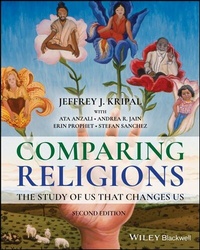
Comparing Religions
Description

Teaches students the art and practice of comparison in the globalizing world, fully updated to reflect recent scholarship and major developments in the field
Comparing Religions: The Study of Us that Changes Us is a wholly original, absorbing, and provocative reimagining of the comparative study of religion in the 21st century. The first textbook of its kind to foreground the extraordinary or "paranormal" aspects of religious experience, this innovative volume reviews the fundamental tenets of the world's religions, discusses the benefits and problems of comparative inquiry, explores how the practice can impact a person's worldview and values, and much more.
Asserting that religions have always engaged in comparing one another, the authors provide insights into the history, trends, debates, and questions of explicit comparativism in the modern world. Easily accessible chapters examine the challenges of studying religion using a comparative approach rather than focusing on religious identity, inspiring students to think seriously about religious pluralism as they engage in comparative practice. Throughout the text, a wealth of diverse case studies and vivid illustrations are complemented by chapter outlines, summaries, toolkits, discussion questions, and other learning features. Substantially updated with new and revised material, the second edition of Comparing Religions:
- Draws from both comparative work and critical theory to present a well-balanced introduction to contemporary practice
- Explains classic comparative themes, provides a historical outline of comparative practices, and offers key strategies for understanding, analyzing, and re-reading religion
- Draws on a wide range of religious traditions to illustrate the complexity and efficacy of comparative practice
- Embraces the transcendent nature of the religious experience in all its forms, including in popular culture, film, and television
- Contains a classroom-proven, three-part structure with easy-to-digest, thematically organized chapters
- Features a companion website with information on individual religious traditions, additional images, a glossary, discussion questions, and links to supplementary material
Comparing Religions: The Study of Us that Changes Us, Second Edition, is the perfect textbook for undergraduate students and faculty in comparative religion, the study of religion, and world religions, as well as a valuable resource for general readers interested in understanding this rewarding area.
More details
Other editions
Additional editions
Persons
Jeffrey J. Kripal is the J. Newton Rayzor Chair in Philosophy and Religious Thought at Rice University. His most recent publications include The Superhumanities: Historical Precedents, Moral Objections, New Realities and The Flip: Who You Are and Why It Matters.
Ata Anzali is an Associate Professor of Islamic Studies at Middlebury College. His current research focuses on the social and intellectual history of religious thought in modern Iran. He has a special interest in mystical and fundamentalist movements. He is the author of Mysticism in Iran: the Safavid Roots of a Modern Concept.
Erin Prophet is an Assistant Instructional Professor in the Department of Religion at the University of Florida. Among her publications are "Charisma and Authority in New Religious Movements" in the Oxford Handbook of New Religious Movements, Volume II.
Andrea R. Jain is a Professor of Religious Studies at Indiana University, the editor of the Journal of the American Academy of Religion, and the author of Selling Yoga: From Counterculture to Pop Culture and Peace Love Yoga: The Politics of Global Spirituality. Her areas of research include religion and capitalism, global spirituality, and theories of religion.
Stefan Sanchez is a PhD candidate at Rice University's Department of Religion. Their research focuses on themes of personal identity and conceptions of nature in Latin American and Indigenous American philosophy and mysticism.
Content
Prologue: "Welcome to the Future" xvii
A Comment on the Cover Image and the Paintings xxvi
List of Illustrations xxvii
Acknowledgments ... and Color xxxi
Part I Prehistory, Preparation, and Perspective 1
Introduction: Beginnings 3
1 If Horses Had Hands: Comparative Practices in Global History 9
2 From the Bible to the Buddha: Recent History of the Modern Practice 47
3 The Magic of Comparison: Reflexivity and Some Related Skills 87
Part II Comparative Acts 123
4 Telling and Performing the World: The Creative Functions of Myth and Ritual 125
5 The Super Natural: Religion, Nature, and Science 161
6 Seed and Soil: Sex, Race, and the Bodies of Religion 199
7 Transmitting the Power: Charisma, Society, Technology 239
8 Angels, Aliens, and Art: The Imagination and the Paranormal 275
9 The Human as Two: Soul, Salvation, and the End of All Things 313
Part III Putting It All Together Again 349
10 Faithful Rereadings: Exclusivism, Inclusivism, Pluralism, and Justice 353
11 Rational Rereadings: Masters of Suspicion, Classical and Contemporary 389
12 Reflexive Rereadings: Looking at the Looker 427
Epilogue: The Moonshot 465
Glossary 469
Index 483
Prologue
"Welcome to the Future"
La Mestiza Cosmica (1991), by Lynn Randolph, 40" × 24"
If I was pushed to say what kind of book this is, I might call it a textbook from the future.
Andrew R. Gallimore, Alien Information Theory
When they come it is like someone shines a bright light behind the movie screen and obliterates the scene. What we perceive as the movie screen, what we call reality, they burn through, proving it's only a construct, a version of reality.
an experiencer in Ralph Blumenthal, The Believer: Alien Encounters, Hard Science, and the Passion of John Mack
It is a pleasure and, I confess, a relief to be able to update this textbook for its teachers and readers with my gifted cowriters.1 As I explained in the first edition, I knew from the instant we finished the book in 2013 that it had problems, or at least loud silences. There always are. But so much has happened since then around the world. There is a palpable urgency in the air. There is also a widespread sadness, despair, and depression, even as there are also the faintest glimmerings of hope.
As the polls have consistently been showing us, young people in many countries are turning away in large numbers from traditional religion and setting out on their own to form new worldviews and future spiritualities, many of them organized around social justice, the environment, and magical practice. And why not? These young people are sick and tired of the hatred, exclusion, and bigotry that "religion" has come to represent for so many in the modern world. They want something more-more just, more joyful, and more cosmic.
I personally could not respond earlier, partly because I could not quite hear what I needed to hear, partly because of the overwhelming existential circumstances of the global pandemic, partly because of some very practical administrative duties at my own university (I was working as an Associate Dean of our School of Humanities and so listening on another level). But I can hear much more now, and so I can write more. I am sure it is still not enough.
It never is.
Global Events
How could it be enough? The entire world has been convulsing in endless visible and invisible ways. A global pandemic began to rage in the early months of 2020. At the time of this writing, over five million people have died gasping suffocating deaths, and countless others have suffered long-term health effects. Just as seriously, the numberless visionary and ecstatic reports of those who emerged from days, weeks, even months of ventilated near-death comas were brushed off in the media as little more than "COVID mania," or some other such easy nonsense. What could have been a transformative global confrontation with religious belief around the afterlife was basically erased with easy rhetorical hand-waves.
While the actualized biological horrors and unactualized spiritual openings of the crowned virus were just beginning, a vast four-century history of trans-Atlantic slavery, untold dehumanization and violence, and contemporary structural racial injustice of unimaginable scope broke into broad public awareness in the US, as too many conservative politicians and their voters denied basic historical facts. That denial continues to this day. And the European world is hardly innocent. Similar patterns and moral awakenings around Euro-American colonialism have been evident for decades. And the more we know, the worse it gets.
As this related racial and colonial reckoning develops in the US and Europe, the climate and oceans around the world have continued to warm, die, storm, enflame, and flood, largely, we know perfectly well, because of human economic activity and the cultural values, capitalisms, and ethnocentrisms that drive this carbon-burning activity (historically in the US and Europe but now increasingly in China). As the oceans rise and suffer untold pollution and plastic, the planet burns, and very much because of human "values" and their consequences.
As if a deadly pandemic, racist and postcolonial histories, and a global climate crisis were not enough, the UFO, which the first edition of this textbook treated as a topic of study, took on some fairly serious media and then military and political attention. More specifically, the New York Times began to break a series of stories late in 2017 on professional pilots, a secret US government research program, and released radar returns from fighter jets. The latter radar videos clearly show, well, a flying saucer and, in another case, a now famous "tic-tac" zipping around over the Pacific Ocean, effortlessly avoiding and inexplicably prejudging the secret maneuvers of the US military.2 Suddenly, the arrogant sneers and eye-rolls made less sense. An official US government report on the problem, now dubbed, as something of a dodge in my opinion, the UAP (for Unidentified Aerial Phenomenon), was issued in the summer of 2021. Congressional hearings on the release of the information and what it might mean were held in May of 2022. NASA got involved in June of the same year and formed a research team (with not a single humanist, historian, or scholar of religion on it). A high-level former intelligence officer stepped forth as a legally protected whistleblower in the summer of 2023. The entire topic, which no one really understands, is getting "hotter" and "hotter" as the present book goes to press.
And that was just the "hard" technological aspect of the phenomena with which the secular media could cope, could accept, still, alas, as some kind of potential military or national "threat." The paranormal dimensions of the UFO phenomenon continue to haunt. As I write these lines, the ability of thoughtful people to separate the technological and the anomalous aspects grows increasingly problematic, if not actually absurd.3 Are such spinning presences in the sky symptoms of our inevitable endings? Warnings of what is to come? Signs of cosmic hope? Visits from the dead? Or something else entirely? Or should we just go back to our dull denials and continue to repeat the same-old-same-old?
Oh, that will work.
Clearly, the world as many once knew it is simply no longer so. That world has ended in invisible viruses, racist religions, colonial histories, flooding cities, a burning planet, and now spirit-like ships in the sky. In truth, the world ended a long time ago for many African American communities, whose ancestors had literally been kidnapped and whisked away on strange foreign ships, died in the stinking holds of these craft before they were thrown overboard into an ocean grave, sold as nonhuman animals, enslaved in the "New World" (it was not new), and then routinely murdered, marginalized in endless ways (like being defined by the US Constitution as three-fifths of a person), threatened, and hung on trees in front of white churches, with postcards announcing the murderous event and body parts cut off and shared as souvenirs.
Yes, it was that evil.
And that is before we even get to all of the indigenous communities of the Americas, who similarly died in endless ways, from foreign diseases and viruses to which they had no immunities, through forced "education" in Western and Christian ways, to imprisonment, open war, the slaughtering of the buffalo, and physical exile. Then, particularly in the Latin American region, there were what the Europeans called "demonic" religious and ritual consumption of psychoactive plants. Frankly, it has been a moral horror show. Once again, the more we know about these histories, the worse it looks. Because it is.
As human communities grapple with (or deny) these various ends of the world, a new global civilization is still in the throes of emerging, or dying, or both. What the world, or the worlds, will someday look like no one knows. But one thing seems certain enough, or so the present textbook will argue: these new worlds will very much depend on how individuals and their communities choose to compare themselves, not only in relationship to one another but also in relationship to the earthly environment and the extraterrestrial cosmos in which this Earth so predictably orbits a medium-sized star.
We are star-people, an evolved species of a vast cosmos who originally came out of Africa and whose bodily elements were once forged in dying stars. As star-beings to our carbon core, perhaps we cannot help but look deep down and way back, but also up and forward, to what we cannot yet see or agree. We are certainly going to do both-look down, and look up-in the following pages. The textbook will attempt to recognize both our endless historical and earthly contexts, all of them different, but also our shared cosmic context, all of it the same. We look down. We look up. We look back. We look forward. We mourn. We know guilt and duplicity. We hope for better futures, sometimes without any good reason at all.
The Superhumanities
Very much troubled and inspired by all of these recent microbial, racist, colonial, environmental, and ufological events, perhaps nothing has been more influential on my own re-writing than what I have called-largely in response to this last decade-the superhumanities.4 The book is not only a...
