

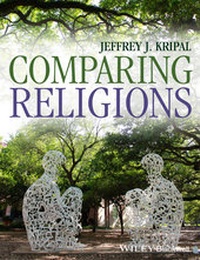
Comparing Religions
Description

Reviews / Votes
"This volume is highly recommended for undergraduates, andeven graduate students and general readers." (Religious Studies Review, 1 September 2014) "This book offers the most original and provocativerecasting of the comparative study of religion in decades, andit's aimed just where we need this rethinking the most: theclassroom. Other textbooks tend to work with a checklist ofsubjects as they summon the major religions serially to the stage.Kripal starts instead with the mystery of the comparative actitself, allowing that to determine what he brings forward for ourattention. So it's charisma, sex, the paranormal, and'soul practices' more than it's Hinduism,Buddhism, Islam. Kripal recognizes the comparativist in each of usand urges us to take it seriously. The result is deep and wide, andexcitingly open-minded." John Stratton Hawley, Barnard College, ColumbiaUniversity "Armed with an extensive array of case studies and arichly diverse portfolio of illustrations, Kripal not only providesa lucid survey of the 'facts' of the world'sreligions, but inspires us to embrace the fundamentallytranscendent nature of the religious experience in all of itsmanifestations, both ordinary and uncanny, and to confront theinherent challenges of studying religion in a responsiblycomparative manner. Comparing Religions is a masterlyexample of how a book intended for the classroom can be aninvigorating stimulus toward new ways of thinking about aphenomenon that pervades every aspect of our world." Sarah Iles Johnston, The Ohio State University "Kripal is at his very best in this exceptionalintroduction to the study of religion. After a self-reflexivejourney through the religious realms of myth, ritual, nature,science, sex, charisma, soul, salvation, and the imagination andits paranormal powers, we are guided to put it all back togetherwith an eye to religious tolerance, freedom, and pluralism. Thisbook is the red pill. Ingest it and you will beenlightened." April D. DeConick, Rice University "Comparing Religions is a lucid, entertaining, andeven fun introduction to the comparative study of religion. It willbe effective with its target audience, young people and theundergraduate classroom, because, while they must wrestle with theway scholars deconstruct and reduce to social or evolutionaryfunctions such phenomena, Kripal never loses sight of theexperiences and meanings of those transformed by, engaged in, andmobilized through it. There is no better single volume to enticestudents into the fraught and fascinating study ofreligion." Bron Taylor, author of Dark Green Religion: NatureSpirituality and the Planetary Future and editor of TheEncyclopedia of Religion and Nature "Jeffrey Kripal provides a thoughtful and compellingdiscussion of key themes, ideas, and challenges that ground thestudy of religion across traditions and geographies. It is alayered and textured treatment that will capture the imaginationand engage students from start to finish. This important and timelytext is not to be missed." Anthony B. Pinn, author of Introducing African AmericanReligionMore details
Other editions
Additional editions
Persons
Content
An Important Note to the Instructor xi
A Comment on the Cover Image and the Paintings xv
List of Illustrations xvi
Acknowledgments xx
Part I Prehistory, Preparation, and Perspective 1
Introduction: Beginnings 3
1 Comparative Practices in Global History: If Horses Had Hands 9
The Comparative Practices of Polytheism 11
The Comparative Practices of Monotheism: Early Judaism 16
The Comparative Practices of Monotheism: Early Christianity 20
The Comparative Practices of Monotheism: Early Islam 27
The Comparative Practices of Asia: Hinduism 33
The Comparative Practices of Asia: Sikhism 36
The Comparative Practices of Asia: Confucianism, Daoism, and Buddhism in China 38
The Tough Questions 39
2 Western Origins and History of the Modern Practice: From the Bible to Buddhism 43
Deep Upstream: Mystical Humanists, Protesters, Rationalists, and Romantics 44
Mid-Upstream: "Not as Moses Said," or the Biblical Beginnings of Critical Theory 54
Just Upstream: Colonialism and the Modern Births of Spirituality and Fundamentalism 58
The Immediate Wake: Counterculture, Consciousness, Context, and Cosmopolitanism 67
The Tough Questions 73
3 The Skill of Reflexivity and Some Key Categories: The Terms of Our Time Travel 77
The History of Religions 79
Patterns of Initiation 82
The Humanities: Consciousness Studying Consciousness 85
Cultural Anthropology and Initiation Rites 88
Working Definitions and Their Histories 89
The Uncertainty Principle: The Insider-Outsider Problem (and Promise) 103
Religious Questions as Ultimate Concerns 105
The Tough Questions 106
Part II Comparative Acts 109
4 The Creative Functions of Myth and Ritual: Performing the World 111
Myth: Telling the Story Telling Us 113
Ritual: Acting Out the Story Acting Us 116
Patterns in Myth 120
Patterns in Ritual 125
Comparative Practice: The Awakened One and the Great Hero in Ancient India 133
Beginning a Toolkit 138
The Tough Questions 139
5 Religion, Nature, and Science: The Super Natural 143
Religion and Contemporary Science 145
The Paradox of the Super Natural 146
Food and Purity Codes: "You Are What You Eat" 149
New Directions: Space Exploration, Dark Green Religion, and Popular Culture 154
Comparative Practice: The Human Plant 164
The Toolkit 172
The Tough Questions 173
6 Sex and the Bodies of Religion: Seed and Soil 177
In the Beginning ... 178
The Social Body: Sexuality, Gender, and Sexual Orientation 181
Sex and Transgression 188
Super Sexualities 192
The Sexual Ignorance of the Religions 195
Comparative Practice: The Two Ann(e)s 198
The Toolkit 204
The Tough Questions 205
7 Charisma and the Social Dimensions of Religion: Transmitting the Power 209
Charisma and Community 211
The Institutionalization of Charisma: Passing on the Charge 215
Patterns of Special Institutions 221
The Miracle and the Saint: Signs of the (Im)possible 226
Comparative Practice: The Flying Saint and the Levitating Medium 229
The Toolkit 234
The Tough Questions 235
8 The Religious Imagination and Its Paranormal Powers: Angels, Aliens, and Anomalies 239
System and Anomaly: Paranthropology 241
The Sixth Super Sense 244
The Imaginal: Not Everything Imagined Is Imaginary 249
The Comparative Practices of Popular Culture 253
Miracles in the Making: The Fortean Lineage 258
Fact and Fraud: On the Trick of the Truth 259
Comparative Practice: Supernatural Assault Traditions 261
Adding to Our Toolkit 266
The Tough Questions 267
9 The Final Questions of Soul, Salvation, and the End of All Things: The Human as Two 271
Two Scenes 272
The Nature of Embodied Consciousness 275
Patterns of the Soul and Salvation in the History of Religions 276
Soul Practices 280
Traumatic Technologies of the Soul 284
Comparative Eschatologies 286
Comparative Practice: Re-Death, Near-Death, and After-Death Experiences 288
The Toolkit 294
The Tough Questions 296
Part III Putting It All Together Again 299
10 Faithful Re-readings: Exclusivism, Inclusivism, Pluralism, and Justice 303
The Task of Theology: Relating Reason and Revelation 306
Excluding the Other Religious Worldview from One's Own 313
Including the Other Religious Worldview within One's Own 315
Encountering the Sacred within and beyond All Religious Worldviews 318
Comparison Is Justice: Liberation, Black, Feminist, and Queer Theologies 321
Nuances: Faith and Scholarship 331
The Tough Questions 331
11 Rational Re-readings: Masters of Suspicion, Classical and Contemporary 335
When Religion Doesn't Work 336
On the Heart of Reductionism: "There Is No Gap" 337
Sigmund Freud: Religion Is a Childish Illusion 340
Émile Durkheim: Religion Is Society Worshipping Itself 344
Postcolonial Theory: The Gaze of Empire 348
On Spirit and Spandrels: Cognitive Science, Evolutionary Psychology, and Cultural Evolution 350
The Study of Religion and Violence before and after 9/11 357
The Tough Questions 361
12 Reflexive Re-readings: Looking at the Looker 365
The School of the More 366
Four Exemplars of Reflexive Re-reading 368
The Phenomenology of Religion: What Is versus What Appears 371
Reflexively Re-reading Miracle: The Man in the Door 372
The Filter Thesis: The Door in the Man 379
Neuroscientists at the Cusp 383
Concluding Thoughts: Culture, Cognition, and Consciousness 389
The Tough Questions 392
... and Cosmos: Epilogue from Houston 397
Glossary 401
Index 413
Illustrations
The Reader (2011), digital artwork by Rob Beschizza for BoingBoing and
Jeffrey J. Kripal, “Psi-Fi: Popular Culture and the Paranormal.”
Listen to the Amniotic Cosmos—Once Upon a Time again (1991), by Lynn Randolph.
Diptych, left panel, 36″ × 28″.
El mano poderoso (1990), by Lynn Randolph, 58″ × 46″.
Giant stone statue portraying the Egyptian pharaoh Ramses II (c. thirteenth
century BCE) as Osiris (the god of the afterlife). Abu Simbel temple, Egypt.
Photographed by Andrew Holt. © Andrew Holt/Getty Images.
A Difficult Passage of the Talmud, by Isaac Snowman. © Bettmann/Corbis.
Adoration of the Magi (1423), by Gentile da Vabriano. Galleria dei Uffizi, Florence,
Italy. © Corbis.
The Masjid al-Haram or “Sacred Mosque” surrounding the Kaba in Mecca,
Saudi Arabia. © Nabeel Turner/Getty Images.
Hindu pantheon (c. 1985–1997). Sri Murugan Temple near Hampi, India.
© Bennett Dean/Eye Ubiquitous/Corbis.
Guru Nanak, by Amarjit Singh. © INTERFOTO/Amarjit Singh/Mary Evans.
Eagle Pneuma (2003), by Lynn Randolph, 36″ × 48″.
Portrait of Giovanni Pico Della Mirandola (seventeenth century), anonymous.
Galleria degli Uffizi, Florence, Italy. Photographed by Stefano Bianchetti.
© Stefano Bianchetti/Corbis.
Luther and the Heroes of the Reformation (1874), hand-colored lithograph
by H. Schile. © Corbis.
Declaration of the Rights of Man and Citizen (1789), French painting. © The Gallery Collection/Corbis.
Emerson’s experience of himself as an egoless “transparent eyeball” (1837–1839),
humorous drawing by Christopher Pearse Cranch.
The Beatles’ Sgt. Pepper’s Lonely Hearts Club Band album cover (1967).
Pictorial Press Ltd/Alamy.
The Shepherdess (1989), by Lynn Randolph, 46″ × 58″.
Plato’s Cave (2007), by Ken Stout. Oil on panel, 12″ × 16″.
Zal Consults the Magi (sixteenth century), attributed to Sultan Muhammad.
Metropolitan Museum of Art, New York. Gift of Arthur A. Houghton Jr., 1970, Acc.n.1970.301.8.
Image © 2013 The Metropolitan Museum of Art/
Art Resource/Scala, Florence.
Mobiüs strip. Computer artwork, Laguna Design/Science Photo Library/Corbis.
Leaving (2001), by Lynn Randolph, 16″ × 20″.
Time’s Journey (1987), by Lynn Randolph, 58″ × 46″.
The Prophet Muhammad’s Ascent to Heaven (1584), unknown artist. Folio from
a manuscript of the Khamsa (Iskandarnama) by Nizami. Ink opaque watercolor
and gold on paper, 39.5 × 26.2 cm (15 9/16″ × 10 5/16″). Harvard Art Museums/
Arthur M. Sackler Museum. The Norma Jean Calderwood Collection of Islamic Art. 2001.50.33.
Photo: Imaging Department © President and Fellows of Harvard College.
A re-enactment of the Dogon people’s creation story, Mali. © Amar Grover/Getty Images.
Staff used by Yoruba peoples (Oyo subgroup), Nigeria, for the worship of Esu/Elegba,
Ogo Elegba, before 1930s (?). Wood, leather, cowrie shells, brass, bone, iron; H 19 1/4″
(50.7 cm); Raymond and Laura Wielgus Collection; Indiana University Art Museum,
87.42.2. Photographed by Michael Cavanaugh and Kevin Montague.
Fireworks on the Birds Nest National Stadium, opening ceremony, 2008 Olympic
Games, Beijing, China. © Christian Kober/Robert Harding World Imagery/Corbis.
Ancient Rome: The Oracle of the Sacred Chickens, colored engraving by Heinrich
Leutemann (1824–1905). © Stefano Bianchetti/Corbis.
A fifty-five-foot tall icon of the Jain kevalin, Gomateshwara Bahubali,
Shravanabelagola, Karnataka, India. Every twelve years, Jains consecrate the image
with various libations in a ritual called the Mahamasthak Abhisheka. Here devotees
pour turmeric water over the image. Photographed by Andrea R. Jain (2006).
Buddha, thirteenth century. Bangkok, Thailand. Jim Thompson House. Image
© Luca Tettoni/Corbis.
Big Bend Lightning (1985), by Lynn Randolph, 36″ × 36″.
The ancient Hebrew conception of the universe (2010), by Michael Paukner.
The ancient Greek cosmology, engraving by Andreas Cellarius from Atlas Coelestis
(1661). Barcelona, Biblioteca de Catalunya (National Library of Catalonia).
Photo © Mary Evans/M. C. Esteban/Iberfoto.
Chariot of Elijah, from the Verdun Altar by Nicolas of Verdun (c. twelfth century).
© Alfredo Dagli Orti/The Art Archive/Corbis.
A field of galaxies through the Hubble Space Telescope. One of the most distant regions
of the universe ever imaged, near the limit of the visible universe. © Corbis.
Young shaman dancing during initiation. Inchon City, South Korea (2008).
Photographed by Stefano De Luigi/VII/Corbis.
Poster for Dennis McKenna’s lecture at Rice University (2013), by Dean Mackey,
Rice University Public Affairs.
St. Albert and the LSD Revelation Revolution (2006), by Alex Grey. Oil on wood panel,
24″ × 36″.
Sacred Wedding in the Night (2002), by Lynn Randolph, 36″ × 28″.
Adam and Eve Banished from Paradise (1610), from Hadiqat al-Suada (Garden
of the Blessed), Baghdad (vellum), Islamic school (seventeenth century).
Topkapi Palace Museum, Istanbul, Turkey/The Bridgeman Art Library.
Rainbow body (c. 2007), Tibetan ritual painting or thangka. Private collection
of Timothy Morton. Photographed by Jenna L. Kripal (2013).
The Resurrection of Christ (c. 1512–1516), from the Isenheim Altarpiece, right wing
(c. 1512–16), oil on panel by Matthias Grünewald (Mathis Nithart Gothart)
(c. 1480–1528). Musée d’Unterlinden, Colmar, France/The Bridgeman Art Library.
Vajrasattva (c. 2007), Tibetan ritual painting or thangka. Private collection
of Timothy Morton. Photographed by Jenna L. Kripal (2013).
Sages with Yin Yang symbol, Kang Hsi period (1661–1722). Painted ceramic,
Chinese School. Private collection, Ancient Art and Architecture Collection Ltd.,
The Bridgeman Art Library.
Reading DNA strands with ultraviolet light. © Karen Kasmauski/Corbis.
Ecstatic Man (1988), by Lynn Randolph, 58″ × 46″.
Shakti-Pat...
