

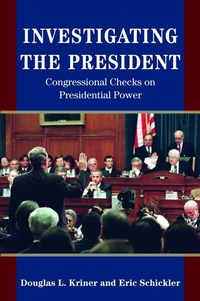
Investigating the President
Congressional Checks on Presidential Power
1st Edition
Published on 30. August 2016
304 pages
978-1-4008-8363-9 (ISBN)
Description

Although congressional investigations have provided some of the most dramatic moments in American political history, they have often been dismissed as mere political theater. But these investigations are far more than grandstanding. Investigating the President shows that congressional investigations are a powerful tool for members of Congress to counter presidential aggrandizement. By shining a light on alleged executive wrongdoing, investigations can exert significant pressure on the president and materially affect policy outcomes.
Douglas Kriner and Eric Schickler construct the most comprehensive overview of congressional investigative oversight to date, analyzing nearly thirteen thousand days of hearings, spanning more than a century, from 1898 through 2014. The authors examine the forces driving investigative power over time and across chambers, identify how hearings might influence the president's strategic calculations through the erosion of the president's public approval rating, and uncover the pathways through which investigations have shaped public policy. Put simply, by bringing significant political pressure to bear on the president, investigations often afford Congress a blunt, but effective check on presidential power-without the need to worry about veto threats or other hurdles such as Senate filibusters.
In an era of intense partisan polarization and institutional dysfunction, Investigating the President delves into the dynamics of congressional investigations and how Congress leverages this tool to counterbalance presidential power.
Douglas Kriner and Eric Schickler construct the most comprehensive overview of congressional investigative oversight to date, analyzing nearly thirteen thousand days of hearings, spanning more than a century, from 1898 through 2014. The authors examine the forces driving investigative power over time and across chambers, identify how hearings might influence the president's strategic calculations through the erosion of the president's public approval rating, and uncover the pathways through which investigations have shaped public policy. Put simply, by bringing significant political pressure to bear on the president, investigations often afford Congress a blunt, but effective check on presidential power-without the need to worry about veto threats or other hurdles such as Senate filibusters.
In an era of intense partisan polarization and institutional dysfunction, Investigating the President delves into the dynamics of congressional investigations and how Congress leverages this tool to counterbalance presidential power.
All prices
More details
Language
English
Place of publication
Princeton, NJ
United States
Publishing group
De Gruyter
Target group
Professional and scholarly
Edition type
Digital original
Product notice
Reflowable
Illustrations
1 halftone. 18 line illus. 37 tables.
File size
0,88 MB
ISBN-13
978-1-4008-8363-9 (9781400883639)
Schweitzer Classification
Other editions
Additional editions
Douglas L. Kriner | Eric Schickler
Investigating the President
Congressional Checks on Presidential Power
Book
09/2016
Princeton University Press
€117.80
Article not available at the moment
Douglas L. Kriner | Eric Schickler
Investigating the President
Congressional Checks on Presidential Power
Book
09/2016
Princeton University Press
€35.00
Shipment within 10-20 days
Persons
Douglas L. Kriner is associate professor of political science at Boston University. Eric Schickler is the Jeffrey and Ashley McDermott Professor of Political Science at the University of California, Berkeley.
Content
List of Tables and Figures ix
Acknowledgments xiii
Chapter 1: Introduction 1
Chapter 2: When Congress Investigates 21
Chapter 3: Investigations and Public Opinion 74
Chapter 4: The Direct Influence of Congressional Investigations on Policy Outcomes 124
Chapter 5: The Indirect Influence of Congressional Investigations on Policy Outcomes 172
Chapter 6: Investigations in the Age of Obama 210
Chapter 7: Conclusion 244
References 259
Index 273
Acknowledgments xiii
Chapter 1: Introduction 1
Chapter 2: When Congress Investigates 21
Chapter 3: Investigations and Public Opinion 74
Chapter 4: The Direct Influence of Congressional Investigations on Policy Outcomes 124
Chapter 5: The Indirect Influence of Congressional Investigations on Policy Outcomes 172
Chapter 6: Investigations in the Age of Obama 210
Chapter 7: Conclusion 244
References 259
Index 273

