

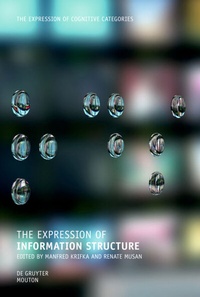
The Expression of Information Structure
Description

Information structure deals with the linguistic forms and techniques that support the integration of what is said into the current informational and attentional state of the addressee. This shows in categories like topic-comment structuring, focus to highlight expressions, marking of givenness and of presupposed information, and ways to indicate that the information provided is restricted. The book relates infor-mation structure to theoretical models of grammar, to computation and modelling and brings together what is known about the expression of information structure in human language with regard to its empirical investigation, its psycholinguistic aspects and the acquisition of information structure.
Since the need to integrate what is said into the informational and attentional state of the addressee is central to all human communication, it is not surprising that all natural languages have developed devices to express information structural cate-gories. To illustrate this, the book also provides concrete and theory independent descriptions of the information structural encoding strategies of individual languages of different types .
The book can be used as a textbook appropriate for advanced undergraduate and graduate courses; it also provides information for linguists that are not specialists in the field.
Reviews / Votes
"'The Expression of Information Structure' discusses the most important issues and offers a rich overview of the most significant studies. [...] the volume provides the reader with useful methodological tools to undertake these kinds of investigation."Jacopo Torregrossa in: Linguist List 24.1765More details
Other editions
Additional editions
Persons
Content
2 - The information structure of Chinese [Seite 53]
3 - The information structure of English [Seite 79]
4 - The information structure of French [Seite 103]
5 - The information structure of Georgian [Seite 135]
6 - The information structure of Hungarian [Seite 167]
7 - The information structure of Japanese [Seite 195]
8 - The empirical investigation of information structure [Seite 225]
9 - The prosodic investigation of information structure [Seite 257]
10 - The psychology of information structure [Seite 295]
11 - The acquisition of information structure [Seite 327]
12 - Computation and modeling of information structure [Seite 371]
13 - Information structure and theoretical models of grammar [Seite 417]
14 - Contributors [Seite 457]
15 - Index of subjects [Seite 459]
16 - Index of persons [Seite 468]
