

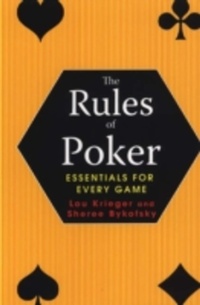
Rules Of Poker: Essentials For Every Game
Essentials For Every Game
1st Edition
Published on 1. December 2006
304 pages
978-0-8184-0731-4 (ISBN)
Description

The Ultimate Argument Settler
This book holds the answer to every poker argument, standstill, or face-off imaginable. Experts Lou Krieger and Sheree Bykofsky provide answers to hundreds of tough questions like:
• What is the minimum raise in a no-limit game?
• Can you bet and raise with a single chip?
• Can you cut a deal at the final table?
• Do players have the right to see the winning hand?
• And much more:
• Comprehensive rules for all the major games
• An easy-to-use index
• Handy charts
• Anecdotes from dealers, players, and poker room staff around the world about real-life arguments and how they were settled.
Here is the poker bible that will let you concentrate on what's really important--winning.
This book holds the answer to every poker argument, standstill, or face-off imaginable. Experts Lou Krieger and Sheree Bykofsky provide answers to hundreds of tough questions like:
• What is the minimum raise in a no-limit game?
• Can you bet and raise with a single chip?
• Can you cut a deal at the final table?
• Do players have the right to see the winning hand?
• And much more:
• Comprehensive rules for all the major games
• An easy-to-use index
• Handy charts
• Anecdotes from dealers, players, and poker room staff around the world about real-life arguments and how they were settled.
Here is the poker bible that will let you concentrate on what's really important--winning.
All prices
More details
Other editions
Additional editions
Book
01/2007
Stuart (Lyle) Inc.,U.S.
€32.37
No shipping information available
Persons
Lou Krieger; Sheree Bykofsky
Content
- Intro
- Copyright
- Contents
- Introduction
- Why This Book Is Needed
- Our Book's Objective
- What We Assume About You
- How to Use This Book
- How This Book Is Organized
- Will This Book Prevent All Future Arguments at the Poker Table?
- Acknowledgments
- Part One: Reponsibilities and Etiquette
- Chapter 1 The House-General Rights and Procedures
- 1.1 The Prime Directive
- 1.2 One Player per Hand
- 1.3 Cards Speak
- 1.4 Location: Cultural and Regional Differences
- 1.5 Languages Permitted at Poker Table
- 1.6 The Management Framework: Decisions, Policies, and Etiquette
- 1.7 Fair Rules: Publication and Player Entitlement
- 1.8 Employee and Management Accountability
- 1.9 Decisions Made by Floor Supervisors, Not Dealers
- 1.10 Decisions Made in Best Interests of Game
- 1.11 Policing Player Conduct
- 1.12 Incorrect Decisions Made in Good Faith
- 1.13 Right to Start and Break Games
- 1.14 Right to Change Game Elements
- 1.15 Right to Introduce New Decks
- 1.16 Right to Prohibit Certain Players from Same Game
- 1.17 Right to Establish Appearance and Grooming Standards
- 1.18 Players-Only at Table Proper
- 1.19 Guests, Player-Sweating, and Spectators
- 1.20 Identifying Shills or Proposition Players
- Chapter 2 The House-Game-Play Management
- 2.1 Beginning New Games
- 2.2 Establishing and Maintaining Seating Order for New Games
- 2.3 Determining Button Placement in New Games
- 2.4 Players' Selection of Seats in New Games
- 2.5 Putting Decks in Play in New Games
- 2.6 Time Required Between Deck Changes
- 2.7 Minimum and Maximum Buy-In Requirements for New Games
- 2.8 Procedures for Player Wishing to Change Seats in Same Game
- 2.9 Seat Changes in Games with Blinds: Sitting Out Hands
- 2.10 Seat Changes in Games with Blinds: Other Requirements
- 2.11 Permission Required to Join Existing Games
- 2.12 Procedures Governing New Player's Seat Selection
- 2.13 Waiting Lists
- 2.14 Reserving Seats While on Waiting Lists
- 2.15 Players Requesting Table Changes
- 2.16 Breaking Games
- 2.17 Seating Players from Broken Games
- 2.18 Establishing and Administering Must-Move Games
- 2.19 Time Collections
- 2.20 Raked Pots
- 2.21 Time Pots
- 2.22 Collecting on Button
- 2.23 Cash on Table
- 2.24 Playing Cash Instead of Chips
- 2.25 Chips Placed on Table
- 2.26 Chips in Full View
- 2.27 Removing Money from Table
- 2.28 Returning to Same Game After Cashing Out
- 2.29 Table Stakes
- 2.30 Number of Bets and Raises Permitted in Limit Games
- 2.31 Number of Bets and Raises Permitted When Betting Round Is Heads-Up
- 2.32 Oversized Chip Rule
- 2.33 Absent Players
- 2.34 Third Man Walking
- 2.35 Playing Over Absent Players
- 2.36 Responsibility for Chips Left on Tables
- 2.37 Picking Up Absent Player's Chips
- 2.38 Pushing Antes
- 2.39 Chopping Blinds
- 2.40 Dividing Odd Chips
- 2.41 Rabbit Hunting
- 2.42 Minimum and Maximum Buy-Ins
- 2.43 Short Buy-Ins
- 2.44 Playing Behind
- 2.45 Minimum Chip Requirements When Changing Tables
- 2.46 Required Chip Denominations
- 2.47 Playing Light in Home Games
- 2.48 Transferring Chips from One Player to Another
- 2.49 Going All-In and Completing Bets
- 2.50 Insurance
- 2.51 (No) Side Bets
- Chapter 3 Player Conduct, Etiquette, and Integrity
- 3.1 Unacceptable Conduct
- 3.2 Acting in Turn
- 3.3 Acting in a Timely Manner
- 3.4 Keeping Cards in Plain Sight
- 3.5 Discussing Hands in Play
- 3.6 Giving Lessons/Advice at the Table
- 3.7 Looking at Other Players' Hands
- 3.8 Collusion
- 3.9 Deliberate Exposure of Cards
- 3.10 Chip Moves and Misleading Gestures
- 3.11 Hand Motions Denote Action
- 3.12 Integrity and Honesty
- 3.13 Table Demeanor
- 3.14 Chips Denote Action
- 3.15 Oversized Chips
- 3.16 Betting Circles
- 3.17 Splashing the Pot
- 3.18 Verbal and Physical Declarations of Action
- 3.19 Placing Chips in Pot/String Raises
- 3.20 Check-and-Raise
- 3.21 Clocking Opponents
- 3.22 Calling Attention to Procedural Errors
- 3.22.1 Calling Short and Withdrawing Bets
- 3.23 Discarding Hands
- 3.24 Checking Down Hands
- 3.25 Assisting Other Players
- 3.26 Folding Toward the Muck
- 3.27 Cards Pitched Off Table
- 3.28 Toking
- 3.29 Mobile Phones
- 3.30 Items on Table
- 3.31 Smoking
- 3.32 Winning and Losing Well
- Part Two: Structures of Play
- Chapter 4 The Deck and Cards
- 4.1 Deck Composition
- 4.2 Hands Begin with Shuffle
- 4.3 Bring-In Bets
- 4.4 Blind Bets
- 4.5 Number of Betting Rounds
- 4.6 Number of Players Per Game
- 4.7 Winning a Pot
- 4.8 Hand Rankings
- 4.8.1 Straight Flush
- 4.8.2 Four-of-a-Kind
- 4.8.3 Full House
- 4.8.4 Flush
- 4.8.5 Straight
- 4.8.6 Three-of-a-Kind
- 4.8.7 Two Pair
- 4.8.8 One Pair
- 4.8.9 No Pair
- 4.8.10 Low Hands
- 4.9 Shuffling
- 4.10 Mechanical Shuffling Machines
- 4.11 Dealer Responsibilities
- 4.12 Burn-Card Placement
- 4.13 Cards Dealt off Table
- 4.14 Boxed Cards
- 4.15 Fouled Deck
- 4.16 Marked or Marred Cards
- 4.17 Misdeals
- Chapter 5 Betting Structures
- 5.1 Fixed-Limit Poker
- 5.1.1 Betting Structures for Community-Card Games
- 5.1.2 Betting Structures for Stud Games
- 5.1.3 Betting Structures for Draw Games
- 5.2 No-Limit Poker
- 5.2.1 Raising Requirements
- 5.2.2 Check-Raising All-In Bets
- 5.2.3 Bet Declarations
- 5.2.4 Oversized Chips, No-Limit
- 5.2.5 Asking for Opponents' Chip Counts
- 5.3 Pot-Limit Poker
- 5.3.1 Betting in Pot-Limit
- 5.3.2 Opening Bets in Pot-Limit
- 5.3.3 Sizing the Pot
- 5.3.4 Overbetting the Pot
- 5.3.5 Oversized Chips, Pot-Limit
- 5.4 Other Pot-Limit Structures
- 5.5 Spread-Limit Poker
- 5.6 Playing Overs
- 5.7 Kill Pots
- 5.8 Kill-Pot Triggers
- 5.9 Killing Pot from Blinds
- 5.10 Leg Up
- 5.11 High-Low Split Games Played with Kill
- 5.12 Sequence of Action when Pot Killed
- 5.13 Refusal to Post Kill
- 5.14 Dealer Requirements in Announcing Kill Pots
- 5.15 Look-at-Two-and-Kill (in Lowball Games)
- 5.16 Half-Kills
- 5.17 Voluntary Kills and Live Straddles
- 5.18 Hand Showdown Order
- 5.19 All Cards Must Be Shown Down
- 5.20 Asking to See a Winning Hand
- 5.21 Pot-Splitting on Tie Hands (Awarding Odd Chips)
- 5.22 Players' Obligations in Determining Best Hand at Showdown
- 5.23 Miscalled Hands
- 5.24 Order of Awarding Pots
- 5.25 Players' Rights to See Called Hands
- 5.26 Show One, Show All
- 5.27 Non-Correctable Errors
- 5.28 Jackpots
- 5.28.1 High-Hand and Royal Flush Jackpots
- 5.28.2 Bad-Beat Jackpots
- 5.28.3 Jackpot Qualifiers and Conditions
- 5.29 Buttons
- 5.29.1 Missed Blind Button
- 5.29.2 Small Blind Button
- 5.29.3 Overs Button
- 5.29.4 Playing Behind Button
- 5.29.5 Openers Button
- 5.29.6 Kill Button
- 5.29.7 Seat-Change Button
- 5.30 Table Card
- Part Three: Rules of the Games
- Chapter 6 Texas Hold'em, Omaha, and Other Community-Card (Board) Games
- 6.1 Texas Hold'em
- 6.1.1 Dealing and Betting Procedures
- 6.1.2 Order of Play
- 6.1.3 Blind Bets
- 6.1.4 Building Hands
- 6.2 Omaha Hold'em
- 6.2.1 Number of Cards
- 6.2.2 Building Hands
- 6.2.3 Low Hands Must "Qualify"
- 6.2.4 Differing Two-Card Combinations for "High" and "Low" Qualifying Hands in Omaha/8
- 6.2.5 Showing Down Winning Hands
- 6.2.6 Playing Omaha with Kill
- 6.3 Five-Card Omaha/8
- 6.4 Three-Card Games
- 6.4.1 Pineapple
- 6.4.2 Crazy Pineapple
- 6.4.3 Tahoe
- Chapter 7 Stud Games
- 7.1 Five-Card Stud
- 7.2 Six-Card Stud
- 7.3 Seven-Card Stud
- 7.3.1 Antes, Deal, and Betting Structures
- 7.3.2 Bring-Ins
- 7.3.3 Betting
- 7.3.4 Recommended Betting Units
- 7.3.5 Raises
- 7.3.6 Double Bets
- 7.3.7 Showdowns
- 7.3.8 Spread-Limit Games
- 7.3.9 Order of Open Cards
- 7.3.10 Mixing Open and Closed Cards
- 7.3.11 Accidentally Exposing Cards
- 7.3.12 Insufficient Cards
- 7.4 Seven-Card Stud, Eight-or-Better High-Low Split (Seven-Stud/8)
- 7.4.1 Qualifying Low Hands
- 7.4.2 Antes, Deal, and Betting Structures
- 7.4.3 Fourth Street-No Double Bets
- 7.4.4 Betting Order
- 7.4.5 Raises
- 7.4.6 Double Bets
- 7.4.7 Showdowns
- 7.5 Razz
- 7.5.1 Low-Hand Determination
- 7.5.2 Bring-Ins
- 7.5.3 Betting
- 7.6 Five-Card Stud
- 7.6.1 Antes, Deal, and Betting Structures
- 7.7 Mississippi Seven-Card Stud
- 7.7.1 Decks and Dealing
- 7.8 Mixed games
- 7.8.1 Back Man Out
- Chapter 8 Draw and Other Games
- 8.1 Draw and Lowball with Joker
- 8.2 Jacks-or-Better
- 8.2.1 Blinds, Antes, and Buttons
- 8.2.2 Decks and Deals
- 8.2.3 Order of Play
- 8.2.4 Asking About Number of Cards Drawn
- 8.2.5 Player's Right to Change Number of Cards Drawn
- 8.2.6 Exposed Cards
- 8.2.7 Rapping Pat
- 8.2.8 Going All-In for Antes
- 8.2.9 Jacks-or-Better, "Show Openers" Requirement
- 8.2.10 Opening with Non-Qualifying Hands
- 8.2.11 Splitting Openers
- 8.3 Jacks Back
- 8.4 Lowball
- 8.5 California Lowball
- 8.5.1 Blinds, Antes, and Buttons
- 8.5.2 Decks and Deals
- 8.5.3 Declaring Hands
- 8.5.4 Betting Sevens
- 8.5.5 Entering the Game
- 8.5.6 Missing the Blinds
- 8.5.7 Exposed Cards
- 8.6 Kansas City Lowball
- 8.7 Deuce-to-Seven Triple Draw
- 8.7.1 Blinds and Buttons
- 8.7.2 Discards and Draws
- 8.7.3 Wagering Rounds
- 8.7.4 Insufficient Cards
- 8.7.5 Betting Limits
- 8.8 Ace-to-Five Triple Draw
- Part Four: Tournaments
- Chapter 9 Tournament Rules
- 9.1 Tournament Rules and Procedures
- 9.2 A Basis for Fair Decision Making
- 9.3 Cash Game Rules
- 9.4 Starting Chips and Seated Players
- 9.5 No Chip Transfers Permitted
- 9.6 Chips in Full View
- 9.7 No-Show Players
- 9.8 Late Entrants
- 9.9 Removing Lower Denomination Chips
- 9.10 Splitting the Pot Among Tied Hands
- 9.11 Side Pots
- 9.12 Time Limits for Acting on a Hand
- 9.13 Dead Button Rule
- 9.14 Exposing Cards with Action Pending
- 9.15 Players Must Be at the Table to Call Time
- 9.16 Face Up When All-In and All Action is Complete
- 9.17 Fifty Percent Rule for Raising
- 9.18 Oversized Chips
- 9.19 One Player per Hand
- 9.20 Random Seat Assignments
- 9.21 English-Only Rule
- 9.22 Mobile Phone Use at the Table
- 9.23 Foreign Chips
- 9.24 Deck Changes
- 9.25 When New Betting Limits Apply
- 9.26 Player May Not Miss a Hand
- 9.27 Keeping Chips Visible
- 9.28 All Chips Must be Visible
- 9.29 Verbal Declaration Regarding Hand Content
- 9.30 Rabbit Hunting
- 9.31 Blind Dodging
- 9.32 Moving Players
- 9.33 Number of Raises in Limit Events
- 9.34 Exposed Down Cards in Stud Games
- 9.35 Killing Unprotected Hands
- 9.36 Cards Speak
- 9.37 Verbal Declarations Made in Turn
- 9.38 Moving from a Broken Table
- 9.39 Penalties for Infractions
- 9.40 No Player Shall Discuss a Hand in Play
- 9.41 Exposing a Card While a Hand Is in Play
- 9.42 One Motion
- 9.43 Verbally Disclosing the Contents of a Hand
- 9.44 Less Than a Full Raise
- 9.45 Chopping Blinds
- 9.46 Re-Buy Tournaments
- 9.47 Heads-Up Button Placement at the Final Table
- 9.48 Deal-Making at the Final Table
- 9.49 Canceled Events
- Part Five: Rules We'd Like to Change
- 1. Betting Circles
- 2. Letter-of-the-Law Versus Spirit-of-the-Game
- 3. Short Buy-Ins
- 4. Triggering Kill Pots
- 5. Asking to See Called Hands
- 6. Must-Move Games
- 7. Dead-Button Rule Standardization
- 8. Responsibility for Chips Left on Tables
- 9. The Auto F-Word Rule
