

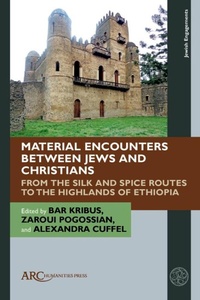
Material Encounters between Jews and Christians
From the Silk and Spice Routes to the Highlands of Ethiopia
Published on 15. November 2024
336 pages
978-1-80270-198-2 (ISBN)
Description

A study of Jewish-Christian interaction in the Middle Ages in the eastern Mediterranean, Central Asia, the Red Sea, and India through material culture.
More details
Series
Edition
Digital original
Language
English
Place of publication
York
United Kingdom
Target group
Professional and scholarly
US School Grade: College Graduate Student
Edition type
Digital original
Illustrations
93 Abbildungen
6 Illustrations, black and white
File size
21,08 MB
ISBN-13
978-1-80270-198-2 (9781802701982)
Copyright in bibliographic data and cover images is held by Nielsen Book Services Limited or by the publishers or by their respective licensors: all rights reserved.
Schweitzer Classification
Other editions
Additional editions
Bar Kribus | Zaroui Pogossian | Alexandra Cuffel
Material Encounters between Jews and Christians
From the Silk and Spice Routes to the Highlands of Ethiopia
Book
11/2024
Arc Humanities Press
€179.50
Shipment within 3-4 weeks
Persons
Contributor: Bar Kribus Bar Kribus is an archaeologist at Tel Aviv University specializing in Late Antique to Early Modern Ethiopia and the archaeology, history, and historical geography of the Betä ¿sräel (Ethiopian Jews). He is 2025 winner of the prestigious Dan David Prize. --- Contributor: Zaroui Pogossian
Zaroui Pogossian is associate professor of Byzantine Civilization at Florence University, focusing on medieval Armenia in the context of wider Eurasian processes. She is the principal investigator of the ERC project Armenia Entangled: Connectivity and Cultural Encounters in Medieval Eurasia, 9th-14th Centuries.
--- Contributor: Alexandra Cuffel Alexandra Cuffel is professor of Jewish Religion at the Ruhr University Bochum. Her research focuses on medieval Jewish-Christian-Muslim relations in Europe and the Middle East.Content
- Front Cover
- Front matter
- Half-title
- Series information
- Title page
- Copyright information
- Table of contents
- List of Illustrations
- Body
- Chapter 1. Material Encounters between Jews and Christians in the East: An Introduction
- Armenia and the Caucasus Context
- The Persianate World
- The Middle East
- Arabia
- The Horn of Africa
- India
- Reference
- Part One: Armenia
- Chapter 2. Light Archaeology at Yeghegis Jewish Cemetery: Analysis and Interpretation
- Introduction
- Material Aspects
- Results
- Conclusions: Why Yeghegis and Why Exactly in Yeghegis? In Search of a Possible Interpretation
- References
- Chapter 3. The Jewish Tombstones at Yeghegis, Armenia, and their Sculptural Decoration
- Introduction
- Tombstones with Decorative Rosettes
- Tombstone with Zoomorphic Images
- Tombstone with Geometric Ornaments
- Tombstone with Architectural Structures
- Conclusions
- References
- Chapter 4. New Iconographies of the Passion of Christ: The Jews in Two Armenian Miniatures of Vaspurakan
- Conclusions
- References
- Part Two: The Holy Land
- Chapter 5. Integrating Jew and Gentile through Visual Culture: Covenant and Eschatology at Bethlehem's Nativity Church and in Jerusalem in the Twelfth Century
- Introduction
- The Church of the Nativity in Bethlehem
- Selected Painted Scenes in the Narthex Chapel, Interpreted Eschatologically and Politically
- The Melisende Psalter
- The Church of the Holy Sepulchre
- The Templum Domini
- Iconography of Selected Covenantal Scenes at the Nativity Church
- Prophecy and Covenant: The Prophet Isaiah and God's Two Covenantal Commitments to Judah
- The Incarnation and its Implications: The Nativity Scene in the Grotto, the Latins as Bringers of Peace, and the Covenantal Joining of Jews and Gentiles
- The Magi and Connections: Links with Ancient Mesopotamia and Babylon
- Genealogy and Covenant: The Davidic Genealogy of Christ and the Covenantal Adoption of Gentiles as Children of Abraham
- The Fulfilment of the Prophecy of Gentiles: Balaam and Cumaean Sibyl in the Tree of Jesse
- Conclusions
- References
- Part Three: South Arabia
- Chapter 6. Jews and their Relations with Christians in Pre-Islamic South Arabia (Fourth-Sixth Century)
- Introduction
- The Political and Religious Landscape of Ancient South Arabia before the Emergence of Monotheisms
- Sketch of Monotheisms in Ancient South Arabia
- Jews and Christians in Ancient South Arabia: An Overview of the Sources
- First Mentions of Jews and Christians
- Epigraphic Evidence
- Other Evidence from Material Culture
- Who Were the Jews of South Arabia?
- Diaspora Jews
- Diaspora Jews and Proselytes
- The Nature of the Dominant Monotheism: Judaism, but a Special Kind of Judaism
- The Religious Evolution in South Arabia in the Context of Late Antiquity
- Relations between Jews and Christians according to Diverse Sources
- Inscriptions
- South Arabian Inscriptions
- Ethiopian Inscriptions
- Historiography
- Hagiographic Sources
- Conclusion: Conflicts between Jews and Christians. Critical Approach
- Appendix
- An Object Decorated with Menorot, with a South Arabian Inscription
- Interpretation and Comparisons
- Inscription IG-PC 1
- General Commentary
- Inscription CIH 543
- Commentary
- Sigla of the Cited Inscriptions
- References
- Part Four: Ethiopia
- Chapter 7. Betä ?sra?el (Ethiopian Jewish)-Ethiopian Orthodox Interaction in the S?men Mountains of Northern Ethiopia: A View from the Betä ?sra?el Monastic Centre of S?men M?na?a
- Introduction: S?men M?na?a as a Unique Test-Case for Jewish-Christian Interaction
- Concepts of Holy Sites and Sacred Space among the Betä ?sra?el
- The Religious Centre of S?men M?na?a: A Brief Overview
- Towards an Understanding of the Symbolism of S?men M?na?a in the Eyes of the Community
- Accounts of Jewish-Christian Interaction in S?men M?na?a
- S?men M?na?a as a Test-Case for the Spatial Layout, Networks, Sacred Geography, and Roles of Betä ?sra?el Religious Centres
- Conclusions
- References
- Chapter 8. A Palace for the Hairy King: An Ethiopian Political and Religious Riddle
- On the Fervours of Classification
- On the Dangers of Essentialization
- On the Musings of Appropriation
- On the Anxieties of Assimilation
- References
- Chapter 9. Anti-Jewish Images in Ethiopian Christian Art from the Seventeenth Century Onwards: An Attempt at Interpretation
- A Brief Outline of Judaism and Christianity in Ethiopia
- The Task of Paintings
- Examples of Depictions of Jews by Christian Painters in Europe and Ethiopia
- Preliminary Findings
- References
- Part Five: India
- Chapter 10. Entangled Identities: Approaching Sacred Spaces of Premodern Kerala, South India
- Introduction: Setting the Context
- Sastra Literature
- Contextualizing "Sacred Space"
- "Constructed" Sacred Spaces
- A??adikpala-The Guardians of the Eight Directions
- Layout of Kerala Sacred Spaces: Expansion and a New Puru?a?
- Conclusion: Moving Forward
- Acknowledgements
- References
- Chapter 11. The Lost Jew Town of Kochi
- Jewish History in Kerala at a Glance
- Three Hebrew Stone Inscriptions and the Kadavumbagam Synagogue
- Historical Ghosts, Erasures, and Distortions
- The Erased Tekkumbagam Synagogue and Castilian Connections
- Erased Cemeteries and Migrating Tombstones
- Conclusion
- References
- Back matter
- Index
