

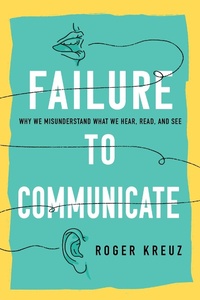
Failure to Communicate
Why We Misunderstand What We Hear, Read, and See
Published on 10. April 2023
296 pages
978-1-63388-890-6 (ISBN)
Description

"Why didn't they understand me? I was as clear as I could be." Everyone has had this thought at one time or another. Research from the fields of psychology and cognitive science can provide concrete answers to these questions. In Failing to Communicate, Dr. Roger Kreuz explores the answers to these questions
We are exposed to the dangers of miscommunication early in life. As children, we play the Telephone Game and learn an important lesson about the fragility of long communication chains. And as adults, we are constantly on the lookout for misunderstanding. People interrupt each other, on average, about every ninety seconds in order to check their understanding. Despite such vigilance, however, a great deal of what is said and written is not understood as intended.
Miscommunication has led to military defeats, the loss of spacecraft, and even more tragically, accidents that cost human lives. It plays a role in road rage and social media feuds. It haunts the courtroom, the boardroom, and the singles bar. Failing to Communicate includes dozens of such examples and explains them in light of what researchers have discovered about how communication works-and why it so often fails.
Research from psychology and cognitive science has revealed a host of specific factors that contribute to misunderstanding. Some of these have to do with how our minds make sense of what we hear and read, while others are the result of cognitive, social, and cultural factors. The very structure of a given language can be problematic as well. In short, there is no one reason for miscommunication: there are a host of underlying causes.
Issues of misunderstanding have only multiplied as new mediums for communication have arisen. Emails, texts, and social media posts are even more problematic because they are impoverished modes of communication. Without facial cues, tone of voice, gestures, and even the creative use of silence, our intentions in these text-only mediums are even more likely to go awry.
Failing to Communicate is intended to appeal, from beginning to end, to the general reader who wants to know more about why our attempts at communication fail so often
We are exposed to the dangers of miscommunication early in life. As children, we play the Telephone Game and learn an important lesson about the fragility of long communication chains. And as adults, we are constantly on the lookout for misunderstanding. People interrupt each other, on average, about every ninety seconds in order to check their understanding. Despite such vigilance, however, a great deal of what is said and written is not understood as intended.
Miscommunication has led to military defeats, the loss of spacecraft, and even more tragically, accidents that cost human lives. It plays a role in road rage and social media feuds. It haunts the courtroom, the boardroom, and the singles bar. Failing to Communicate includes dozens of such examples and explains them in light of what researchers have discovered about how communication works-and why it so often fails.
Research from psychology and cognitive science has revealed a host of specific factors that contribute to misunderstanding. Some of these have to do with how our minds make sense of what we hear and read, while others are the result of cognitive, social, and cultural factors. The very structure of a given language can be problematic as well. In short, there is no one reason for miscommunication: there are a host of underlying causes.
Issues of misunderstanding have only multiplied as new mediums for communication have arisen. Emails, texts, and social media posts are even more problematic because they are impoverished modes of communication. Without facial cues, tone of voice, gestures, and even the creative use of silence, our intentions in these text-only mediums are even more likely to go awry.
Failing to Communicate is intended to appeal, from beginning to end, to the general reader who wants to know more about why our attempts at communication fail so often
More details
Language
English
Place of publication
New York
United States
File size
0,61 MB
ISBN-13
978-1-63388-890-6 (9781633888906)
Copyright in bibliographic data and cover images is held by Nielsen Book Services Limited or by the publishers or by their respective licensors: all rights reserved.
Schweitzer Classification
Other editions
Additional editions
Book
04/2023
Prometheus Books
€25.50
Article not available at the moment
Person
Roger Kreuz is an Associate Dean of the College of Arts & Sciences at the University of Memphis and a Professor in the University's Psychology Department. He works mainly in experimental psychology, cognitive psychology, and psychology of language. He earned his Ph.D at Princeton University. In addition to two edited), and over fifty journal articles and book chapters, He has been an author on about a hundred research presentations at national and international conferences. According to Google Scholar, his publications have been cited more than 5,000 times. He has fellow status in three professional organizations: The Association for Psychological Science, the Psychonomic Society, and the Society for Text and Discourse.
Content
- Intro
- Title
- Copyright
- Dedication
- Contents
- PROLOGUE
- ACKNOWLEDGMENTS
- 1 ASPECTS OF MISCOMMUNICATION
- "Pasadena, We've Got a Problem"
- Great Expectations
- The Vagaries of Vagueness
- Hints and Dog Whistles
- How Good Is Good Enough?
- When Informal Is Too Informal
- 2 PSYCHOLOGICAL FACTORS
- Do You See What I Mean?
- Creating Common Ground
- Just Being Sarcastic
- "What Is a 'Dangerous Thing'?"
- Guilt by Association
- Caution: Repairs Ahead
- 3 PERCEPTUAL ISSUES
- Do You Hear What I Hear?
- Similar Sounds
- Hearing Voices
- Lady Mondegreen and Slips of the Ear
- Seeing Is (Not) Believing
- The Curse of Cursive
- 4 WORDS, PART 1
- Hard to Say
- Of Homophones and Eggcorns
- On the Contrary
- Denotation and Connotation
- You Can't Please Everyone
- You Just Had to Be There
- Jarring Jargon
- 5 WORDS, PART 2
- What's the Good Word?
- If You Know What I Mean
- What's a Metaphor Good For?
- Idiomatically Speaking
- The (Linguistic) Times Are a-Changin'
- Who Decides What Words Mean?
- The Trouble with Texting
- 6 MISINTERPRETING NONVERBAL LANGUAGE
- (Mis)reading the Face
- Do the Eyes Have It?
- Token Gestures
- Sign, Sign, Everywhere a Sign
- Worth a Thousand Words?
- The Play's the Thing
- The Bounds of Silence
- 7 COGNITIVE FACTORS
- Chinese Whispers and Russian Scandals
- Going Down the Garden Path
- Problematic Punctuation
- A Need for Speed?
- The Malleability of Memory
- At a Loss for Words
- 8 SOCIAL FACTORS
- Just Kidding
- Have You Heard?
- They Do Things Differently There
- Foxy Doctor Fox
- Masking One's Meaning
- Deliberate Misunderstanding
- 9 CONTEXTS, PART 1
- Out of Context
- Garbage Language?
- Misunderstood Authors
- Lost in Translation
- Echo Chambers and Cucumber Time
- Come Here Often?
- 10 CONTEXTS, PART 2
- Egocentrism and Email
- Rage on the Road
- Disorder in the Court
- Military Misadventure
- The Language of the Air
- Tragedy at Tenerife
- EPILOGUE
- NOTES
- BIBLIOGRAPHY
- ABOUT THE AUTHOR
