

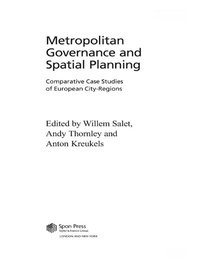
Metropolitan Governance and Spatial Planning
Comparative Case Studies of European City-Regions
Published on 19. August 2005
424 pages
978-1-134-49606-8 (ISBN)
Description

Metropolitan Governance and Spatial Planning explores the relationship between metropolitan decision-making and strategies to co-ordinate spatial policy. This relationship is examined across 20 cities of Europe and the similarities and differences analysed.
Cities are having to formulate their urban policies in a very complex and turbulent environment. They are faced with numerous new pressures and problems and these often create contradictory conditions. The book provides a theoretical framework for exploring these issues and links this to a detailed investigation of each city.
In the context of globalisation, cities in the last twenty years have experienced new patterns of activity and these usually transcend political boundaries. The management of these changes therefore requires an effort of co-ordination and different cities have found different approaches.
However the institutional setting itself has not remained static. The nation states in Europe have handed over many responsibilities to the European Union while also increasing devolution to regions and cities. Government has therefore become a more complex multi-level activity.
There has also been the move from government to governance. Many different public, quasi-public and private bodies are now involved in making decisions that affect urban development. Metropolitan governance is therefore also a complex multi-actor process.
In these conditions of fragmented governance and the widening spatial networking of urban development, the issue of policy co-ordination become ever more important. The exploration of the 20 cities shows that many face similar difficulties while some also provide interesting examples of innovative practice. The book concludes that the way forward is to find strategies to link the different spheres of metropolitan action through 'organising connectivity'.
Cities are having to formulate their urban policies in a very complex and turbulent environment. They are faced with numerous new pressures and problems and these often create contradictory conditions. The book provides a theoretical framework for exploring these issues and links this to a detailed investigation of each city.
In the context of globalisation, cities in the last twenty years have experienced new patterns of activity and these usually transcend political boundaries. The management of these changes therefore requires an effort of co-ordination and different cities have found different approaches.
However the institutional setting itself has not remained static. The nation states in Europe have handed over many responsibilities to the European Union while also increasing devolution to regions and cities. Government has therefore become a more complex multi-level activity.
There has also been the move from government to governance. Many different public, quasi-public and private bodies are now involved in making decisions that affect urban development. Metropolitan governance is therefore also a complex multi-actor process.
In these conditions of fragmented governance and the widening spatial networking of urban development, the issue of policy co-ordination become ever more important. The exploration of the 20 cities shows that many face similar difficulties while some also provide interesting examples of innovative practice. The book concludes that the way forward is to find strategies to link the different spheres of metropolitan action through 'organising connectivity'.
More details
Language
English
Place of publication
London
United Kingdom
Publishing group
Taylor & Francis Ltd
Target group
College/higher education
Professional and scholarly
File size
2,88 MB
ISBN-13
978-1-134-49606-8 (9781134496068)
Copyright in bibliographic data and cover images is held by Nielsen Book Services Limited or by the publishers or by their respective licensors: all rights reserved.
Schweitzer Classification
Other editions
Additional editions
Anton Kreukels | Willem Salet | Andy Thornley
Metropolitan Governance and Spatial Planning
Comparative Case Studies of European City-Regions
Book
11/2002
Routledge
€197.50
Article not available at the moment

Anton Kreukels | Willem Salet | Andy Thornley
Metropolitan Governance and Spatial Planning
Comparative Case Studies of European City-Regions
Book
11/2002
Routledge
€84.80
Shipment within 15-20 days
Persons
Andy Thornley is Director of Planning Studies at the London School of Economics and Political Science.Anton Kreukels.>
Content
Part One: General Introduction
1. Institutional and spatial coordination in European metropolitan regions
2. Metropolitan regions in the face of the European dimension
Part Two: London, Birmingham, Cardiff/Wales, Stockholm
3. London: Institutional turbulence but enduring nation-state control
4. The Birmingham case
5. The experience of Cardiff and Wales
6. The Stockholm region: metropolitan governance and spatial policy
Part Three: Berlin, Frankfurt, Hannover, Stuttgart, Amsterdam, Rotterdam
7. Berlin
8. The Frankfurt Rhine-Main Region
9. The Hanover Metropolitan Region
10. Governance in the Stuttgart metropolitan region
11. Amsterdam and the North Wing of the Randstad
12. Rotterdam and the South Wing of the Randstad
Part Four: Prague, Vienna, Venice, Milan
13. The Prague metropolitan region
14. Metropolitan governance and regional planning in Vienna
15. Venice
16. The region of Milan
Part Five: Paris, Bruxelles, Marseilles-Aix, Barcelona, Madrid
17. Paris
18. Brussels: a superimposition of social, cultural and spatial layers
19. Marseilles-Aix Metropolitan Region (1981-2000)
20. The case of Barcelona
21. Metropolitan government and development strategies in Madrid
Part Six: Concluding part: the problem of coordination in fragmented metropolises
22. Practices of Metropolitan Governance in Europe: Experiences and Lessons
1. Institutional and spatial coordination in European metropolitan regions
2. Metropolitan regions in the face of the European dimension
Part Two: London, Birmingham, Cardiff/Wales, Stockholm
3. London: Institutional turbulence but enduring nation-state control
4. The Birmingham case
5. The experience of Cardiff and Wales
6. The Stockholm region: metropolitan governance and spatial policy
Part Three: Berlin, Frankfurt, Hannover, Stuttgart, Amsterdam, Rotterdam
7. Berlin
8. The Frankfurt Rhine-Main Region
9. The Hanover Metropolitan Region
10. Governance in the Stuttgart metropolitan region
11. Amsterdam and the North Wing of the Randstad
12. Rotterdam and the South Wing of the Randstad
Part Four: Prague, Vienna, Venice, Milan
13. The Prague metropolitan region
14. Metropolitan governance and regional planning in Vienna
15. Venice
16. The region of Milan
Part Five: Paris, Bruxelles, Marseilles-Aix, Barcelona, Madrid
17. Paris
18. Brussels: a superimposition of social, cultural and spatial layers
19. Marseilles-Aix Metropolitan Region (1981-2000)
20. The case of Barcelona
21. Metropolitan government and development strategies in Madrid
Part Six: Concluding part: the problem of coordination in fragmented metropolises
22. Practices of Metropolitan Governance in Europe: Experiences and Lessons
