

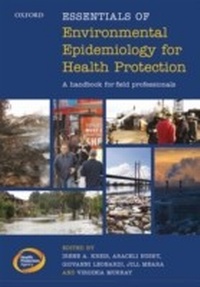
Essentials of Environmental Epidemiology for Health Protection
A handbook for field professionals
1st Edition
Published on 29. November 2012
296 pages
978-0-19-165141-0 (ISBN)
Description

Essentials of Environmental Epidemiology for Health Protection guides front line public health practitioners through the decisions they are likely to face when dealing with environmental health problems. It does this by showing how to integrate relevant aspects of environmental science, communication sciences, toxicology, and most importantly environmental epidemiology skills to conduct initial investigations which encompass all relevant issues.
The book uses a problem orientated style, using case studies, to provide practical examples of how to plan and carry out investigations or research projects. It emphasises the scoping and planning stages of a study in order to avoid common pitfalls, and includes discussions of the limitations of epidemiological studies, how to communicate with the public and funders, ethics and handling large datasets. Through the case studies the book also covers the practice of environmental public health in developed countries.
Each chapter is written by knowledgeable practitioners in the topic, making Essentials of Environmental Epidemiology for Health Protection essential reading for all professionals in environmental public health in the UK and abroad.
More details
Other editions
Additional editions
Irene A. Kreis | Araceli Busby | Giovanni Leonardi
Essentials of Environmental Epidemiology for Health Protection
A handbook for field professionals
Book
11/2012
Oxford University Press
€127.40
Shipment within 15-20 days
Content
- Section 1 Identifying the problem
- 1: Irene A. Kreis: Introduction to Environmental Epidemiology for Health Protection, illustrated with a case study on lead through the ages
- 2: Giovanni Leonardi: Epidemiology of environmental hazards, illustrated with a case study on landfill concerns and water (acute and chronic issues)
- 3: Irene A. Kreis and David Cromwell: Literature reviews, systematic but how and why? Illustrated with case studies on dioxin
- 4: Fred Woudenberg: Communication in epidemiological studies, illustrated with a case study on a gas-factory terrain clean-up
- 5: Harrie van Dijk and Wilfried Notten: Identifying and dealing with high-risk groups systematically and transparently, illustrated with a case study on Q fever
- 6: Oliver Morgan and Sue Odams: Health registers as a tool for disaster epidemiology, illustrated with a case study on a fireworks explosion
- Section 2 Assessing the problems and developing a scoping study
- 7: Sotiris Vardoulakis: Environmental measurements, illustrated with a case study on ambient air pollution
- 8: Ariana Zeka: Exposure assessment for epidemiology, illustrated with a case study on air quality in schools
- 9: Virginia Murray and Rachel MacLehose: Toxicology and its practical use in chemical incident response, illustrated with a case study on mercury
- 10: Raquel Duarte-Davidson: Risk assessment, illustrated with a case study on carcass removal in a Foot and Mouth epidemic
- 11: Sam Bracebridge, Alex Elliot, and Gillian Smith: Real-time syndromic surveillance, illustrated with a case study on an oil depot explosion
- 12: Rebecca Close, Mike Studden, Araceli Busby, and Giovanni Leonardi: Routine data, illustrated with a case study on carbon monoxide
- 13: Leslie Jones: Geographic Information Services (GIS), illustrated with a case study on Legionaires' disease outbreak
- Section 3 Environmental epidemiology design and problem analysis
- 14: Irene A. Kreis and David Cromwell: Study designs for public health investigations: basic concepts and practice, illustrated with a case study on asthma
- 15: Helen Maguire,Irene.A. Kreis, and Virginia Murray: Field epidemiology: logistics, illustrated with case studies on a Legionella outbreak and a child blood lead survey
- 16: Araceli Busby: Data quality, illustrated with a case study on congenital eye defects
- 17: Dominik Zenner: Applied statistical techniques, illustrated with case studies on a cancer cluster and PCB in human milk
- 18: Sue Odams: Ethics in environmental epidemiology, illustrated with a case study on lead levels in children
- Section 4 Special topics
- 19: Marjon Drijver, Araceli Busby, and Irene A. Kreis: Cluster investigations, illustrated with a case study on childhood leukaemia in a cut-flower community
- 20: Virginia Murray: Occupational epidemiology, illustrated with a case study on bladder cancer
- 21: Colin Muirhead and Jill Meara: Radiation, illustrated with case studies on extremely low frequency electromagnetic fields and radiofrequency electromagnetic fields
- 22: Catriona Carmichael and Graham Bickler: Heatwave plan evaluation
- 23: Carla Stanke: Analysis of mental health impacts of flooding
- 24: Virginia Murray: Chemical Incidents, illustrated with a case study on an oil depot explosion
- 25: Helen Smethurst: Odours incidents and epidemiology, illustrated with a case study on trans-border transmissions
- 26: Irene A. Kreis and David A. Griffiths: Decision model for an investigation, illustrated with a case study on odours and dust
- Index
