

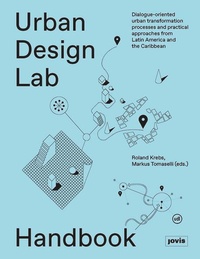
Urban Design Lab Handbook
Description

Lateinamerika und die Karibik bilden eine der am stärksten urbanisierten Regionen der Welt, und weiterhin verzeichnen die Städte enormes Wachstum. Um auf die damit verbundenen Herausforderungen zu reagieren, müssen langfristige Strategien entwickelt werden. Wie erweitert man eine wachsende Stadt, ohne ihre Urbanität zu verlieren? Wie kann das städtische Wachstum mit sozialen, ökologischen, kulturellen und wirtschaftlichen Fragen verknüpft werden?
Urban Design Lab (UDL) hat in mehr als 20 Städten Lateinamerikas und der Karibik gearbeitet - und dabei Planungswerkzeuge entwickelt, die Transformationsprozesse anstoßen, indem sie Nachbarschaften vor Ort mit einbeziehen und unterstützen.
Dieses Handbuch erläutert den Kontext sowie die Herausforderungen dieser Städte und bietet Lösungsansätze für die Probleme urbaner Agglomerationen.
More details
Other editions
Additional editions
Persons
Content
- Intro
- Contents
- Introduction
- Preface
- Introducing the Urban Design Lab
- The Need for an Urban Laboratory
- Emerging Topics in Latin American and Caribbean Cities
- Photoessay 1
- A Evolution
- Community, Participation and Urban Transformation
- Habitat and Social Inclusion in Urban Planning: Participation and Investigation in the Urban Design Lab Methodology
- The Urban Design Lab in Latin American Cities: A View from Academia
- Diagrams of Participatory Urbanism
- Tailor-Made Urbanism: Urban Design Lab in Panama City
- Ultra-Light Metropolis: The Ephemeral Megacity of the Kumbh Mela
- Culture as an Incubator for Urban Transformation
- The City at Eye Level: Focusing on the Plinth
- Towards a Human-Scale City in Latin America
- Photoessay 2
- A Practical Approach to Urban Planning
- Research
- Stakeholder Dialogue
- Project Design
- Simple Toolbox for Participative Planning and Design Workshops
- Guest Contributors
- Medellín-A "City for Life"
- Cultivating "Urban Complexity" in Latin America
- The Design of Public Policy
- In Situ Planning: Moderating Urban Development Processes Locally
- C Solutions
- Integral Urban Strategies for the Regeneration of Central Areas
- Central Nassau Urban Regeneration Plan, Nassau, The Bahamas
- Integrated Housing and Mixed-Use Strategy for the Historic Center of Paramaribo, Suriname
- Vivimos Juntos: Integration and Densification of the Historic Center of Managua, Nicaragua
- Urban Strategies for a Livable Downtown Montego Bay, Jamaica
- Volver al Centro: Integrated Urban Revitalization of the Historic City Center of Santiago de los Caballeros, Dominican Republic
- Barrio Mercado: Rehabilitation Strategy for Central Market of Monteria, Colombia
- Connected City: Pasto River Fluvial Park, Pasto, Colombia
- Neighborhood Revitalization and Sub-Centralities
- Urban Regeneration Plan of the Calidonia District, Panama City, Panama
- Photoessay 3
- Urban Renovation Plan of Barrio Infanta, Las Heras, Mendoza, Argentina
- Alto Comedero Urban Renovation: A Strategy for Social and Spatial Integration, Jujuy, Argentina
- Urban Regeneration Plan of the Eje Pacífico- González Víquez, San José, Costa Rica
- Conceptual Design for the Improvement of Barrio Collico, Valdivia, Chile
- A New Sub-Center for the East of San Francisco de Campeche, México
- La Mariscal: Activation of Borja Yerovi Plaza, Quito, Ecuador
- Transformation Strategies for Abandoned Railway Infrastructure
- Improvement of Intercultural Center at Former Railway Station, Quetzaltenango, Guatemala
- Goya Central Park: Reinterpretation of the Former Railway Station, Goya, Argentina
- Nodo Spurr: Integration of Former Railway Station into System of Centralities, Bahia Blanca, Argentina
- Connecting Xalapa: Integrated Revitalization of Railway Corridor, Xalapa, Mexico
- Integral Strategies for Metropolitan Areas
- Five-minute city-Strategy for the territorial integration of Ciudad Juan Bosch, Santo Domingo Este, Dominican Republic
- Metropolitan Public Space Integration Plan, Puerto Montt and Puerto Varas, Chile
- Metropolitan Landscape and Green Habitat: Rio Elqui and Parque El Culebrón, La Serena and Coquimbo, Chile
- Guest Contributors
- Community Capital in Action: New Financial Models for Resilient Cities
- Digital Strategies for Low-Income Neighborhoods
- Photoessay 4
- The Immanent Potential of Vacant Spaces
- Airport Landscape Initiative
- D Outlook
- Interview with Jorge Perez Jaramillo
- About the Contributors
- Urban Design Lab-Project Teams
- Imprint
