

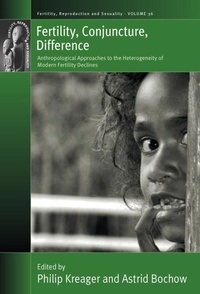
Fertility, Conjuncture, Difference
Description

In the last forty years anthropologists have made major contributions to understanding the heterogeneity of reproductive trends and processes underlying them. Fertility transition, rather than the story of the triumphant spread of Western birth control rationality, reveals a diversity of reproductive means and ends continuing before, during, and after transition. This collection brings together anthropological case studies, placing them in a comparative framework of compositional demography and conjunctural action. The volume addresses major issues of inequality and distribution which shape population and social structures, and in which fertility trends and the formation and size of families are not decided solely or primarily by reproduction.
More details
Other editions
Additional editions
Persons
Philip Kreager is Senior Research Fellow in Human Sciences, Somerville College; Director, Fertility and Reproduction Studies Group, Institute of Social and Cultural Anthropology; and Reseach Associate, Department of Sociology, Oxford University. He has written extensively on the history and conceptual development of population theory and analysis in European culture, and on comparative family systems and anthropological demography.
Content
List of Illustrations, Figures and Tables
Preface
Introduction
Philip Kreager and Astrid Bochow
Chapter 1. The Key to Fertility: Generation, Reproduction and Class Formation in a Namibian Community
Julia Pauli
Chapter 2. Becoming and Belonging in African Historical Demography, 1900-2000
Sarah Walters
This chapter is available open access under a Creative Commons Attribution International License (CC BY) thanks to the support of the Wellcome Trust.
Chapter 3. Between the Central Laws of Moscow and Local Particularity: The Reproduction of Subgroups in the South of Tajikistan
Sophie Roche and Sophie Hohmann
Chapter 4. Feeling Secure to Reproduce: Economy, Community and Fertility in Southern Europe
Patrick Heady
Chapter 5. Ambivalent Men: Male Dilemmas and Fertility Control in Senegal
Sara Randall, Nathalie Mondain, and Alioune Diagne
Chapter 6. Accounting for Reproductive Difference: Sociality, Temporality and Individuality during Pregnancy in Cameroon
Erica van der Sijpt
Chapter 7. Understanding Childlessness in Botswana: Reproduction and Tswana-nization of Middle-Class Identities in the Twenty-First Century
Astrid Bochow
Chapter 8. Low Fertility and Secret Family Planning in Lesotho
Lena L. Kroeker
Chapter 9. 'The Doctor's Way': Traditional Contraception and Modernity in Cambodia
Eleanor Hukin
Chapter 10. Demographers on Culture: Fertility, Nuptiality, Family Structures
Yves Charbit and Véronique Petit
Chapter 11. Vital Conjunctures Revisited
Jennifer A. Johnson-Hanks
Index
