

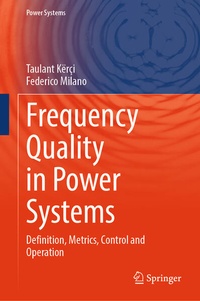
Frequency Quality in Power Systems
Description

This book explains frequency quality in a comprehensive and systematic way. It does so by combining theoretical and practical knowledge on the topic. It includes dynamic simulations and real-world examples. For example, the book discusses the frequency performance of large-scale real-world power systems such as the Irish, UK, and Australian power systems. The book also presents a comprehensive analysis of the impact of different electricity market models, different control parameters, microgrids, topology, and converter-based demand on frequency quality. Then, the book provides an in-depth description of industry practice when it comes to frequency reserves dimensioning approaches and monitoring and reporting of frequency quality. The authors also clarify many terms related to frequency control and commonly used by the power system community.
The book serves as a reference for engineers working for transmission system operators as well as researchers studying the topic of frequency quality and control and the challenges of modern power systems with high shares of converter-interfaced generation and demand.
More details
Other editions
Additional editions
Persons
Taulant Kërçi received the B.Sc. and M.Sc. degrees in electrical engineering from the Polytechnic University of Tirana, Albania, in 2011 and 2013, respectively, and the Ph.D. degree in electrical engineering from the University College Dublin, Ireland, in November 2021. He was with Albanian DSO from June 2013 to October 2013 and TSO from November 2013 to January 2018. In September 2021, he joined Irish TSO, EirGrid plc, where he is currently a Power System Specialist. He is also an IEEE Senior Member. His research interests include power system operations and dynamics.
Federico Milano received the M.E. and Ph.D. degrees in electrical engineering from the University of Genoa, Italy, in 1999 and 2003, respectively. In 2013, he joined the University College Dublin, Ireland, where he is currently Professor of Power System Dynamics. His research interests include power system modeling, control, and stability analysis. He is IEEE Fellow, IEEE PES Distinguished lecturer, senior editor of IEEE Transactions on Power Systems, IET fellow, and co-editor-in-chief of the IET Generation, Transmission, and Distribution. He was chair of the IEEE Power System Stability Controls Subcommittee and of the Technical Programme Committee of the 23th Power System Computation Conference.
Content
Part 1: Basic concepts and definitions.- Instantaneous frequency.- Frequency control.- Frequency quality.- Frequency distribution.- Part 2: Control and stability analysis.- Frequency strength.- Frequency stability.- Converter-based demand.- Flexible resources.- Part 3: Operation and planning.- Automatic generation control.- Sub-hourly unit commitment.- Wind and solar generation.- New reserves and volume forecasting.- Dynamic model of power systems.
