

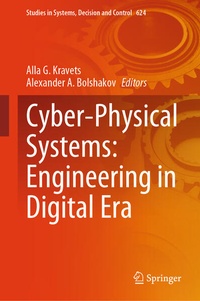
Cyber-Physical Systems: Engineering in Digital Era
Description

This book is a comprehensive exploration of the fundamental principles and contemporary applications of cyber-physical systems (CPS) in various engineering disciplines. This book is structured into five thematic sections, each addressing unique facets of CPS integration and digital transformation in engineering practices. This book opens the discussion by examining the creation and utilization of digital twins and computational models in diverse engineering contexts. Chapter 1 focuses on the digital twin of a functional food product, while subsequent chapters address the modeling of gas well operations under flooding conditions, productivity assessment of horizontal wells with multistage hydraulic fracturing, carbonate reservoir acid treatments, and thermal power plant optimization with combined cycle gas turbines. This book transitions to the specific challenges and opportunities presented by CPS in chemical engineering. Chapters cover the analysis of rarefied flow formation in chemical technology apparatuses, parameter estimation for optimizing polymer compositions, and decision support systems for automating ore phosphate charge production. This book delves into the broader landscape of heterogeneous environments within CPS. Topics include structural-parametric synthesis of global optimization algorithms, the application of pass-through structures for ultra-wideband information processing, and numerical modeling of acoustic instability in supersonic flows. Discussions encompass molecular fingerprint-based analyses of chemical formulas in patents, flexible word linking concepts for verifying recognized administrative documents and quality control mechanisms for administrative document recognition. Chapters highlight integrated computer systems for coke oven battery design training, software for studying key distribution schemes, and formalizations of mental models in human operators. This book is intended for researchers, practitioners, and students interested in the intersection of cyber-physical systems and engineering in the digital era. It provides a holistic view of current trends and best practices, offering valuable insights into the transformative potential of CPS across various engineering domains.
More details
Other editions
Additional editions
Content
From Digital Twin to Smart Control Systems: Synthesis of Hybrid Model for the Control of Thermal Equipment in Central Processing Facilities.- Digital twin of functional food product.- Modeling and Assessment of the Productivity of Horizontal Wells with Multistage Hydraulic Fracturing.- Modeling of Acid Treatments of Carbonate Reservoirs.- Optimization of thermal power plant operating modes with combined cycle gas turbine.- Modeling the Operation Process of a Gas Well Under Flooding Conditions.- Analysis of the rarefied flows formation process in chemical technology apparatuses for cyber-physical systems.- Engineering Methodology for Calculating Parameters of a Gravity Type Mixer for Cyber Physical Systems.- Cyber physical system parameters estimation for the polymer composition properties optimization.- Decision support information system for automation of ore phosphate charge production in a mixing and dosing cyber physical system.
