

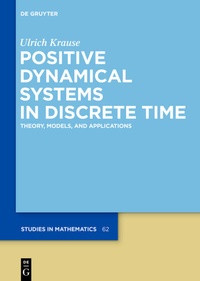
Positive Dynamical Systems in Discrete Time
Theory, Models, and Applications
1st Edition
Published on 10. March 2015
XV, 348 pages
978-3-11-036569-6 (ISBN)
Description

This book provides a systematic, rigorous and self-contained treatment of positive dynamical systems. A dynamical system is positive when all relevant variables of a system are nonnegative in a natural way. This is in biology, demography or economics, where the levels of populations or prices of goods are positive. The principle also finds application in electrical engineering, physics and computer sciences.
"The author has greatly expanded the field of positive systems in surprising ways." - Prof. Dr. David G. Luenberger, Stanford University(USA)
More details
Other editions
Additional editions
E-Book
11/2015
1st Edition
De Gruyter
€189.95
Available for download
Book
01/2015
1st Edition
De Gruyter
€189.95
Shipment within 7-9 days
Person
Ulrich Krause, University of Bremen, Bremen, Germany.
Content
- Intro
- Preface
- Notation
- List of Figures
- 1 How positive discrete dynamical systems do arise
- 1.1 Non-linear population dynamics in one dimension
- Exercises
- 1.2 The density dependent Leslie model
- Exercises
- 1.3 Non-linear price dynamics in one dimension
- Exercises
- 1.4 The Leontief model with choice of techniques
- Exercises
- 1.5 Opinion dynamics under bounded confidence
- Exercises
- Bibliography
- 2 Concave Perron-Frobenius theory
- 2.1 Iteration of normalized concave operators
- Exercises
- 2.2 Indecomposability and primitivity for ray-preserving concave operators
- Exercises
- 2.3 Concave operators which are positively homogeneous
- Exercises
- 2.4 A special case: Linear Perron-Frobenius theory
- Exercises
- 2.5 Applications to difference equations of concave type
- Exercises
- 2.6 Relative stability in the concave Leslie model
- Exercises
- 2.7 Price setting and balanced growth in a concave Leontief model
- Exercises
- Bibliography
- 3 Internal metrics on convex cones
- 3.1 Extraction within convex cones
- Exercises
- 3.2 Internal metrics
- Exercises
- 3.3 Geometrical properties
- Exercises
- 3.4 Completeness for internal metrics
- Exercises
- Bibliography
- 4 Contractive dynamics on metric spaces
- 4.1 Iteration of contractive selfmappings
- Exercises
- 4.2 Non-autonomous discrete systems
- Exercises
- 4.3 A local-global stability principle for power-lipschitzian mappings
- Exercises
- Bibliography
- 5 Ascending dynamics in convex cones of infinite dimension
- 5.1 Definition and examples of ascending operators
- Exercises
- 5.2 Relative stability for ascending operators by Hilbert's projective metric
- Exercises
- 5.3 Absolute stability for weakly ascending operators by the part metric
- Exercises
- 5.4 Applications to nonlinear difference equations and to nonlinear integral operators
- Exercises
- Bibliography
- 6 Limit set trichotomy
- 6.1 Weak and strong forms of limit set trichotomy in Banach spaces
- 6.2 Differentiability criteria for non-expansiveness and contractivity
- 6.3 Applications to nonlinear difference equations and cooperative systems of differential equations
- Exercises
- Bibliography
- 7 Non-autonomous positive systems
- 7.1 The concepts of path stability, asymptotic proportionality, weak and strong ergodicity
- 7.2 Path stability and weak ergodicity for ascending operators
- 7.3 Strong ergodicity for ascending operators
- 7.4 A nonlinear version of Poincaré's theorem on nonautonomous difference equations
- 7.5 Price setting in case of technical change
- 7.6 Populations under bounded and periodic enforcement
- Exercises
- Bibliography
- 8 Dynamics of interaction: opinions, mean maps, multi-agent coordination, and swarms
- 8.1 Scrambling matrices
- 8.2 Consensus formation and opinion dynamics under bounded confidence
- 8.3 Mean processes, mean structures and the iteration of mean maps
- 8.4 Infinite products of stochastic matrices: path stability, convergence and a generalized theorem of Wolfowitz
- 8.5 Multi-agent coordination and opinion dynamics
- 8.6 Swarm dynamics
- Exercises
- Bibliography
- Index
