

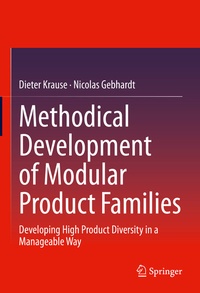
Methodical Development of Modular Product Families
Description

The target groups
This book is aimed at product developers and decision makers in practice. Science is offered a helpful reference book and interested engineering students can immerse themselves in the development of modular product families with the necessary basics.
This book is a translation of the original German 1 st edition Methodische Entwicklung modularer Produktfamilien by Dieter Krause & Nicolas Gebhardt, published by Springer Fachmedien Wiesbaden GmbH, part of Springer Nature in 2018. The translation was done with the help of artificial intelligence (machine translation by the service DeepL.com). A subsequent human revision was done primarily in terms of content, so that the book will read stylistically differently from a conventional translation. Springer Nature works continuously to further the development of tools for the production of books and on the related technologies to support the authors.
More details
Other editions
Additional editions
Persons
Prof. Dr.-Ing. Dieter Krause studied production technology/mechanical engineering and received his doctorate at the Alexander University of Erlangen-Nuremberg. This was followed by leading positions as design manager, technical manager and managing director in mechanical and plant engineering. Since 2005 he has been head of the Institute for Product Development and Design Technology at the TU Hamburg-Harburg. He is a member of the Scientific Society for Product Development (WiGeP).
Dr.-Ing. Nicolas Gebhardt studied product development/mechanical engineering at Hamburg University of Technology and received his doctorate on the use of graphics and visualization in product development at the Institute for product development and Mechanical Engineering Design. As a research assistant, he conducted several research and development projects for modular products and product development processes. Since 2017, he has been working as a complexity manager and product architect in the German industry.
Content
Introduction and motivation.- Effects of diversity.- Basics and terminology.- Potentials of modular product families.- Modular product structure strategies.- Methods for developing modular product families.- Effects on product development processes and future trends.
