

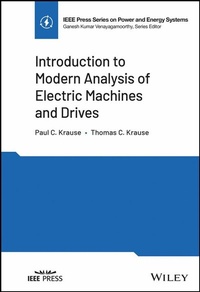
Introduction to Modern Analysis of Electric Machines and Drives
Description

Comprehensive resource introducing magnetic circuits and rotating electric machinery, including models and discussions of control techniques
Introduction to Modern Analysis of Electric Machines and Drives is written for the junior or senior student in Electrical Engineering and covers the essential topic of machine analysis for those interested in power systems or drives engineering. The analysis contained in the text is based on Tesla's rotating magnetic field and reference frame theory, which comes from Tesla's work and is presented for the first time in an easy to understand format for the typical student.
Since the stators of synchronous and induction machines are the same for analysis purposes, they are analyzed just once. Only the rotors are different and therefore analyzed separately. This approach makes it possible to cover the analysis efficiently and concisely without repeating derivations. In fact, the synchronous generator equations are obtained from the equivalent circuit, which is obtained from work in other chapters without any derivation of equations, which differentiates Introduction to Modern Analysis of Electric Machines and Drives from all other textbooks in this area.
Topics explored by the two highly qualified authors in Introduction to Modern Analysis of Electric Machines and Drives include:
* Common analysis tools, covering steady-state phasor calculations, stationary magnetically linear systems, winding configurations, and two- and three-phase stators
* Analysis of the symmetrical stator, covering the change of variables in two- and three-phase transformations and more
* Symmetrical induction machines, covering symmetrical two-pole two-phase rotor windings, electromagnetic force and torque, and p-pole machines
* Direct current machines and drives, covering commutation, voltage and torque equations, permanent-magnet DC machines, and DC drives
Introduction to Modern Analysis of Electric Machines and Drives is appropriate as either a first or second course in the power and drives area. Once the reader has covered the material in this book, they will have a sufficient background to start advanced study in the power systems or drives areas.
More details
Other editions
Additional editions

Persons
Paul C. Krause, PhD, started PC Krause and Associates, Inc. in 1983. He was a Professor in the School of Electrical and Computer Engineering at Purdue University for 39 years. He is a Life Fellow of the IEEE and has authored or co-authored over 100 technical papers and three textbooks on electric machines. He was the recipient of the IEEE Nikola Tesla Award in 2010.
Thomas C. Krause received the B.S degree in electrical engineering from Purdue University, West Lafayette, IN, USA, in 2019 and the M.S. degree in electrical engineering and computer science from the Massachusetts Institute of Technology, Cambridge, MA, USA, in 2021. He is currently pursuing the PhD degree with the Massachusetts Institute of Technology.
Content
Preface
CHAPTER 1 COMMON ANALYSIS TOOLS
1.1 INTRODUCTION
1.2 STEADY-STATE PHASOR CALCULATIONS
Power and Reactive Power
1.3 STATIONARY MAGNETICALLY-LINEAR SYSTEMS
Two-Winding Transformer
1.4 WINDING CONFIGURATIONS
1.5 TWO- AND THREE-PHASE STATORS
Two-Phase Stator
Three-Phase Stator
Line-to-Line Voltage
1.6 PROBLEMS
1.7 REFERENCE
CHAPTER 2 ANALYSIS OF THE SYMMETRICAL STATOR
2.1 INTRODUCTION
2.2 TESLA'S ROTATING MAGNETIC FIELD
Two-Pole Two-Phase Stator
Two-Pole Three-Phase Stator
2.3 REFERENCE FRAME THEORY
Two-Phase Transformation
Three-Phase Transformation
2.4 STATOR VOLTAGE AND FLUX LINKAGE EQUATIONS IN THE ARBITRARY REFERENCE FRAME AND THE INSTANTANEOUS PHASOR
Two-Phase Stator
Three-Phase Stator
Instantaneous and Steady-State Phasors
2.5 PROBLEMS
2.6 REFERENCES
CHAPTER 3 SYMMETRICAL INDUCTION MACHINE
3.1 INTRODUCTION
3.2 SYMMETRICAL MACHINES
3.3 SYMMETRICAL TWO-POLE ROTOR WINDINGS
Two-Phase Rotor Windings
Three-Phase Rotor Windings
3.4 SUBSTITUTE VARIABLES FOR SYMMETRICAL ROTATING CIRCUITS AND EQUIVALENT CIRCUIT
Two-Phase Machine
Three-Phase Machine
3.5 ELECTROMAGNETIC FORCE AND TORQUE
3.6 P-POLE MACHINES
3.7 FREE ACCELERATING VARIABLES VIEWED FROM DIFFERENT REFERENCE FRAMES
3.8 STEADY-STATE EQUIVALENT CIRCUIT
3.9 PROBLEMS
3.10 REFERENCES
CHAPTER 4 SYNCHRONOUS MACHINES
4.1 INTRODUCTION
4.2 ANALYSIS OF THE PERMANENT-MAGNET ac MOTOR
Torque
Unequal Direct- and Quadrature-Axis Inductances
Three-Phase Machine
4.3 WINDINGS OF THE SYNCHRONOUS MACHINE
4.4 EQUIVALENT CIRCUIT - VOLTAGE AND TORQUE EQUATIONS
Torque
Rotor Angle
4.5 DYNAMIC AND STEADY-STATE PERFORMANCES
4.6 ANALYSI OF STEADY-STATE OPERATION
4.7 TRANSIENT STABILITY
Three-Phase Fault
4.8 PROBLEMS
4.9 REFERENCE
CHAPTER 5 DIRECT CURRENT MACHINE AND DRIVE
5.1 INTRODUCTION
5.2 COMMUTATION
5.3 VOLTAGE AND TORQUE EQUATIONS
5.4 PERMANENT-MAGNET dc MACHINE
5.5 DC DRIVE
Average-Value Time-Domain Block Diagram
Torque Control
5.6 PROBLEMS
5.7 REFERENCE
CHAPTER 6 BRUSHLESS dc AND FIELD ORIENTED DRIVES
6.1 INTRODUCTION
6.2 THE BRUSHLESS dc DRIVE CONFIGURATION
6.3 COMMON MODE OF BRUSHLESS dc DRIVE OPERATION
6.4 OTHER MODES OF BRUSHLESS dc DRIVE OPERATION
Maximum-Torque Per Volt Operation of a Brushless dc Drive
Maximum-Torque Per Ampere Operation of a Brushless dc Drive
Torque Control
6.5 FIELD ORIENTED INDUCTION MOTOR DRIVE
6.6 PROBLEMS
6.7 REFERENCES
CHAPTER 7 SINGLE-PHASE INDUCTION MOTORS
7.1 INTRODUCTION
7.2 SYMMETRICAL COMPONENTS
7.3 ANALYSIS OF UNBALANCED MODES OF OPERATION
Unbalanced Stator Voltages
Unbalanced Stator Impedances
Open-Circuited Stator Phase
7.4 SINGLE-PHASE AND CAPACITOR-STATOR INDUCTION MOTORS
Single-Phase Induction Motor
Capacitor-Start Induction Motor
7.5 DYNAMIC AND STEADY-STATE PERFORMANCE OF A CAPACITOR-START SINGLE-PHASE INDUCTION MOTOR
7.6 SPLIT-PHASE INDUCTION MOTOR
7.7 PROBLEMS
7.8 REFERENCES
CHAPTER 8 STEPPER MOTORS
8.1 INTRODUCTION
8.2 BASIC CONFIGURATIONS OF MULTISTACK VARIABLE-RELUCTANCE STEPPER MOTORS
8.3 EQUATIONS FOR MULTSTACKVARIABLE-RELUCTANCE STEPPER MOTORS
8.4 OPERATING CHARACTERISTICS OF MULTISTACK VARIABLE-RELUCTANCE STEPPER MOTORS
8.5 SINGLE-STACK VARIABLE-RELUCTANCE STEPPER MOTORS
8.6 BASIC-CONFIGURATION OF PERMANENT-MAGNET STEPPER MOTORS
8.7 EQUATIONS FOR PERMANENT-MAGNET STEPPER MOTORS
8.8 PROBLEMS
8.9 REFERENCES
1
Common Analysis Tools
1.1 Introduction
The electric machine consists of a stationary member called the stator and inside this stator is a rotating member called the rotor. The stator and rotor are generally constructed from conductive wire, iron (steel), and/or permanent magnets. For alternating current (ac) machines, the main focus of this text, the rotor is different for each type of machine, but the stators are essentially the same. This chapter introduces tools to analyze the currents and magnetic fields that flow through and about the stators and rotors of electric machines.
Since the beginning of analysis of machines, several basic tools have become more or less standard. These concepts are covered briefly in this chapter. Most are used in the analysis of the machines considered in this text. This chapter starts with phasors which is a complex-number means for analyzing steady-state ac variables and ends with two- and three-phase stator arrangements. These concepts have been covered by many authors but are necessary and warrant consideration in texts on the analysis of machines.
1.2 Steady-State Phasor Calculations
We will deal with steady-state sinusoidal variables in this text and phasor analysis is very convenient for analyzing these variables. In the early 1900s, Charles Stienmetz set forth a method of analyzing the steady-state sinusoidal variables. This method has evolved over the years with different names, for example, vector analysis, sinor analysis, and now phasor analysis; however, depending on the area of application, the phasor may be slightly different. We will define it as used in the power and drives areas, which may differ somewhat from that taught in other courses.
The phasor is established by expressing a steady-state sinusoidal variable as
(1.2-1)where the s subscript is used here to denote sinusoidal quantities. In the following chapters, the s subscript will denote stator variables. The sinusoidal variations are expressed as cosines, capital letters are used to denote steady-state quantities, and is the peak value of the sinusoidal variation. Here, F is just a placeholder for any quantity of interest. Generally, in circuit analysis, F will be V for voltage or I for current. For steady-state conditions, may be written as
(1.2-2)where is the electrical angular velocity in rad/sec and is the time-zero position of the electrical variable. Substituting (1.2-2) into (1.2-1) yields
(1.2-3)Now, Euler's formula is
(1.2-4)and since we are expressing the sinusoidal variation as a cosine, (1.2-3) may be written as
(1.2-5)where Re is shorthand notation for the "real part of." Equations (1.2-3) and (1.2-5) are equivalent. Let us rewrite (1.2-5) as
(1.2-6)We need to take a moment to define what is referred to as the root-mean-square (rms) of a sinusoidal variation. In particular, the rms value is defined as
(1.2-7)where F is the rms value of and T is the period of the sinusoidal variation. It is left to the reader to show that the rms value of (1.2-3) is . Therefore, we can express (1.2-6) as
(1.2-8)By definition, the phasor representing , which is denoted with a raised tilde, is
(1.2-9)which is a complex number. We see from (1.2-8) and (1.2-9) that if we consider the complex plane and rotate counterclockwise (ccw) at the angular velocity of the sinusoidal variable, the real projection is the instantaneous sinusoidal variable. We can stop the rotation and work only with the complex number. In sinusoidal steady state with a single source, the quantities of interest in a linear system will oscillate at the same frequency but with different magnitudes and relative phases. Phasor analysis keeps the amplitude and relative phase of sinusoidal quantities and eliminates the redundant information, frequency. Phasors of all like frequencies may be added by adding the real parts and imaginary parts of each phasor. We will use phasors extensively.
The reason for using the rms value as the magnitude of the phasor will be addressed later in this section. Equation (1.2-6) may now be written as
(1.2-10)A shorthand notation for (1.2-9) is
(1.2-11)Equation (1.2-11) is commonly referred to as the polar form of the phasor. The Cartesian form is
(1.2-12)When using phasors to calculate steady-state voltages and currents, we think of the phasors as being stationary at t = 0; however, we know from (1.2-10) that a phasor is related to the instantaneous value of the sinusoidal quantity it represents. In other words, the real projection of the phasor rotating counterclockwise at is the instantaneous value of . Thus, with in (1.2-3)
(1.2-13)the phasor representing (1.2-13) is
(1.2-14)For
(1.2-15)the phasor is
(1.2-16)We will use degrees and radians interchangeably when expressing phasors. Although there are several ways to arrive at (1.2-16) from (1.2-15), it is helpful to ask yourself where must the rotating phasor be positioned at time zero so that, when it rotates counterclockwise at , its real projection is ? It follows that a phasor of amplitude F positioned at 90° represents .
To summarize, a sinusoidal variation can be viewed as the real projection of a rotating line equal in magnitude to the positive peak value of the variation and rotating counterclockwise in the complex plane at the electrical angular velocity of the sinusoidal variation. Since we are in steady state and the electrical angular velocity is constant, we can stop the rotation at any time and view it as a fixed line. This fixed line is the phasor representation of the sinusoidal quantity depicted in phasor diagrams. A phasor diagram is shown in Fig. 1.A-1. Please understand that if we ran at in unison with the rotating line, it would appear as a constant to us.
In order to show the facility of the phasor in the analysis of steady-state performance of ac circuits and devices, we will consider the following circuit elements, a resistor with resistance, R, an inductor with inductance, L, and a capacitor with capacitance, C. Thus, using uppercase letters to indicate sinusoidal steady-state variables, the voltage across a resistance may be expressed in terms of the current flowing through it. That is, with given as
(1.2-17) (1.2-18)In phasor form, the voltage across the resistor is in phase with the current through it as shown in Fig. 1.2-1 [?esv(0) = ?esi(0)]. Thus,
(1.2-19)For the inductor
(1.2-20)where
(1.2-21)Figure 1.2-1 Waveforms of steady-state variables in resistive (R), inductive (L), and capacitive (C) circuits.
(1.2-22)Now
(1.2-23)with , which is referred to as the inductive reactance. The phasor form of (1.2-23) is
(1.2-24)Thus, the voltage across the inductor leads the current through it by p/2. That is, the current through the inductor lags the voltage across it by p/2 . This is shown in Fig. 1.2-1.
For the capacitor
(1.2-25)Following the procedure used for the inductor, the phasor voltage across it becomes
(1.2-26)where , the capacitive reactance. The voltage across the capacitor lags the current through it by p/2 , or the current through the capacitor leads the voltage across it by p/2. This is also shown in Fig. 1.2-1.
A series RLC circuit is shown in Fig. 1.2-2. From Fig. 1.2-2,
(1.2-27)Figure 1.2-2 Phasor equivalent circuit for a series RLC circuit.
where . We should be careful here. Some prefer to write (1.2-27) as where X is and let be negative. This is essentially a matter of choice and does not change the end result. We will deal primarily with and not , therefore, this will have little impact on our work; nevertheless, since some authors will use a negative , we should make the reader aware of this difference.
It is appropriate to discuss the notation that will be used throughout the text. When an equation is written with the variables in lowercase letters, it is valid for transient and steady state. If the variables are written with uppercase letters, the equation is a function of time and valid for instantaneous steady-state conditions. Equation (1.2-27) is a phasor equation representing steady-state sinusoidal variables and are written in uppercase...
