

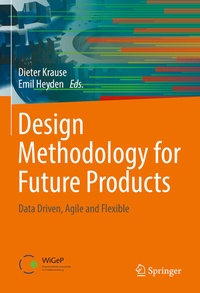
Design Methodology for Future Products
Description

Design Methodology for Future Products - Data Driven, Agile and Flexible provides an overview of the recent research in the field of design methodology from the point of view of the members of the scientific society for product development ( WiGeP - Wissenschaftliche Gesellschaft für Produktenwicklung e.V. ). This book aims to contribute to design methods and their implementation for innovative future products. The main focus is the crucial data-driven, agile, and flexible way of working.
Four topics are covered in corresponding chapters, Methods for Product Development and Management , Methods for Specific Products and Systems , Facing the Challenges in Product Development and Model-Based Engineering in Product Development .
This publication starts with the agile strategic foresight of sustainable mechatronic and cyber-physical systems, moves on to the topics of system generation engineering in development processes, followed by the technical inheritance in data-driven product development. Product improvements are shown via agile experiential learning based on reverse engineering and via combination of usability and emotions. Furthermore, the development of future-oriented products in the field of biomechatronic systems, sustainable mobility systems and in situ sensor integration is shown. The overcoming of challenges in product development is demonstrated through context-adapted methods by focusing on efficiency and effectiveness, as well as designer-centered methods to tackle cognitive bias. Flow design for target-oriented availability of data and information in product development is addressed. Topics of model-based systems engineering are applied to the function-driven product development by linking model elements at all stages and phases of the product. The potential of model-based systems engineering for modular product families and engineering of multidisciplinary complex systems is shown.
More details
Other editions
Additional editions
Persons
Emil Heyden studied mechanical engineering at the TU Hamburg. Since 2018 he works in the field of dynamic analysis and design of lightweight structures at the Institute of Product Development and Mechanical Engineering Design at the TU Hamburg. He is assistant of the board of the Scientific Society for Product Development (WiGeP).
